StoreRocket Store Locator vs StoreLocators: 2026 Pricing
Store locator and dealer locator widget for any website
StoreRocket is the most polished widget in its class: four self-serve tiers, unlimited traffic on all of them, a documented REST API, server-rendered SEO location pages, and a Google Sheets sync that runs daily on its own. Two things are easy to miss, both from its own pages: the advertised prices are promotional against higher list prices, and twelve features sit behind the top tier, the API and the Sheets sync among them.
Last reviewed
The short answer
StoreRocket is the better buy if the store list is yours and you want the best-built widget for the job, particularly if indexable location pages matter. We are the better buy when the list belongs to retailers you do not control, or when shoppers need product availability rather than a tag you maintain.
What each product is designed to do, in its own terms. A capability named on one side is not a claim that the other lacks it, and neither column ranks the two: the table below is where they are compared row by row.
What StoreRocket is built for
You own your locations and the list is already accurate
Indexable, server-rendered location pages are a genuine requirement
A dealer locator with tag filtering is the actual job
You want the whole purchase self-serve, from trial to cancellation
The top-tier gating is acceptable, or you only need the basics
Price it at the tier that carries what you need rather than the entry tier.
What StoreLocators is built for
Retailers you do not control hold the store list
Shoppers need per-product, per-variant, per-store availability rather than a tag
The API and data sync should not depend on reaching the top plan
You run more than one locator and per-project billing multiplies
The map belongs inside one subscription
StoreLocators and StoreRocket, side by side
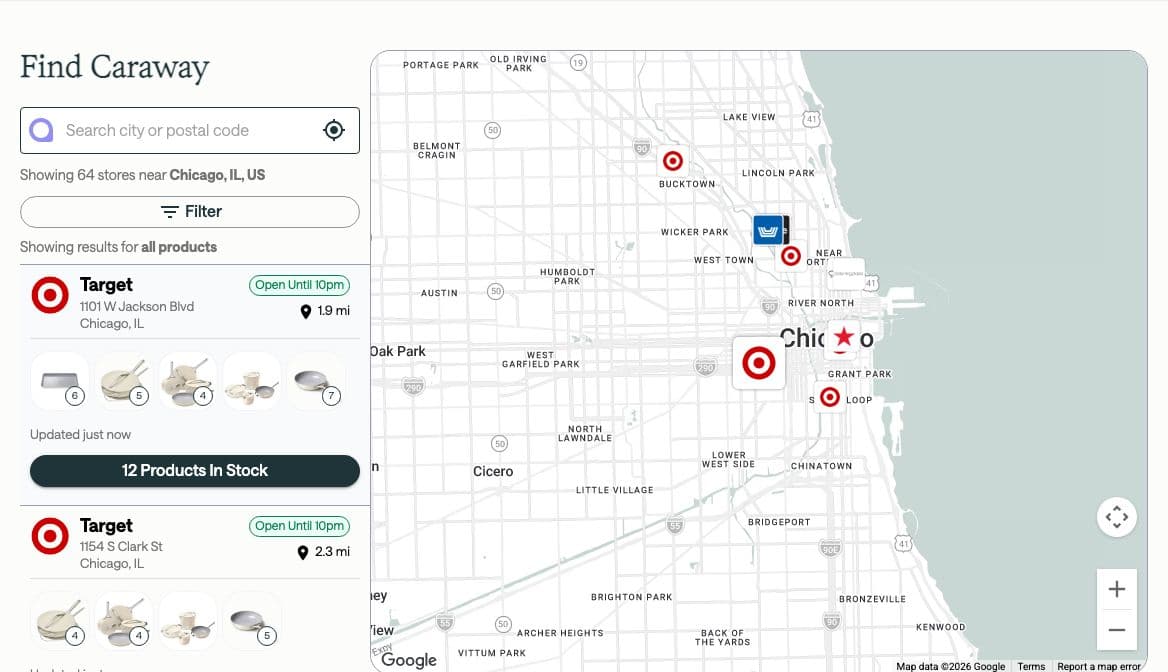
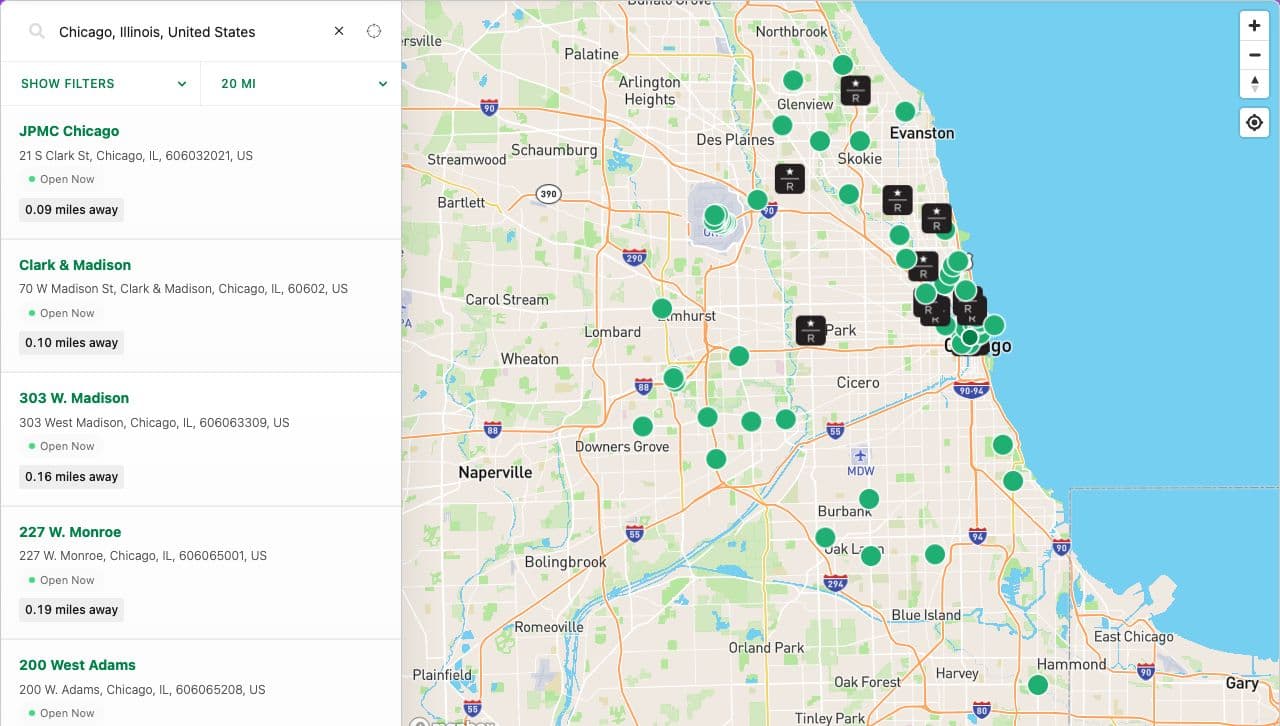
Both store locators as a shopper sees them, captured the same way: a 1280 by 800 browser window placed in Chicago, searching for Chicago. A demo holds whatever sample data its vendor chose, so where that changes what the picture shows, the caption says so. Each shot is trimmed to a common shape here; select one to see all of it.
StoreLocatorsCaptured October 15, 2026 from a live customer site, searching “Chicago, IL”.
StoreLocators · Captured October 15, 2026 from a live customer site, searching “Chicago, IL”.
StoreRocketCaptured October 15, 2026 from the vendor’s own demo, searching “Chicago, IL”.
StoreRocket · Captured October 15, 2026 from the vendor’s own demo, searching “Chicago, IL”.
Pricing, side by side
StoreRocket runs $25 to $69 a month promotional, $39 to $99 list, with a quote-only Enterprise tier above. We start at $195. On sticker price this is not close, and the comparison is about the tier you actually need.
The API, the automatic Sheets sync and branding removal all sit on the top published tier, so the realistic StoreRocket price for a brand that wants those is $69 promotional rather than $25.
StoreLocators
Prices published
Three tiers on our Shopify App Store listing, scaling by retail locations: Launch up to 2,000 locations, Grow from 2,000 to 10,000, and Scale above 10,000, at $195, $395 and $995 per month.
Month to month, no long-term contract and no termination fee
Refund available within 30 days of the latest charge
Map included; shopper sessions and map loads are not metered
Free trial documented. A 14-day free trial on every tier.
Sources,
StoreRocket
Prices published
Four tiers. Basic $25 promotional against $39 list for 100 locations, Pro $39 against $59 for 1,000, Business $69 against $99 for 20,000, and Enterprise quote-only with custom features and a dedicated account manager. Unlimited traffic on every tier.
No free plan; a 7-day trial with no card required
No setup fee; cancellation self-serve through the Stripe portal, effective at period end
Refunds for double charges, charges after cancelling and billing errors, reviewed by a person
Billing is per project: two locators means two subscriptions
If you pay by card, uninstalling the Shopify app does not cancel the subscription
Customer supplies a Google Maps or Mapbox key; StoreRocket handles geocoding on import
Free trial documented. 7 days, no credit card required.
Sources,,
StoreLocators vs StoreRocket at a glance
Sixteen rows, current as of 15 October 2026. Tier contents follow StoreRocket’s help-centre comparison table, which its pricing page matches.
Source 1StoreRocket: homepagestorerocket.io. Reviewed 2026-10-15.Full citationSource 2StoreRocket: pricingstorerocket.io. Reviewed 2026-10-15.Full citationSource 3StoreRocket help centre: plan feature tablehelp.storerocket.io. Reviewed 2026-10-15.Full citationSource 4StoreRocket help centre: Google Sheets synchelp.storerocket.io. Reviewed 2026-10-15.Full citationSource 5StoreRocket: dealer locator softwarestorerocket.io. Reviewed 2026-10-15.Full citationSource 6StoreRocket help centre: installing on Shopifyhelp.storerocket.io. Reviewed 2026-10-15.Full citationSource 7StoreRocket help centre: SEO and indexing for location pageshelp.storerocket.io. Reviewed 2026-10-15.Full citationSource 8StoreRocket help centre: billing and cancellationhelp.storerocket.io. Reviewed 2026-10-15.Full citationSource 9StoreRocket on CapterraCapterra. Reviewed 2026-10-15.Full citationSource 10StoreRocket on the Shopify App StoreShopify App Store. Reviewed 2026-10-15.Full citationSource 11StoreLocators: guarantee, refunds and cancellationstorelocators.com. Reviewed 2026-10-15.Open the sourceFull citationSource 12StoreLocators on the Shopify App StoreShopify App Store. Reviewed 2026-10-15.Open the sourceFull citationSource 13StoreLocators: free retailer store listsstorelocators.com. Reviewed 2026-10-15.Open the sourceFull citation
Month to month or annual, cancel any timeStoreRocket: Contract termsNo setup fee. Cancellation is self-serve through the Stripe billing portal and takes effect at period end. The published refund policy covers double charges, charges after cancelling and billing errors, each reviewed by a person. Billing is per project, so two locators means two subscriptions.Sources2. StoreRocket: pricing8. StoreRocket help centre: billing and cancellation
Pricing
$195–$995 per monthStoreLocators: PricingThree tiers on our Shopify App Store listing, scaling by retail locations: Launch up to 2,000, Grow from 2,000 to 10,000, Scale above 10,000.Source12. StoreLocators on the Shopify App Store
Published, and promotionalStoreRocket: PricingBasic $25, Pro $39, Business $69, against list prices of $39, $59 and $99 respectively. Enterprise is quote-only. The published figures are real but are promotional rates rather than the standing list price.Source2. StoreRocket: pricing
Merchant ratingSame storefront, so these compare. Read with the count.
4.8StoreRocket: Merchant rating4.8 from 6 reviews on Shopify App Store.5.0 from 29 reviews on Capterra.Six reviews is far too small a sample to read as a rating. The split is five five-star and one one-star, so the score sits between two opposite outcomes rather than settling anywhere, and one more review either way would move it. StoreRocket’s 5.0 from 29 reviews on Capterra is the sturdier figure, but it is a different audience and a different review policy, so it is not comparable with the Shopify ratings in this column on other pages.Sources10. StoreRocket on the Shopify App Store9. StoreRocket on Capterra
Yes7-day free trial, no cardStoreRocket: Evaluate without a sales callNo free plan.Source2. StoreRocket: pricing
Retailer coverage
Adding a retailer you sell throughThe gap between the retailer list you are sold and the one you actually sell through.
On request, typically within days, at no additional cost
You import itStoreRocket: Adding a retailer you sell throughNo discovery mechanism. Every location is one you supply, by form, file, sheet or API.Source5. StoreRocket: dealer locator software
Retailer coverageCoverage only counts where you actually sell.
–Not published by the vendorStoreRocket: Retailer coverageNo retailer network.StoreRocket supplies no store data and publishes no coverage figure. It names fourteen customer brands on its homepage, among them Puma, Hisense, Purple, Aqualung and Lemon Perfect.Source1. StoreRocket: homepage
Location capA cap you can grow past is a repricing event, not a feature.
Priced by retail locations, not cappedStoreLocators: Location capPlans scale by location count rather than cutting the map off at a number.
Where the store data comes fromThe whole difference. Everything else follows.
Automatic discovery across 205 integrated retailer feedsStoreLocators: Where the store data comes fromNo spreadsheet to maintain. Retailers that stock you are found in their own feeds and appear without you entering them.
Locations you supply, four waysStoreRocket: Where the store data comes fromManual entry, CSV or Excel import, Google Sheets sync, and a REST API. The API and the Sheets sync are both Business-tier features. Geocoding happens automatically on import and StoreRocket handles it.Sources5. StoreRocket: dealer locator software3. StoreRocket help centre: plan feature table
Refresh cadenceA locator that sends a shopper to a store that dropped the line costs more trust than it wins.
Retailer feeds, refreshed daily
Daily auto-sync, from your sheetStoreRocket: Refresh cadenceBetter than most of this class: the Google Sheets sync can run daily, at 4:00 AM Eastern, rather than waiting for someone to press import, and StoreRocket puts a 5,000 to 20,000 row sheet at about a minute. It refreshes the sheet, not the world, and auto-sync runs only on the Business plan or a free trial.Sources4. StoreRocket help centre: Google Sheets sync3. StoreRocket help centre: plan feature table
Product-level availabilityWhether the map answers "who has this product" or only "where are the shops".
YesPer product, per variant, per store, filtered to in-stockStoreLocators: Product-level availabilityRetailer-reported rather than a live poll of a physical shelf, which is the honest description of what this category actually has.
A "carries this product" tagStoreRocket: Product-level availabilityFiltering by product, brand or dealer type is supported, driven by tags you maintain. There is no live stock or inventory feature, so it tells a shopper the location carries the line rather than that a unit is there today.Source5. StoreRocket: dealer locator software
Shopify app that auto-connects, or a snippet anywhereStoreRocket: Install pathTwo documented first-class routes on Shopify: install from the Shopify App Store, which connects the store automatically, or paste the snippet. Elsewhere it is a script, with a separate SPA widget for React, Next.js and custom apps.Source6. StoreRocket help centre: installing on Shopify
Developer requiredWhether this ships this week or waits for engineering time.
Two to three minutes, per StoreRocketStoreRocket: Time to launchTheir claim, given as both figures on the same pricing page.Source2. StoreRocket: pricing
Who pays for the mapA locator billed per map load has a second invoice attached to it, from Google or Mapbox rather than the vendor.
YesIncludedStoreLocators: Who pays for the mapThe map is part of the subscription. There is no separate Google or Mapbox bill, and shopper sessions are not metered.
Your key, but geocoding is on themStoreRocket: Who pays for the mapYou supply a Google Maps or Mapbox key. StoreRocket’s Shopify guide puts Mapbox at free up to 50,000 loads a month with no card, and StoreRocket handles geocoding itself on import, which is more than most of this class does.Sources6. StoreRocket help centre: installing on Shopify5. StoreRocket: dealer locator software
Features
Wholesale self-submissionIndependent stockists rarely appear in any feed. Letting them add themselves is the only way to catch them.
YesSubmit Your Location block
A no-results lead form, Business onlyStoreRocket: Wholesale self-submissionThere is no dealer self-submission intake. What exists is a lead capture form shown when a search returns nothing, which collects the shopper rather than the shop, and it is gated to the Business tier.Source3. StoreRocket help centre: plan feature table
Support
Support model
Every message reaches Our Customer Success & Onboarding Specialist
Live chat, email and a help centreStoreRocket: Support modelPriority support is a Business-tier feature in StoreRocket’s own plan table. No support hours or response-time commitment is published.Source3. StoreRocket help centre: plan feature table
StoreRocket in its own words
“Relax. Forget about pageviews and visits. Our store locators support unlimited traffic!”
“Import your dealer network from a CSV or Excel file or sync it from Google Sheets, and we handle the geocoding and the map for you”
“Auto-sync runs only while your Business plan or free trial is active.”
The unlimited traffic claim is more meaningful here than at most competitors, because StoreRocket also handles geocoding itself when you import. The map key is still yours, but its Shopify guide notes Mapbox is free up to 50,000 loads a month with no card, which takes the sting out of it for most locators.,,
One small oddity worth noting because it appears twice on one page: the pricing page advertises a three-minute installation in its hero and, a few lines later, says usually less than two minutes. Nothing turns on it, and we give both.
Where StoreLocators is different
Nothing important is behind the top tier
StoreRocket gates twelve features to Business, including the REST API, the Sheets sync, branding removal, duplicate detection and priority support, and Basic gets no analytics at all. Our plans scale by retail locations rather than by which features you are allowed.
The store list is found, not synced
StoreRocket’s sync is a good answer to the wrong question for a brand in retail: it keeps the map matching your sheet, but somebody still has to know what belongs in the sheet. We read retailer feeds directly, so retailers that stock you appear without anyone maintaining a row for them.
Availability rather than a tag
Product filtering in StoreRocket runs on tags you set. Ours is per product and per store from retailer feeds, refreshed daily, which is a different answer to a different question: not whether a dealer carries the line, but whether this store has it.
One subscription, one locator, one map
StoreRocket bills per project, so a second locator is a second subscription, and if you pay by card, uninstalling the Shopify app does not stop the billing. Our pricing is per account and the map is included.
Every row where the table above separates us
Taken from that table rather than written out again, so the two cannot disagree. A row shows up here when we publish an answer and they publish none, or when both answer and ours covers more of the feature. Rows where both sides publish a figure, a price or a rating, stay out: those differ by their content.
StoreLocators: Submit Your Location block|StoreRocket: A no-results lead form, Business only
What the tiers actually cost, and actually include
StoreRocket publishes $25, $39 and $69 for Basic, Pro and Business, with Enterprise quote-only. Those are promotional prices. The list prices on the same page are $39, $59 and $99.
The bigger factor is what each tier carries. StoreRocket’s own help-centre comparison table gates twelve rows to Business: Location Types, the leads form, the REST API, Google Sheets sync, the search box and floating button widgets, branding removal, auto language detection, location suggestions, search-data export, duplicate detection and priority support. Analytics and location images start at Pro, which means Basic has no analytics at all, even though the same article’s opening summary says every plan includes analytics.
The pricing page agrees with that table: it strikes through the features a tier does not include, so Basic visibly lacks analytics, the REST API and Sheets sync before you buy. The only thing that disagrees is the help article’s own opening line, which says every plan includes analytics while the table beneath it says Basic does not.,
The practical read: if you want the API or the automatic Sheets sync, the entry price is $69 promotional or $99 list, not $25. That is still inexpensive. It is just a different number from the one on the button.
Two locators, two subscriptions
StoreRocket bills per project. If you run a store locator and a separate dealer locator, or one map per region, each is its own subscription and its own charge.
Worth pairing with a second billing detail: if you pay by card rather than through Shopify, uninstalling the Shopify app does not cancel the subscription. Billing continues until it is cancelled from the Billing page, which is a well-known way to keep paying for something you thought you had removed. Paying through Shopify is different: uninstalling cancels the Shopify charge.
Neither is hidden and both are documented in their help centre, which is where we found them. They matter for anyone modelling cost across several brands or markets, where the per-project multiple can outrun a single higher-tier subscription elsewhere.
Who actually uses StoreRocket
StoreRocket names fourteen brands on its homepage: Puma, Hisense, Purple, MOOYAH, Aqualung, CoinFlip, Farmer Focus, Lemon Perfect, FlingGolf, O-Care, Rungum, Alyce Paris, USA Insurance Network and Señor Sangria.
That is the whole list, and it is the whole list on purpose. Customer names in this category get copied from one comparison article to the next until nobody can point at where they came from, and a name that arrives that way is an endorsement nobody gave. Every brand above came off StoreRocket’s own homepage on the review date, and any name we could not find there is not on this page.
Moving from StoreRocket to StoreLocators
Clean, provided you are on Business: the REST API is a top-tier feature, so on Basic or Pro the export route is the CSV or the Google Sheet you were already keeping.
The change is that retailer locations stop being rows anyone owns. Locations you genuinely control stay managed; the rest come from feeds.
1Export, by API or by sheetOn Business, pull everything through the REST API including tags and location types. On Basic or Pro, take the CSV or the Google Sheet that was feeding the locator.Under an hour
2Separate owned locations from retailYour own sites and hand-tracked independents become managed locations. Chain retail rows do not need to move: those retailers arrive from feeds, current, with nobody importing them.An hour or so, once
3Turn on your retailersChoose the retailers you sell through from the integrated list. Anything missing is added on request, typically within days, at no extra cost.Minutes, plus our turnaround for anything new
4Install and redirectAdd the app section on Shopify or a script and one div elsewhere, then redirect the old locator URL so nothing indexed is lost.Under 5 minutes on Shopify
5Cancel every project, then check the cardStoreRocket bills per project, so cancel each subscription rather than assuming one covers them all, and if you pay by card, cancel from the Billing page rather than by uninstalling the Shopify app, which does not stop a card subscription.Minutes, but do not skip it
Frequently asked questions
How much does StoreRocket cost?
Four tiers, and the advertised figures are promotional. Basic is $25 a month against a $39 list price for 100 locations, Pro $39 against $59 for 1,000, and Business $69 against $99 for 20,000. Enterprise is quote-only with custom features and a dedicated account manager. Every tier has unlimited traffic, there is no setup fee and no free plan, and the trial is 7 days with no card. Note that billing is per project, so two locators means two subscriptions.,
What features are only on StoreRocket’s Business plan?
Their own help-centre comparison table gates twelve rows to Business: Location Types, the leads form, the REST API, Google Sheets sync, the search box widget, the floating button widget, branding removal, auto language detection, location suggestions, search-data export, duplicate detection and priority support. Analytics and location images start at Pro, so the Basic plan has no analytics at all. The pricing page shows the same gating, striking through the features each tier does not include.,
Does StoreRocket have SEO location pages?
Yes, and they are better than most of this category: individually crawlable, server-rendered rather than client-side, and managed from a slugs dashboard. Which domain they are served from is not something we can confirm. Their article never states it, and its own advice to control indexing through your website’s robots.txt or meta tags points toward your own domain, so we are not claiming either way.
Does StoreRocket show live inventory?
No. It supports filtering by product, brand or dealer type using tags you maintain, so a shopper can narrow to locations that carry a line. There is no stock or inventory feature, so it does not report whether a given store has a unit today.
Is StoreRocket good?
It holds 5.0 on Capterra across 29 reviews. Its Shopify App Store rating is 4.8 but from only six reviews, five five-star and one one-star, which is too thin a sample to read much into. Its G2 and Trustpilot standing are unverifiable. As a product it is the best-built widget in its class: unlimited traffic, a scheduled Sheets sync, server-rendered location pages and a fully self-serve purchase. The catch is how much sits on the top tier.,
What is the best StoreRocket alternative?
If you want the same job done differently, other widgets in this class do it well. If the problem is that the store list belongs to retailers rather than to you, or that shoppers want to know which store has a product rather than which stores carry the line, that is what StoreLocators does instead: retailer feeds refreshed daily rather than a sheet, per-product and per-store availability, and the map inside one subscription. It costs several times more, and on an owned store list StoreRocket is the better buy.
Every StoreRocket claim on this page was taken from storerocket.io, its help centre, or its public listings on Capterra and the Shopify App Store, and each was checked on 15 October 2026. The sources are listed below with the exact URL we read.,,
Every claim was checked twice against the vendor's own pages before publishing. The only customer names here are the fourteen StoreRocket publishes itself.
We could not confirm a G2 or Trustpilot rating for StoreRocket, so none is shown. Claims about StoreLocators come from our own public pages and are not separately cited.
Sources
13 sources
Every claim on this page cites the source it came from, with the date we checked it. Sources are named but not linked; search for the title to find the page.
1.StoreRocket: homepagestorerocket.io. Reviewed 2026-10-15.“StoreRocket powers store locators for leading brands including Puma, Hisense, Purple, MOOYAH, Aqualung, CoinFlip, Farmer Focus, Lemon Perfect, FlingGolf, O-Care, Rungum, Alyce Paris, USA Insurance Network and Señor Sangria.”Exactly fourteen brands are named, and they are the only customer names on this page. Several others attributed to StoreRocket elsewhere appear nowhere on its homepage, pricing, features, demo, widget, dealer-locator or Shopify pages.
2.StoreRocket: pricingstorerocket.io. Reviewed 2026-10-15.“Relax. Forget about pageviews and visits. Our store locators support unlimited traffic!”Four tiers, not three: Basic $25 promotional against $39 list for 100 locations, Pro $39 against $59 for 1,000, Business $69 against $99 for 20,000, and a quote-only Enterprise tier with custom features and a dedicated account manager. No setup fee and a 7-day trial with no card. The page states both "3 minute installation" and "usually less than 2 minutes". Its per-tier feature lists mark the excluded features with a strike-through rather than omitting them, so the gating matches the help-centre comparison table; a text-only reading of the page loses that styling and makes every tier look identical.
3.StoreRocket help centre: plan feature tablehelp.storerocket.io. Reviewed 2026-10-15.The feature table now sits inside the billing article. It gates twelve rows to Business: Location Types, Leads Form, REST API, Google Sheets Sync, Search Box Widget, Floating Button Widget, Remove branding, Auto language detection, Location suggestions, Export search data, Duplicate detection and Priority support. Analytics and Location images are Pro and above, so Basic has no analytics, although the article’s own opening summary says all plans include analytics. Filters, custom CSS and custom map themes are on every tier. This is the more specific of the documents and is the one this page follows.
4.StoreRocket help centre: Google Sheets synchelp.storerocket.io. Reviewed 2026-10-15.“Auto-sync runs only while your Business plan or free trial is active.”Documents a daily auto-sync at 4:00 AM New York time, which cannot be changed, alongside a manual Sync FROM Sheets button. Its timing table puts sheets of 5,000 to 20,000 rows at about a minute usually and about three minutes for nine in ten syncs.
5.StoreRocket: dealer locator softwarestorerocket.io. Reviewed 2026-10-15.“Import your dealer network from a CSV or Excel file or sync it from Google Sheets, and we handle the geocoding and the map for you”Product, brand and dealer-type filtering runs on tags the customer maintains. No live stock or inventory feature appears anywhere.
6.StoreRocket help centre: installing on Shopifyhelp.storerocket.io. Reviewed 2026-10-15.“Method 1: Install via the Shopify App Store... The app automatically connects your Shopify store.”Two documented first-class methods, with the App Store install listed first. Gives Mapbox as free up to 50,000 loads a month with no credit card, and Google Maps as needing your own key and Google Cloud account. Says uninstalling cancels the charge if you pay through Shopify, but not if you pay by card. Neither this article nor the Shopify product page states whether Shopify’s native Locations sync automatically, so no claim is made either way.
7.StoreRocket help centre: SEO and indexing for location pageshelp.storerocket.io. Reviewed 2026-10-15.“StoreRocket's hosted location pages follow standard HTML conventions for crawl directives.”Confirms server-rendered, individually crawlable location pages managed from a slugs dashboard. It never states which domain they are served from, and its advice to control indexing "through your website's robots.txt or meta tags" points toward the customer's own domain, so this page claims neither.
8.StoreRocket help centre: billing and cancellationhelp.storerocket.io. Reviewed 2026-10-15.Billing is per project, so each locator is its own subscription. Cancellation is self-serve through the Stripe billing portal and the widget keeps working to the end of the billing period. If you pay through Shopify, uninstalling cancels the Shopify charge; if you pay by card, it does not. The refund policy covers double charges, charges after cancelling and billing errors, reviewed by a real person; no 30-day window is stated. Lists Basic 100, Pro 1,000 and Business 20,000 locations, and offers annual billing at a discount.
9.StoreRocket on CapterraCapterra. Reviewed 2026-10-15.5.0 across 29 reviews. StoreRocket’s G2 and Trustpilot standing could not be verified and is not published here.
10.StoreRocket on the Shopify App StoreShopify App Store. Reviewed 2026-10-15.4.8 across six reviews on 15 October 2026, being five five-star and one one-star. The listing’s header, its reviews tab and its star breakdown agree on both the score and the count. Plans listed: Basic $25 for 100, Pro $39 for 1,000 and Business $69 for 20,000, each with a 7-day trial. Too thin a sample to carry weight in either direction, which is why the Capterra figure leads on this page. Nothing is claimed here about how recent the individual reviews are.
11.StoreLocators: guarantee, refunds and cancellationstorelocators.com. Reviewed 2026-10-15.“StoreLocators.com operates on a month-to-month subscription model with no long-term contracts or termination fees.”Also states that a subscription can be cancelled at any time through Account Settings under Billing, and that a refund may be requested within 30 days of the latest charge.
13.StoreLocators: free retailer store listsstorelocators.com. Reviewed 2026-10-15.Publishes 110,516 store locations across 205 retailers as free CSV downloads with addresses, phone numbers, opening hours and coordinates. The counts are taken from the live lists.
110,516+ locations connected
Every ClickDeserves aDestination
Connect your online shoppers to in-stock products at retail stores nearby. In five minutes. With zero maintenance.