Storepoint Store Locator vs StoreLocators: 2026 Pricing
Store locator widget with CPG where-to-buy features
Storepoint is the store locator widget that goes furthest towards where-to-buy: import guides for UNFI, KeHE, DOT Foods and McLane reports, dealer territories, and a tag for which products a store carries. It is aimed at the same brands we are. The difference is that those distributor integrations are not live, which Storepoint says plainly, so the CPG workflow is still a person exporting a report and re-uploading it.
Last reviewed
The short answer
Storepoint is the better buy if you can live with re-uploading a distributor report on a schedule, and you want a full API from $25 a month. We are the better buy if the re-upload is the thing you are trying to stop doing, or if shoppers need availability that is current between those uploads.
What each product is designed to do, in its own terms. A capability named on one side is not a claim that the other lacks it, and neither column ranks the two: the table below is where they are compared row by row.
What Storepoint is built for
A quarterly or monthly distributor re-upload is current enough for your category
You want a full read/write API without buying an enterprise tier
Dealer or rep territories are a requirement, and the $99 Business tier is in budget
Your site is somewhere unusual and you want a documented install guide for it
The budget is $25 to $99 a month rather than hundreds
For a brand whose distribution changes slowly, this is a genuinely good product at a fraction of our price.
What StoreLocators is built for
The distributor re-upload is the task you are trying to eliminate
Distribution changes fast enough that a quarterly map is wrong most of the time
Shoppers need per-product, per-variant, per-store availability rather than a static tag
Retailer locations should arrive without anyone assembling an import
Independent stockists need a way to submit themselves
StoreLocators and Storepoint, side by side
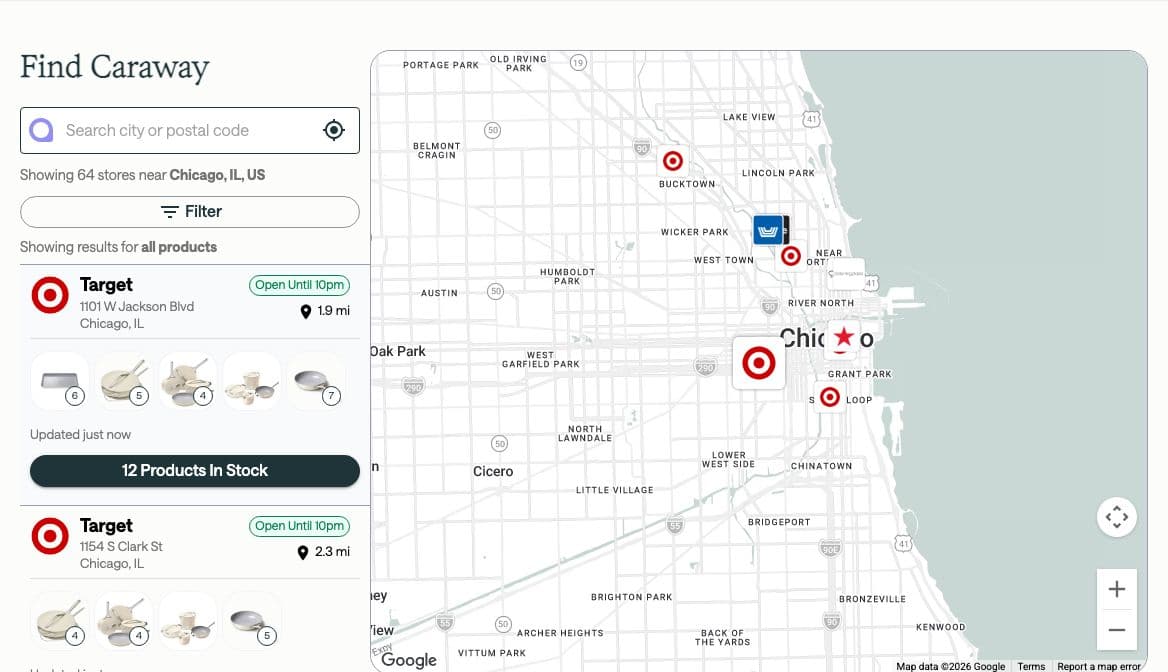
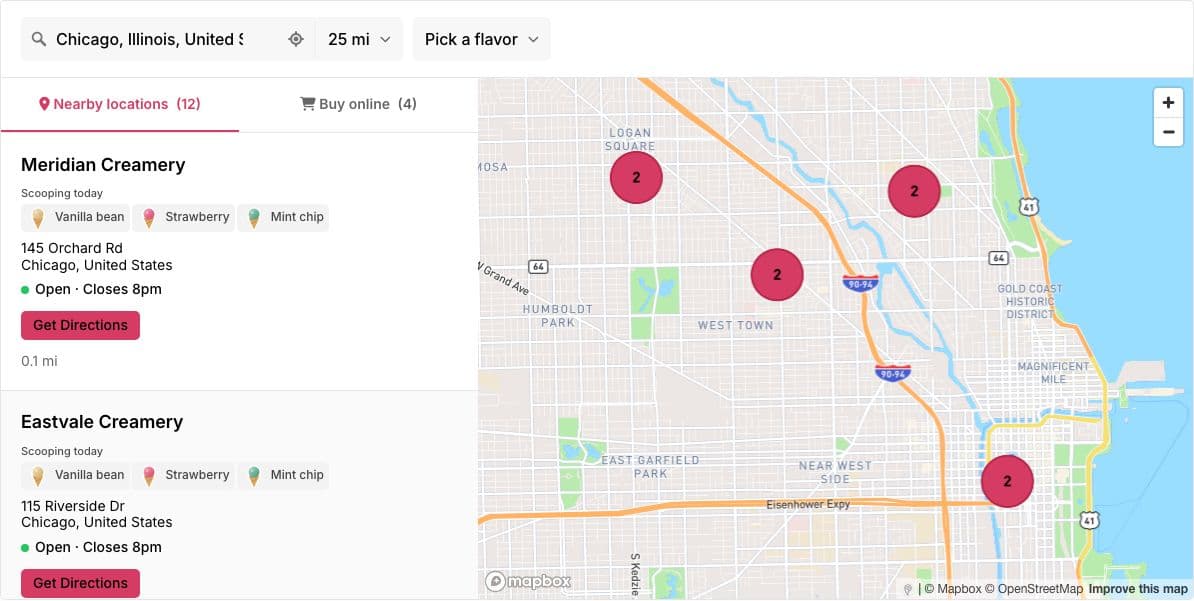
Both store locators as a shopper sees them, captured the same way: a 1280 by 800 browser window placed in Chicago, searching for Chicago. A demo holds whatever sample data its vendor chose, so where that changes what the picture shows, the caption says so. Each shot is trimmed to a common shape here; select one to see all of it.
StoreLocatorsCaptured October 15, 2026 from a live customer site, searching “Chicago, IL”.
StoreLocators · Captured October 15, 2026 from a live customer site, searching “Chicago, IL”.
StorepointCaptured October 15, 2026 from the vendor’s own demo, searching “Chicago, IL”.
Storepoint · Captured October 15, 2026 from the vendor’s own demo, searching “Chicago, IL”.
Pricing, side by side
Both publish prices. Storepoint is between $25 and $99 a month; we start at $195. On price alone this is not close, and the honest comparison is about what the cheaper figure leaves you doing.
Storepoint’s own pricing page describes its annual discount as "one month free per year when you pay upfront for the year". The yearly totals appear on its Shopify App Store listing instead: $275, $539 and $1,089.,
StoreLocators
Prices published
Three tiers on our Shopify App Store listing, scaling by retail locations: Launch up to 2,000 locations, Grow from 2,000 to 10,000, and Scale above 10,000, at $195, $395 and $995 per month.
Month to month, no long-term contract and no termination fee
Refund available within 30 days of the latest charge
Map included; shopper sessions and map loads are not metered
Free trial documented. A 14-day free trial on every tier.
Sources,
Storepoint
Prices published
Three tiers: Starter at $25 a month for 200 locations and 2 team members, Pro at $49 for 2,000 locations and 5 members, and Business at $99 for unlimited locations and 20 members. Every tier includes the location management, query and JavaScript APIs. White Label is on Business.
No free plan; a 7-day trial instead
Month to month, cancel at any time
Annual billing: one month free per year; the Shopify listing gives $275, $539 and $1,089 a year
Map key can be yours or a Storepoint-managed option with views bundled
SEO and AI local pages are offered on custom plans quoted on request; a Custom Integration Build is an additional fee on Business
Terms governed by the laws of Ontario, Canada
Free trial documented. 7 days.
Sources,,
StoreLocators vs Storepoint at a glance
Sixteen rows on one review date. Where Storepoint publishes nothing, the cell says so rather than guessing.
Source 1Storepoint: homepagestorepoint.co. Reviewed 2026-10-15.Full citationSource 2Storepoint: pricingstorepoint.co. Reviewed 2026-10-15.Full citationSource 3Storepoint: supported platformsstorepoint.co. Reviewed 2026-10-15.Full citationSource 4Storepoint: featuresstorepoint.co. Reviewed 2026-10-15.Full citationSource 5Storepoint docs: store locator from distributor reportsstorepoint.co. Reviewed 2026-10-15.Full citationSource 6Storepoint: documentation indexstorepoint.co. Reviewed 2026-10-15.Full citationSource 7Storepoint: FAQstorepoint.co. Reviewed 2026-10-15.Full citationSource 8Storepoint: terms of servicestorepoint.co. Reviewed 2026-10-15.Full citationSource 9Storepoint Store Locator on CapterraCapterra. Reviewed 2026-10-15.Full citationSource 10Storepoint on TrustpilotTrustpilot. Reviewed 2026-10-15.Full citationSource 11Storepoint on the Shopify App StoreShopify App Store. Reviewed 2026-10-15.Full citationSource 12Storepoint docs: adding a store locator to Shopifystorepoint.co. Reviewed 2026-10-15.Full citationSource 13StoreLocators: guarantee, refunds and cancellationstorelocators.com. Reviewed 2026-10-15.Open the sourceFull citationSource 14StoreLocators on the Shopify App StoreShopify App Store. Reviewed 2026-10-15.Open the sourceFull citationSource 15StoreLocators: free retailer store listsstorelocators.com. Reviewed 2026-10-15.Open the sourceFull citation
Month to month, cancel any timeStorepoint: Contract termsAnnual billing gives one month free per year. The terms are governed by the laws of Ontario, Canada.Sources2. Storepoint: pricing8. Storepoint: terms of service
Pricing
$195–$995 per monthStoreLocators: PricingThree tiers on our Shopify App Store listing, scaling by retail locations: Launch up to 2,000, Grow from 2,000 to 10,000, Scale above 10,000.Source14. StoreLocators on the Shopify App Store
$25–$99 per monthStorepoint: PricingMonthly figures are on storepoint.co, which describes annual billing as "one month free per year when you pay upfront for the year". The Shopify App Store listing gives the annual figures: $275, $539 and $1,089 a year.Sources2. Storepoint: pricing11. Storepoint on the Shopify App Store
Merchant ratingSame storefront, so these compare. Read with the count.
5.0Storepoint: Merchant rating5.0 from 22 reviews on Capterra.4.0 from 4 reviews on Trustpilot.Storepoint’s Shopify App Store listing launched on October 6, 2026 and had no reviews on October 15, 2026, so there is no Shopify rating yet. The Capterra and Trustpilot figures are not comparable with Shopify ratings on other pages: different audiences, different review policies, and four reviews is too few to read as a rating at all.Sources9. Storepoint Store Locator on Capterra10. Storepoint on Trustpilot11. Storepoint on the Shopify App Store
Yes7-day free trialStorepoint: Evaluate without a sales callNo free plan.Source2. Storepoint: pricing
Retailer coverage
Adding a retailer you sell throughThe gap between the retailer list you are sold and the one you actually sell through.
On request, typically within days, at no additional cost
You import itStorepoint: Adding a retailer you sell throughNo automatic discovery exists. Storepoint states that direct distributor integrations are unavailable because most distributor platforms do not offer public APIs for retailer-level data, so new retailers arrive when you next export and upload a report.Source5. Storepoint docs: store locator from distributor reports
Retailer coverageCoverage only counts where you actually sell.
–Not published by the vendorStorepoint: Retailer coverageNo retailer network.Storepoint supplies no store data and publishes no coverage figure. It names customers rather than retailers: SodaStream, Drunk Elephant, Benchmade, Athletic Brewing, Dermalogica and others.Source1. Storepoint: homepage
Location capA cap you can grow past is a repricing event, not a feature.
Priced by retail locations, not cappedStoreLocators: Location capPlans scale by location count rather than cutting the map off at a number.
200, 2,000, then unlimitedStorepoint: Location capStarter 200, Pro 2,000, Business unlimited. Team seats are capped separately at 2, 5 and 20.Source2. Storepoint: pricing
Data and freshness
Where the store data comes fromThe whole difference. Everything else follows.
Automatic discovery across 205 integrated retailer feedsStoreLocators: Where the store data comes fromNo spreadsheet to maintain. Retailers that stock you are found in their own feeds and appear without you entering them.
Reports and sheets you import, plus an APIStorepoint: Where the store data comes fromManual entry and CSV or Excel import on every plan, plus location management and query APIs. Google Sheets sync and Webflow CMS sync start on Pro; "Sync From Your Own System" (a JSON endpoint) is on Business, with a Custom Integration Build at an additional fee. Broad ingestion, all of it starting from data you supply.Source2. Storepoint: pricing
Refresh cadenceA locator that sends a shopper to a store that dropped the line costs more trust than it wins.
Retailer feeds, refreshed daily
As current as your last importStorepoint: Refresh cadenceGoogle Sheets sync is not on Starter; it runs daily on Pro and as often as every five minutes on Business, which refreshes the sheet, not the world. For distributor data Storepoint’s own guide describes quarterly re-uploads as common, some brands monthly.Sources2. Storepoint: pricing5. Storepoint docs: store locator from distributor reports
Product-level availabilityWhether the map answers "who has this product" or only "where are the shops".
YesPer product, per variant, per store, filtered to in-stockStoreLocators: Product-level availabilityRetailer-reported rather than a live poll of a physical shelf, which is the honest description of what this category actually has.
A product tag you maintainStorepoint: Product-level availabilityStorepoint supports product-level tagging so a store can be shown as carrying a given product. It is a static tag set from your import rather than a stock signal, so it says a store stocks the line, not that the shelf has one today.Source5. Storepoint docs: store locator from distributor reports
Shopify app or copy-paste snippet, roughly 50 platforms documentedStorepoint: Install pathA Shopify App Store listing launched on October 6, 2026. Installed from there, the locator goes in as a Locator app section in the theme editor or as a ready-made page. Signed up directly, the Shopify path is pasting the snippet into a Custom Liquid section or page HTML. The platforms page names around fifty environments, from Webflow and Squarespace to Astro, Svelte and Kajabi.Sources11. Storepoint on the Shopify App Store12. Storepoint docs: adding a store locator to Shopify3. Storepoint: supported platforms
Developer requiredWhether this ships this week or waits for engineering time.
NoNot required
NoNot requiredStorepoint: Developer requiredStorepoint’s Shopify guide says setup needs no coding. Through the Shopify app it is an app section added in the theme editor; on a direct signup the snippet goes into a Custom Liquid section or page HTML.Source12. Storepoint docs: adding a store locator to Shopify
Minutes, per StorepointStorepoint: Time to launchTheir claim, for the locator itself. Assembling the first distributor import is the longer part of the job.Source1. Storepoint: homepage
Who pays for the mapA locator billed per map load has a second invoice attached to it, from Google or Mapbox rather than the vendor.
YesIncludedStoreLocators: Who pays for the mapThe map is part of the subscription. There is no separate Google or Mapbox bill, and shopper sessions are not metered.
Your key, or a managed optionStorepoint: Who pays for the mapYou can bring your own Google Maps or Mapbox key, or take a Storepoint-managed arrangement with map views bundled. That choice is more than most widgets in this class offer.Source2. Storepoint: pricing
Features
Wholesale self-submissionIndependent stockists rarely appear in any feed. Letting them add themselves is the only way to catch them.
YesSubmit Your Location block
Via a form tool you connectStorepoint: Wholesale self-submissionThere is no built-in submission form. Storepoint’s FAQ suggests connecting a form tool of your choice to a synced Google Sheet, so submissions flow into the locator; Google Sheets sync starts on Pro. Its Dealer And Rep Territories feature, on Business, is about routing rather than intake.Sources7. Storepoint: FAQ2. Storepoint: pricing
Support
Support model
Every message reaches Our Customer Success & Onboarding Specialist
Email or a booked call, priority on BusinessStorepoint: Support modelPublished channels are email and a Calendly booking. No phone line is published. No response-time commitment appears in the FAQ or terms.Sources7. Storepoint: FAQ2. Storepoint: pricing
Storepoint in its own words
“Our one-step copy-and-paste installation makes it easy to get up and running in minutes, with no coding!”
“We offer one month free per year when you pay upfront for the year.”
Storepoint is clear about this. Its own documentation states that direct integrations with UNFI Insights, KeHE CONNECT BI and the rest are unavailable because most distributor platforms do not offer public APIs for retailer-level data, and it does not claim or imply live distributor integrations.
What follows from it is a workflow rather than a feed. You export the report, you import it, and the map is accurate as of that import. Storepoint’s own guidance describes quarterly as common practice, with some brands on monthly.
Where StoreLocators is different
The distributor report stops being a job
This is the entire comparison. Storepoint imports the report you export; we read retailer feeds directly, refreshed daily, so nobody exports anything. Storepoint is candid that live distributor integrations are not possible for it, and it is right about why. We solved it from the retailer end instead.
Availability rather than a tag
A product tag says a store stocks the line as of your last import. Our availability is per product and per store from retailer feeds, refreshed daily. On a quarterly upload cycle those are very different answers, and the gap is widest exactly when it matters: right after a distribution change.
Retailer coverage you do not have to assemble
Storepoint maps the retailers you list, however they get in: typed, imported, synced from a sheet or pushed through its API. We start from integrated retailer feeds, so a chain that picks up your product appears without anyone adding a row.,
Independents can add themselves
Storepoint has no built-in submission form; its FAQ suggests wiring a third-party form tool to a synced Google Sheet. Our Submit Your Location block does it inside the product, with an independent stockist putting itself forward for approval, which is the only way to catch shops that appear in no report at all.
Every row where the table above separates us
Taken from that table rather than written out again, so the two cannot disagree. A row shows up here when we publish an answer and they publish none, or when both answer and ours covers more of the feature. Rows where both sides publish a figure, a price or a rating, stay out: those differ by their content.
StoreLocators: Submit Your Location block|Storepoint: Via a form tool you connect
What "distributor integration" means here
Storepoint publishes import guides for the reports CPG brands already receive: UNFI Insights, KeHE CONNECT BI, DOT Foods, McLane Link, regional and DSD reports, and broker reports. If you sell through natural and specialty distribution, those are the right file formats to care about.
They are import guides rather than integrations, and Storepoint says so directly. Its own explanation is that most distributor platforms do not offer public APIs for retailer-level data, which is true and is the reason nobody else in this price bracket has solved it either.
The practical shape is a recurring task with an owner. Someone pulls the report, cleans it, uploads it, and the map is right until the next distribution change. Storepoint’s guidance describes quarterly as common with some brands monthly, which means the map spends most of its life describing a slightly older world than the one the shopper is in.
Whether that matters is a real question rather than a rhetorical one. In a category where distribution moves slowly, a quarterly refresh is close enough and $25 a month is a very good deal. In one where a chain authorisation lands and 900 doors appear at once, the lag is the product.
Annual pricing, and the figures we will not derive
Storepoint publishes three monthly prices: $25, $49 and $99. On its own pricing page annual billing is a sentence rather than a number: one month free per year when you pay upfront for the year, switched on from account settings after signup. Its Shopify App Store listing does give yearly totals: $275, $539 and $1,089.,
Dividing those by twelve gives $22.92, $44.92 and $90.75 a month, and you will find those numbers in comparison articles. They are arithmetic rather than quotes. This page prints the yearly totals Storepoint publishes and not the monthly equivalents, because a derived figure presented as a published one is the same error as guessing, just harder to catch.
The same rule runs through every cell here. Where a vendor publishes a figure we quote it and name the page. Where they publish a policy instead, we quote the policy.
A new Shopify app, and the snippet route
Storepoint listed on the Shopify App Store on October 6, 2026. Installed from there, the locator is added as a Locator app section in the theme editor, or used as a ready-made page on your own domain, and Shopify handles the billing. Signed up directly, the Shopify install is pasting the embed into a Custom Liquid section or page HTML. Storepoint puts either route at about five minutes.,
The listing is new. On October 15, 2026 it had no reviews, so Storepoint’s public track record sits on Capterra and Trustpilot rather than Shopify for now.,
Against that, the breadth is real. The platforms page names roughly fifty environments, well beyond the usual list: Astro, Svelte, Nuxt, Kajabi, Notion, Adobe Experience Manager. If your site is somewhere unusual, Storepoint has probably written the guide.
Moving from Storepoint to StoreLocators
Straightforward, because Storepoint gives you good ways to get your data out: a full read/write API on every plan, plus whatever CSV or Google Sheet you were importing.
The goal of the move is that the import cycle ends. Locations you genuinely own stay under your control; retailer locations arrive from feeds instead of from a report someone exports.
1Pull everything through the API or your sheetRead your records out through the Location Management API, export them from the dashboard, or take the Google Sheet you were syncing. Either way you leave with the full set.Under an hour
2Separate what you own from what a distributor told youYour own locations and any independents you track by hand come across as managed locations. Chain retail rows from UNFI, KeHE, DOT or McLane reports do not need to: those retailers come from the feeds, current, without an upload.An hour or two, once
3Turn on your retailersSelect the retailers you sell through from the integrated list. Anything missing is added on request, typically within days, at no additional cost.Minutes, plus our turnaround for anything new
4Install and redirectAdd the app section on Shopify or a script and one div elsewhere, then point the old locator URL at the new page so nothing indexed is lost.Under 5 minutes on Shopify
5Cancel the last report subscription nobody neededOnce the map is on feeds, check whether the distributor report was being pulled solely to feed it. Often it was, and that is a recurring task that can simply stop.One conversation
Frequently asked questions
How much does Storepoint cost?
Storepoint publishes three monthly tiers: Starter at $25 for up to 200 locations and 2 team members, Pro at $49 for 2,000 locations and 5 members, and Business at $99 for unlimited locations and 20 members. Every tier includes API access; White Label branding removal is on Business. There is no free plan; the trial is 7 days. Annual billing gives one month free per year, and its Shopify App Store listing puts that at $275, $539 and $1,089 a year. SEO and AI local pages sit on custom plans quoted on request, and a Custom Integration Build is an additional fee on Business.,
Does Storepoint integrate with UNFI, KeHE or DOT Foods?
Not as a live integration, and Storepoint says so itself. It publishes import guides for UNFI Insights, KeHE CONNECT BI, DOT Foods, McLane Link and broker reports, so it handles those file formats well, but its own documentation states that direct integrations are unavailable because most distributor platforms do not offer public APIs for retailer-level data. In practice that means exporting the report and uploading it, which its guidance describes as commonly quarterly, some brands monthly.
Does Storepoint show live inventory?
No. It supports product-level tagging, so a store can be shown as carrying a product, but that tag comes from your import rather than from a stock feed. It tells a shopper the store stocks the line, not that a unit is on the shelf today, and it is only as current as the last upload.
Is Storepoint on the Shopify App Store?
Yes, since October 6, 2026. Installed from the Shopify App Store, the locator is added as a Locator app section in the theme editor or used as a ready-made page, and Shopify bills you. Signing up directly still works, with the embed snippet pasted into a Custom Liquid section or page HTML. The listing had no reviews on October 15, 2026. Storepoint also documents roughly fifty other platforms, a wider list than most competitors publish.,,
Is Storepoint good?
It holds 5.0 on Capterra across 22 reviews and 4.0 on Trustpilot across 4, with support responsiveness the theme reviewers return to. Its Shopify App Store listing is new and had no reviews on October 15, 2026. We could not confirm a G2 rating, so none is shown. It names customers including SodaStream, Drunk Elephant, Benchmade, Athletic Brewing and Dermalogica. For a widget at this price it is a strong record, and the CPG features are more thought through than anything else in its bracket.,,,
What is the best Storepoint alternative?
It depends what is failing. If Storepoint is fine but you want it cheaper, this is not the page for that. If the problem is that someone keeps exporting a distributor report and re-uploading it, or that the map is only right for a few weeks after each upload, that is what StoreLocators replaces: retailer feeds refreshed daily instead of an import cycle, and per-product, per-variant, per-store availability instead of a static tag. It costs several times more, and on slow-moving distribution Storepoint may still be the better buy.
Every Storepoint claim on this page was taken from storepoint.co, its pricing, platforms, features, docs, FAQ and terms pages, or a public review listing, and each was checked on 15 October 2026. The sources are listed below with the exact URL we read.,,
Every claim was checked twice against the vendor's own pages before publishing.,
Two things are deliberately not stated. We could not confirm a G2 rating, so none is shown. And no annual per-month price is quoted: Storepoint publishes yearly totals on its Shopify listing and a policy on its own site, and the per-month equivalents circulating in comparison articles are arithmetic, not quotes. Claims about StoreLocators come from our own public pages and are not separately cited.
Sources
15 sources
Every claim on this page cites the source it came from, with the date we checked it. Sources are named but not linked; search for the title to find the page.
1.Storepoint: homepagestorepoint.co. Reviewed 2026-10-15.“Our one-step copy-and-paste installation makes it easy to get up and running in minutes, with no coding!”Customer logos include SodaStream, Drunk Elephant, Benchmade, Lemme, Cult Gaia, Athletic Brewing and Dermalogica. No retailer coverage figure is published, because Storepoint supplies no store data.
2.Storepoint: pricingstorepoint.co. Reviewed 2026-10-15.“We offer one month free per year when you pay upfront for the year.”Source for all three tiers and their caps: Starter $25 / 200 locations / 2 team members, Pro $49 / 2,000 / 5, Business $99 / unlimited / 20. In the plan grid White Label, Dealer And Rep Territories, Sync From Your Own System and Location Edit History are Business only; Location Analytics, Google Analytics Events, Webflow CMS Sync and Online Stores start on Pro; Custom Reports & Exports is "1 Included" on Business; the Location Management, Query and JavaScript APIs are on all three. Google Sheets sync is absent on Starter, daily on Pro and every 5 minutes on Business. Custom Integration Build is an additional fee on Business. "SEO & AI local pages" are listed under custom plans. Support is "Free", "Free" and "Priority". No annual dollar figures appear on this page.
3.Storepoint: supported platformsstorepoint.co. Reviewed 2026-10-15.Lists about fifty environments, well beyond the usual set, including Divi, Beaver Builder, Bricks, Oxygen, Square Online, Ecwid, PrestaShop, Shopware, Tiendanube, Sitecore, Adobe Experience Manager, Craft CMS, Contentful, Vue, Nuxt, Astro, Svelte, GoHighLevel, Kajabi and Thinkific.
4.Storepoint: featuresstorepoint.co. Reviewed 2026-10-15.“Custom Fields & Buttons: Add booking links, menus, social profiles, or any extra information”Confirms that per-location actions are not limited to directions. Also documents an Online Stores feature that can show ecommerce, delivery or regional distributor alternatives; its description does not say it triggers specifically on an empty result, so this page does not claim that it does.
5.Storepoint docs: store locator from distributor reportsstorepoint.co. Reviewed 2026-10-15.Documents imports for UNFI Insights, KeHE CONNECT BI, DOT Foods, McLane Link, DSD and regional distributors, and broker reports. States "Direct integrations with UNFI Insights, KeHE CONNECT BI, and the others aren't available since most distributor platforms don't offer public APIs for retailer-level data." On cadence: "Quarterly is common. Some brands go monthly." Each store becomes one pin "tagged with the products carried at that location", a tag from the import rather than a stock signal.
6.Storepoint: documentation indexstorepoint.co. Reviewed 2026-10-15.Carries guides for Dealer Locator with Territories and Appointment Booking. No built-in dealer or stockist submission form appears in the docs.
7.Storepoint: FAQstorepoint.co. Reviewed 2026-10-15.“Can't find your answer? Contact us or book a call.”Published support channels are email and a booked Calendly call. No phone line is published anywhere, and no response-time commitment appears in the FAQ or the terms. Business adds priority support. Also answers "Is there a way for users to submit their own locations?" with "Connect the Google Sheets sync to a form tool of your choice. Submissions flow into the Google Sheet, and from there into your locator automatically."
8.Storepoint: terms of servicestorepoint.co. Reviewed 2026-10-15.“These Terms shall be governed by, and interpreted and enforced in accordance with, the laws in the Province of Ontario and the laws of Canada, as applicable.”No street address appears in the terms; the Shopify App Store listing gives the developer location as Toronto, ON, CA. No uptime or response-time commitment is given.
9.Storepoint Store Locator on CapterraCapterra. Reviewed 2026-10-15.5.0 across 22 reviews on 2026-10-15 (from the page's structured data). A May 2026 review exists, but a quote attributed to it elsewhere could not be reproduced from the page, so no Capterra quote is published here.
10.Storepoint on TrustpilotTrustpilot. Reviewed 2026-10-15.4.0 across 4 reviews. We could not confirm a G2 rating, so none is shown.
11.Storepoint on the Shopify App StoreShopify App Store. Reviewed 2026-10-15.“Add a beautiful store locator in minutes.”Launched October 6, 2026; developer location Toronto, ON, CA; 0.0 with 0 reviews on 2026-10-15. Plans: Starter $25 a month or $275 a year, Pro $49 or $539 a year, Business $99 or $1,089 a year, each "save 8%", each with a 7-day free trial. White label and near real-time Google Sheets sync are listed under Business.
12.Storepoint docs: adding a store locator to Shopifystorepoint.co. Reviewed 2026-10-15.“It takes about 5 minutes, needs no coding, and works with every theme.”Documents two routes. "Installed from Shopify": Add section, then under Apps select Locator, or use a ready-made page. "Signed up with Storepoint": paste the embed code into a Custom Liquid section, or into a page in HTML view.
13.StoreLocators: guarantee, refunds and cancellationstorelocators.com. Reviewed 2026-10-15.“StoreLocators.com operates on a month-to-month subscription model with no long-term contracts or termination fees.”Also states that a subscription can be cancelled at any time through Account Settings under Billing, and that a refund may be requested within 30 days of the latest charge.
15.StoreLocators: free retailer store listsstorelocators.com. Reviewed 2026-10-15.Publishes 110,516 store locations across 205 retailers as free CSV downloads with addresses, phone numbers, opening hours and coordinates. The counts are taken from the live lists.
110,516+ locations connected
Every ClickDeserves aDestination
Connect your online shoppers to in-stock products at retail stores nearby. In five minutes. With zero maintenance.