Storemapper Store Locator vs StoreLocators: 2026 Pricing
Store locator widget for Shopify and any website
Storemapper is a long-established store locator widget with a documented API, support for more platforms than almost anything else in its class, and ratings to match: 4.9 on the Shopify App Store and 4.8 on Capterra. It also has a pricing page that publishes two different prices for the same plan, and a refund clause no current plan qualifies for. The map runs on a Google Cloud billing account you open yourself.
Last reviewed
The short answer
Storemapper is a capable, well-reviewed widget and the cheapest credible way onto a lot of platforms. We are the better buy when the store list belongs to retailers rather than to you, when shoppers need product availability rather than a product tag, or when opening a Google Cloud billing account to run a map is not something you want to own.
What each product is designed to do, in its own terms. A capability named on one side is not a claim that the other lacks it, and neither column ranks the two: the table below is where they are compared row by row.
What Storemapper is built for
You own your locations and the list is already accurate
Your site is on one of the 18 platforms it names, or any site that takes an HTML embed
A documented CRUD API matters and the budget is $25 to $70 a month
You are on Shopify and want a free single location to prove it out first
Managing a Google Cloud billing account is not a problem for your team
Confirm the Pro price in writing first, given the page states two.
What StoreLocators is built for
Retailers you do not control hold the store list
Shoppers need per-product availability rather than a manually enabled tag
You do not want a second billing relationship holding up your map
Enabling products store by store is not a job anyone has time for
Support needs to reach a human without being email-only and English-only
StoreLocators and Storemapper, side by side
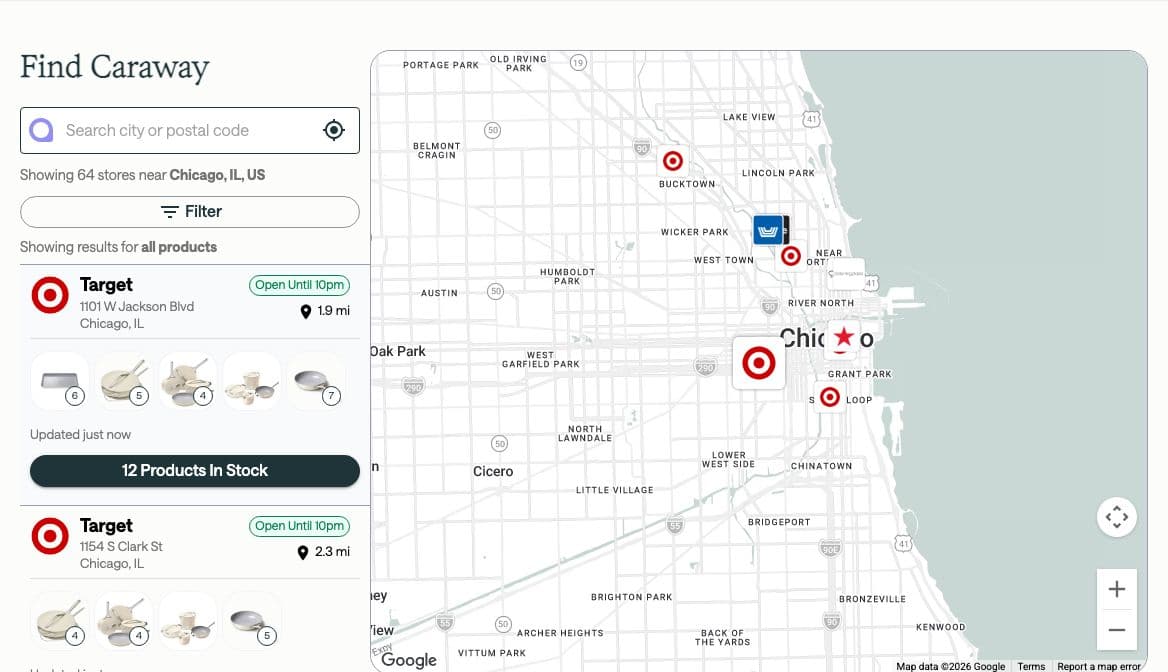
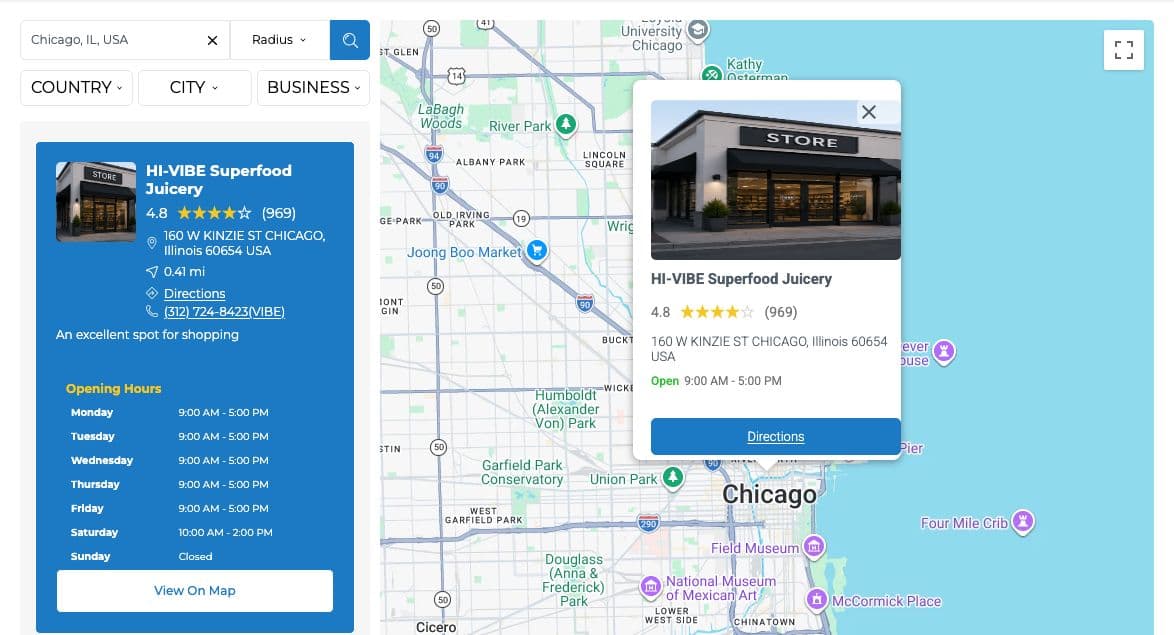
Both store locators as a shopper sees them, captured the same way: a 1280 by 800 browser window placed in Chicago, searching for Chicago. A demo holds whatever sample data its vendor chose, so where that changes what the picture shows, the caption says so. Each shot is trimmed to a common shape here; select one to see all of it.
StoreLocatorsCaptured October 15, 2026 from a live customer site, searching “Chicago, IL”.
StoreLocators · Captured October 15, 2026 from a live customer site, searching “Chicago, IL”.
StoremapperCaptured October 15, 2026 from the vendor’s own demo, searching “Chicago, IL”.
Storemapper · Captured October 15, 2026 from the vendor’s own demo, searching “Chicago, IL”.
Pricing, side by side
Storemapper is between $24.99 and roughly $199 a month depending on locations and on which of its own figures you read. We start at $195. On sticker price this is not close.
Two costs sit outside Storemapper’s price list: the Google Cloud billing account the map needs, and the time spent enabling products store by store if you use the product feature.,
StoreLocators
Prices published
Three tiers on our Shopify App Store listing, scaling by retail locations: Launch up to 2,000 locations, Grow from 2,000 to 10,000, and Scale above 10,000, at $195, $395 and $995 per month.
Month to month, no long-term contract and no termination fee
Refund available within 30 days of the latest charge
Map included; shopper sessions and map loads are not metered
Free trial documented. A 14-day free trial on every tier.
Sources,
Storemapper
Prices published
Micro $24.99 a month for 100 locations, Pro for 1,000 at either $49.99 or $39.99 depending on which part of the pricing page you read, Premium $69.99 for 10,000, and Corporate at $199 (stated once as $199.99). A free single-location plan exists on the Shopify App Store only, and an unpriced Tailored Plan sits below the table.
7-day free trial on every plan, no card required
Google Maps or Mapbox key supplied by the customer; Google Maps also needs your own Google Cloud billing account
The 30-day money-back period is discretionary and scoped to plans without a free trial, and every plan has one
Support is email only and English only per the terms
The Shopify listing carries four plans; Corporate is not purchasable there
Free trial documented. 7 days on every plan, with no credit card required.
Sources,,
StoreLocators vs Storemapper at a glance
Sixteen rows, current as of 15 October 2026. Where Storemapper’s own pages contradict each other, both figures are given rather than one being chosen.
Source 1Storemapper: homepagestoremapper.com. Reviewed 2026-10-15.Full citationSource 2Storemapper: pricingstoremapper.com. Reviewed 2026-10-15.Full citationSource 3Storemapper: terms of servicestoremapper.com. Reviewed 2026-10-15.Full citationSource 4Storemapper: FAQstoremapper.com. Reviewed 2026-10-15.Full citationSource 5Storemapper docs: adding a Google Maps API keyhelp.storemapper.com. Reviewed 2026-10-15.Full citationSource 6Storemapper docs: CRUD API v3help.storemapper.com. Reviewed 2026-10-15.Full citationSource 7Storemapper docs: adding products to listingshelp.storemapper.com. Reviewed 2026-10-15.Full citationSource 8Storemapper help centrehelp.storemapper.com. Reviewed 2026-10-15.Full citationSource 9Storemapper on the Shopify App StoreShopify App Store. Reviewed 2026-10-15.Full citationSource 10Storemapper reviews on the Shopify App StoreShopify App Store. Reviewed 2026-10-15.Full citationSource 11Storemapper on CapterraCapterra. Reviewed 2026-10-15.Full citationSource 12StoreLocators: guarantee, refunds and cancellationstorelocators.com. Reviewed 2026-10-15.Open the sourceFull citationSource 13StoreLocators on the Shopify App StoreShopify App Store. Reviewed 2026-10-15.Open the sourceFull citationSource 14StoreLocators: free retailer store listsstorelocators.com. Reviewed 2026-10-15.Open the sourceFull citation
Monthly or annual, and the money-back clause is discretionaryStoremapper: Contract termsThe 30-day money-back period is scoped to plans that do not include a free trial, and is something Storemapper “may offer, during the registration process” rather than a guarantee. Every current plan carries a 7-day trial, so the two clauses do not fit together. Outside it, amounts already paid are stated as neither fully nor partially refundable.Source3. Storemapper: terms of service
Pricing
$195–$995 per monthStoreLocators: PricingThree tiers on our Shopify App Store listing, scaling by retail locations: Launch up to 2,000, Grow from 2,000 to 10,000, Scale above 10,000.Source13. StoreLocators on the Shopify App Store
Published, and self-contradictoryStoremapper: PricingMicro $24.99 and Premium $69.99 are consistent. Pro is published twice on the same page at two prices: $49.99 a month on the plan card and $39.99 in the comparison table below it. Corporate appears once as $199.99 and twice as $199. Both Pro figures are given on this page rather than one being chosen.Source2. Storemapper: pricing
Merchant ratingSame storefront, so these compare. Read with the count.
4.9Storemapper: Merchant rating4.9 from 95 reviews on Shopify App Store.4.8 from 53 reviews on Capterra.As of 15 October 2026. The breakdown is 89 five-star, four four-star, one two-star and one one-star, which sums to the published total. At that sample a single new review moves the average, which is why the count is printed beside the score.Sources9. Storemapper on the Shopify App Store10. Storemapper reviews on the Shopify App Store11. Storemapper on Capterra
Adding a retailer you sell throughThe gap between the retailer list you are sold and the one you actually sell through.
On request, typically within days, at no additional cost
You add it yourselfStoremapper: Adding a retailer you sell throughNo discovery mechanism for third-party retail locations exists. The Google Business Profile sync pulls only locations you have already declared as your own.Source8. Storemapper help centre
Retailer coverageCoverage only counts where you actually sell.
–Not published by the vendorStoremapper: Retailer coverageNo retailer network.Storemapper supplies no store data, so there is no coverage figure. Its homepage publishes user and location totals, which count its own customers and their uploads rather than retail coverage.Source1. Storemapper: homepage
Location capA cap you can grow past is a repricing event, not a feature.
Priced by retail locations, not cappedStoreLocators: Location capPlans scale by location count rather than cutting the map off at a number.
1 free, then 100, 1,000, 10,000Storemapper: Location capMicro 100, Pro 1,000, Premium 10,000, with a Corporate tier above and a sixth unpriced Tailored Plan below the table. The free single-location plan exists only on the Shopify App Store listing, not on Storemapper’s own pricing page.Sources2. Storemapper: pricing9. Storemapper on the Shopify App Store
Data and freshness
Where the store data comes fromThe whole difference. Everything else follows.
Automatic discovery across 205 integrated retailer feedsStoreLocators: Where the store data comes fromNo spreadsheet to maintain. Retailers that stock you are found in their own feeds and appear without you entering them.
Locations you supply, plus a CRUD APIStoremapper: Where the store data comes fromManual entry, CSV bulk upload, Google Sheets sync, Google Business Profile sync, Shopify product sync, and a documented REST CRUD API. The Business Profile sync imports only your own declared locations, not third-party retailers.Sources6. Storemapper docs: CRUD API v38. Storemapper help centre
Refresh cadenceA locator that sends a shopper to a store that dropped the line costs more trust than it wins.
Retailer feeds, refreshed daily
Whenever you push an updateStoremapper: Refresh cadenceNo vendor-side data pipeline exists, so there is no cadence to publish. The map reflects your last change.Source8. Storemapper help centre
Product-level availabilityWhether the map answers "who has this product" or only "where are the shops".
YesPer product, per variant, per store, filtered to in-stockStoreLocators: Product-level availabilityRetailer-reported rather than a live poll of a physical shelf, which is the honest description of what this category actually has.
A product tag, enabled store by storeStoremapper: Product-level availabilityProducts import from Shopify or are entered by hand, then are enabled per store one at a time, which Storemapper documents as a manual process with no CSV path. The fields are name, description, price, image and a call-to-action; there is no stock quantity and no live inventory signal. Which tier carries it is disputed between Storemapper’s own two listings.Sources7. Storemapper docs: adding products to listings2. Storemapper: pricing9. Storemapper on the Shopify App Store
Shopify theme app block, or an embed on any HTML siteStoremapper: Install pathOn Shopify you create a custom page template, add the app block and assign the template. Elsewhere it is a copy-and-paste embed, and its own pages name 18 platforms individually, among them Wix, Squarespace, BigCommerce, WooCommerce, Sitecore and Magento.Sources4. Storemapper: FAQ1. Storemapper: homepage
Developer requiredWhether this ships this week or waits for engineering time.
NoNot required
NoNot requiredStoremapper: Developer requiredStoremapper describes the Shopify setup as quick and requiring no coding. Opening the Google Cloud billing account is a separate matter.Source4. Storemapper: FAQ
2 to 3 minutes, for the widget onlyStoremapper: Time to launchTheir claim, and fair for placing the widget. It excludes the Google Cloud account, API enablement and billing setup that the Google Maps option requires, which is documented in a different place entirely.Sources2. Storemapper: pricing5. Storemapper docs: adding a Google Maps API key
Who pays for the mapA locator billed per map load has a second invoice attached to it, from Google or Mapbox rather than the vendor.
YesIncludedStoreLocators: Who pays for the mapThe map is part of the subscription. There is no separate Google or Mapbox bill, and shopper sessions are not metered.
NoYour key and your Google Cloud billing accountStoremapper: Who pays for the mapStoremapper is explicit: you need your own relationship with the mapping provider, meaning an account, a key and billing. Mapbox is offered as the easier route precisely because it skips the billing step. The Shopify listing advertises "No API Key Required During Trial", which scopes that relief to the trial.Sources5. Storemapper docs: adding a Google Maps API key9. Storemapper on the Shopify App Store
Features
Wholesale self-submissionIndependent stockists rarely appear in any feed. Letting them add themselves is the only way to catch them.
YesSubmit Your Location block
–Not verified by usStoremapper: Wholesale self-submissionNo dealer or stockist self-submission intake appears in Storemapper’s documentation or feature listings. Nothing states that it is absent either, so this is our limit rather than a statement about the product.Source8. Storemapper help centre
Support
Support model
Every message reaches Our Customer Success & Onboarding Specialist
Email only, English onlyStoremapper: Support modelStated in the terms rather than the marketing. A phone number appears in the site footer but is not recognised as a support channel in the terms, and the Shopify listing names twenty languages.Sources3. Storemapper: terms of service9. Storemapper on the Shopify App Store
Storemapper in its own words
“Takes 2-3 minutes to setup. No coding required.”
“you’ll have to have your own relationship with mapping provider (Google in this case). This involves the creation of an account with them and generating API key or token”
“Support for the Services is only available in English, via email (help@storemapper.co).”
Those first two quotes sit awkwardly together and it is worth being fair about why. The two-to-three minute claim describes dropping the widget onto a page, which is true. It does not cover opening a Google Cloud account, enabling the Maps APIs and attaching a billing method, which Storemapper documents separately and which is the part people get stuck on. Storemapper now offers Mapbox as an alternative specifically because it needs no billing setup.,
The English-only, email-only line matters more than it looks. It is in the terms rather than the marketing, it sits beside a Shopify listing that names twenty languages, and there is a phone number in the site footer that the terms do not recognise as a support channel.,
Where StoreLocators is different
No Google Cloud account in the critical path
Our map is inside the subscription. Storemapper needs your own key and, for Google Maps, your own Google Cloud billing account, which is a second vendor relationship, a second invoice and a second thing that can break your locator when a card expires.
The store list is found rather than uploaded
Storemapper maps what you give it, and its only automatic import pulls locations you already declared as your own. We discover retailers that stock you across integrated feeds, refreshed daily, which is the difference between a map you maintain and one that maintains itself.
Availability, not a tag enabled store by store
Storemapper’s product feature is real but manual: import the products, then enable them per store one at a time, with no CSV path and no stock quantity. Ours is per product and per store from retailer feeds, refreshed daily, with no per-store enabling at all.
Support that is not email-only and English-only
Storemapper’s terms confine support to English, by email. Every message to us reaches a human, and that is not a tier.
Every row where the table above separates us
Taken from that table rather than written out again, so the two cannot disagree. A row shows up here when we publish an answer and they publish none, or when both answer and ours covers more of the feature. Rows where both sides publish a figure, a price or a rating, stay out: those differ by their content.
StoreLocators: Submit Your Location block|Storemapper: Not verified
The Google Cloud account nobody mentions until later
The published price of a Storemapper plan is not the published price of a Storemapper locator. The map runs on your own key, and for Google Maps that means your own Google Cloud account with billing attached.
Storemapper is direct about it once you find the article: you need your own relationship with the mapping provider, involving an account and a generated key. Their FAQ notes Google’s recurring monthly credit, which covers a lot of small locators. Their newer Mapbox option exists specifically because it does not require billing setup.,
Two consequences. The setup is longer than the advertised two to three minutes, because that claim covers the widget rather than the mapping account. And the locator now depends on a billing relationship somebody has to own: when that card expires, the map stops, and the vendor you are paying is not the one that broke.
The Shopify listing says "No API Key Required During Trial", which is a fair accommodation and also tells you exactly when the requirement starts.
What Pro costs, according to Storemapper
On one page, at the same time, Storemapper publishes two prices for the Pro plan. The plan card says $49.99 a month, billed annually at $499. The comparison table lower down the same page says $39.99 a month and $399 a year.
The Corporate tier is stated three ways as well: $199.99 in the top block, and $199 in both the second block and the table. Below all of it sits an unpriced sixth tier, the Tailored Plan, for brands managing thousands of locations.
This page publishes both Pro figures rather than picking the flattering one or the unflattering one. We do not know which is correct and neither does anyone reading the page. If you are buying Pro, get the number confirmed in writing before you subscribe.
A money-back period that does not fit the plans
Storemapper’s terms offer a 30-day money-back period, and scope it to subscription plans that do not involve a free trial period.
Storemapper offers a 7-day free trial on every plan, and the clause is written as something the vendor “may offer” at registration rather than a guarantee, so it is not a commitment any current plan can rely on. Everything else is covered by the sentence stating that amounts already paid are neither fully nor partially refundable.,
It is very likely drafting rather than intent, and a support conversation would probably sort out a genuine case. It is worth knowing before you rely on it, which is the only reason it is here.
Moving from Storemapper to StoreLocators
Easy in this direction, because Storemapper has a documented CRUD API and a CSV path. Your data comes out cleanly.
The point of the move is that retailer locations stop being rows you own. Your own locations stay yours; the rest arrive from feeds.
1Export via the API or CSVQuery the stores endpoint, or take the CSV or Google Sheet you were syncing. Records include tags, custom fields and coordinates. The API token comes from Storemapper support if you have not asked for one before.Under an hour, plus token turnaround
2Split owned locations from retail locationsYour own sites and hand-tracked independents become managed locations. Chain retail rows do not need to come across: those retailers arrive from feeds, current, without an upload.An hour or so, once
3Turn on your retailersChoose the retailers you sell through from the integrated list. Anything missing is added on request, typically within days, at no extra cost.Minutes, plus our turnaround for anything new
4Install and redirectAdd the app section on Shopify, or a script and one div elsewhere, then redirect the old locator URL so nothing indexed is lost.Under 5 minutes on Shopify
5Close down the map keyOnce the Storemapper embed is gone, its Google Maps key is no longer serving anything. Remove or restrict it in Google Cloud so it cannot accrue charges, and decide whether the billing account is still needed at all.Minutes
Frequently asked questions
How much does Storemapper cost?
Micro is $24.99 a month for up to 100 locations and Premium is $69.99 for 10,000. Pro, for 1,000 locations, is published at two different prices on the same page: $49.99 a month on the plan card and $39.99 in the comparison table below it. Corporate appears once as $199.99 and twice as $199. There is also an unpriced Tailored Plan below the table, and a free single-location plan that exists only on the Shopify App Store. Every plan has a 7-day free trial with no card required. Not included in any of those figures: the Google Maps key and Google Cloud billing account the map needs.,,
Does Storemapper need a Google Maps API key?
Yes, and for Google Maps it also needs your own Google Cloud billing account. Storemapper puts it plainly: you have to have your own relationship with the mapping provider, which involves creating an account and generating a key. They now offer Mapbox as an alternative specifically because it does not require the billing setup, and their Shopify listing advertises no API key during the trial. Their FAQ points out Google’s recurring monthly credit, which covers a lot of low-traffic locators.,,
Does Storemapper show product availability?
It has a product feature, but it is a tag rather than stock. Products import from Shopify or are added by hand, then are enabled per store one at a time, which their documentation describes as a manual process with no CSV option. The fields are name, description, price, image and a call-to-action button. There is no stock quantity and no live inventory signal. Which plan carries it is disputed between Storemapper’s own sources: their pricing table gates Shoppable Product to Corporate while their Shopify listing puts Sync Products on Premium.,,
Can I get a refund from Storemapper?
On the terms as written, probably not, though this looks like a drafting problem rather than intent. The 30-day money-back period is offered only for subscription plans that do not involve a free trial period, and Storemapper offers a 7-day free trial on every plan, so no current plan fits it — and the clause says the vendor “may offer” it at registration rather than guaranteeing it. The terms otherwise state that amounts already paid are neither fully nor partially refundable. A genuine case would likely be handled by support, but it is worth knowing before you rely on the published clause.
Is Storemapper good?
The public record is strong: 4.9 across 95 reviews on the Shopify App Store and 4.8 across 53 on Capterra, with a 4.9 customer service sub-rating. It names more platforms than most of its class and publishes a documented CRUD API. We could not confirm a G2 or Trustpilot rating, so none is shown. The rough edges are on its own pages rather than in the product: two prices for one plan, and a refund clause nothing can qualify for.,
What is the best Storemapper alternative?
If you want the same job done cheaper or on a different platform, the answer is another widget in the same class. If the problem is that the store list belongs to retailers rather than to you, or that shoppers want product availability rather than a tag someone enabled by hand, that is what StoreLocators does differently: retailer feeds refreshed daily, per-product and per-store availability, and the map cost inside one subscription with no Google Cloud account to open. It costs several times more, which is the honest headline.
Every Storemapper claim on this page was taken from storemapper.com, its help centre, its terms and FAQ pages, or its public listings on the Shopify App Store and Capterra, and each was checked on 15 October 2026. The sources are listed below with the exact URL we read.,,
Every claim was checked twice against the vendor's own pages before publishing.,,
We could not confirm a G2 or Trustpilot rating for Storemapper, so none is shown. Claims about StoreLocators come from our own public pages and are not separately cited.
Sources
14 sources
Every claim on this page cites the source it came from, with the date we checked it. Sources are named but not linked; search for the title to find the page.
1.Storemapper: homepagestoremapper.com. Reviewed 2026-10-15.Names 18 platforms individually alongside generic HTML support: Shopify, BigCommerce, WordPress, Squarespace, Joomla, Wix, Drupal, WooCommerce, Weebly, Sitecore, Magento, Lightspeed, OpenCart, 3dcart, X-Cart, Volusion, Big Cartel and osCommerce. The pricing-page FAQ gives the same 18; the FAQ page also has Webflow instructions. Publishes user and location totals (22k users and 7.1M locations on 15 October 2026), which count Storemapper customers and their uploads rather than retail coverage.
2.Storemapper: pricingstoremapper.com. Reviewed 2026-10-15.“Takes 2-3 minutes to setup. No coding required.”Publishes two different Pro prices on the same page: the plan card says $49.99 a month billed annually at $499, while the comparison table says $39.99 a month and $399 a year. Corporate appears once as $199.99 and twice as $199, with $1,999 annually consistent. Micro is $24.99 for 100 locations and Premium $69.99 for 10,000. The comparison table shows Location Clustering and Custom Map Themes available from Pro upward, not Premium only. An unpriced sixth "Tailored Plan" sits below the table.
3.Storemapper: terms of servicestoremapper.com. Reviewed 2026-10-15.“Support for the Services is only available in English, via email (help@storemapper.co).”Section 3.3. Section 6.4 scopes the 30-day money-back period to "subscription plans that do not involve a Free Trial Period" and makes it something the vendor "may offer, during the registration process" rather than a guarantee, while every plan carries a 7-day trial, and state that amounts already paid are neither fully nor partially refundable. Service is described as available 24/7 while uninterrupted, timely, secure and error-free operation is disclaimed. The words processor, CCPA and SOC 2 do not appear anywhere in the terms.
4.Storemapper: FAQstoremapper.com. Reviewed 2026-10-15.“To install Storemapper on Shopify, you create a custom page template, add the Storemapper app block to it, and then assign that template to a new page. The setup is quick and requires no coding.”Confirms the Shopify install is a theme app block. Also references Google’s recurring monthly credits in the context of setting up billing for the Maps key.
5.Storemapper docs: adding a Google Maps API keyhelp.storemapper.com. Reviewed 2026-10-15.“Because that map is on your website, publicly available, and your customer uses it freely, you’ll have to have your own relationship with mapping provider (Google in this case). This involves the creation of an account with them and generating API key or token”Also states that Storemapper now supports an alternative map provider with a simpler key setup that does not require you to set up billing, which is why Mapbox is the easier of the two routes.
6.Storemapper docs: CRUD API v3help.storemapper.com. Reviewed 2026-10-15.“To access API v3, an API token is required. Please reach out to our support team to obtain your unique token.”Documents create, query, update and delete against the stores endpoint. Accepted arguments include name, address, phone, email, url, description, tags, custom_fields, image_url, custom_marker_url, latitude, longitude, hidden and tier, which is what confirms manual coordinate override alongside automatic geocoding.
7.Storemapper docs: adding products to listingshelp.storemapper.com. Reviewed 2026-10-15.“this is currently a manual process (there is no option on the CSV just yet”Products import from Shopify or are added by hand, then are enabled per store one at a time. The fields are product name, description, price, image URL, call-to-action button and its destination. There is no stock quantity, no live inventory signal and no stated refresh cadence.
8.Storemapper help centrehelp.storemapper.com. Reviewed 2026-10-15.Searched for discovery and SEO capabilities. No mechanism for discovering third-party retail locations appears; the Google Business Profile sync imports only the brand’s own declared locations. A help-centre search for "SEO" returns no articles, and the locator is delivered as a single embedded widget rather than per-store indexable pages.
9.Storemapper on the Shopify App StoreShopify App Store. Reviewed 2026-10-15.4.9 across 95 reviews on 15 October 2026. Carries four plans only, labelled Free, Micro, Pro and Premium, so Corporate is not purchasable through Shopify. The free single-location plan appears here and not on Storemapper’s own pricing page. The listing headline advertises "No API Key Required During Trial", and it places Sync Products on Premium, which conflicts with the vendor pricing table gating Shoppable Product to Corporate. Lists twenty languages. The 7-day trial is shown on Micro, Pro and Premium; the Free plan has none.
10.Storemapper reviews on the Shopify App StoreShopify App Store. Reviewed 2026-10-15.4.9 from 95 reviews, distributed 89 five-star, four four-star, no three-star, one two-star and one one-star, which sums to the published total. The figure printed here is the one Shopify displays rather than a mean recomputed from the breakdown.
11.Storemapper on CapterraCapterra. Reviewed 2026-10-15.4.8 across 53 reviews, with a customer service sub-rating of 4.9. We could not confirm a G2 or Trustpilot rating, so none is shown.
12.StoreLocators: guarantee, refunds and cancellationstorelocators.com. Reviewed 2026-10-15.“StoreLocators.com operates on a month-to-month subscription model with no long-term contracts or termination fees.”Also states that a subscription can be cancelled at any time through Account Settings under Billing, and that a refund may be requested within 30 days of the latest charge.
14.StoreLocators: free retailer store listsstorelocators.com. Reviewed 2026-10-15.Publishes 110,516 store locations across 205 retailers as free CSV downloads with addresses, phone numbers, opening hours and coordinates. The counts are taken from the live lists.
110,516+ locations connected
Every ClickDeserves aDestination
Connect your online shoppers to in-stock products at retail stores nearby. In five minutes. With zero maintenance.