MetaLocator vs StoreLocators: 2026 Pricing and Comparison
Enterprise locator and where-to-buy platform
MetaLocator is the most capable product in this bracket and the only one that acquires retailer data itself rather than waiting for you to upload it: its own crawler runs under a published policy, and it claims SKU-level stock per location. What it does not publish is a refresh interval, a retailer network size, or a live customer locator. Its support and white-labelling scale sharply with which tier you buy.
Last reviewed
The short answer
The closest competitor in this group on capability. MetaLocator wins on compliance and on configurability, and it is cheaper at the entry tier. We win on published freshness, on a Shopify install rather than a code paste, and on support and terms that do not change with the plan you are on.
What each product is designed to do, in its own terms. A capability named on one side is not a claim that the other lacks it, and neither column ranks the two: the table below is where they are compared row by row.
What MetaLocator is built for
Territory routing by county, postcode or polygon is a real requirement
The store list already lives in Salesforce, Dynamics or Airtable
Salesforce, HubSpot, Dynamics 365, Yext or SFTP have to be the data source, and an Enterprise contract is fine
Deep configurability matters more than a fast, opinionated setup
The entry price matters and 100 locations is enough to start
Ask for the refresh interval and the retailer coverage figure on the call. Neither is published.
What StoreLocators is built for
You want the refresh cadence and the retailer count published rather than described
A Shopify app section beats a snippet pasted into your theme
Support, terms and features should be the same on every plan
Month to month matters more than an annual discount you cannot exit
You would rather start in five minutes than configure hundreds of options
StoreLocators and MetaLocator, side by side
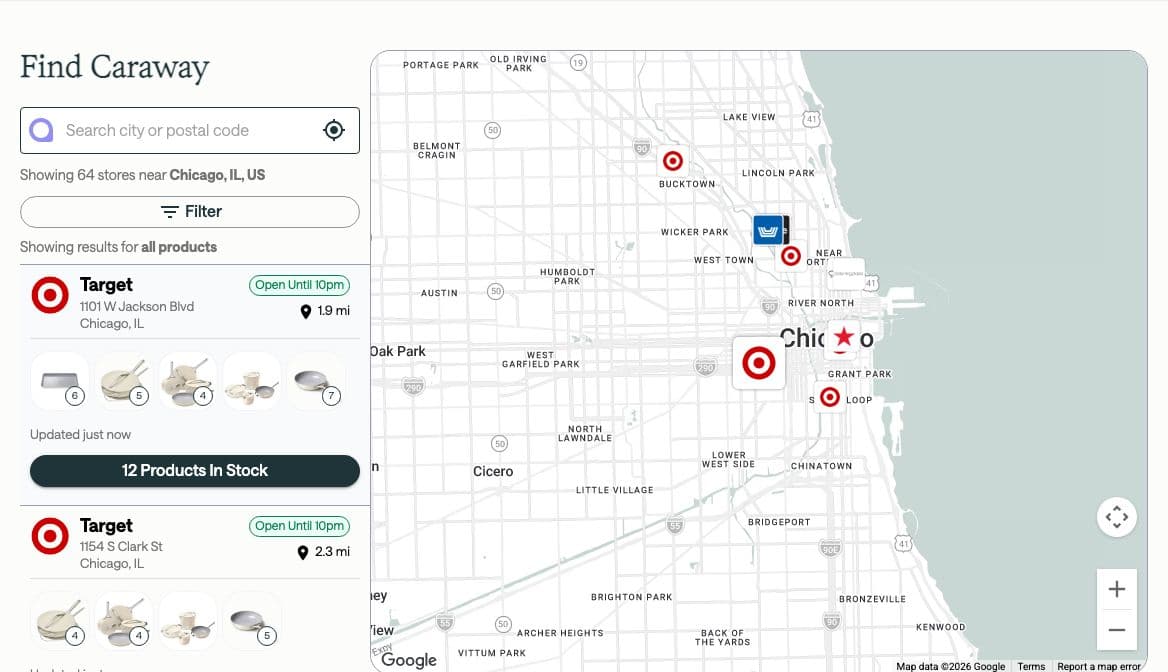
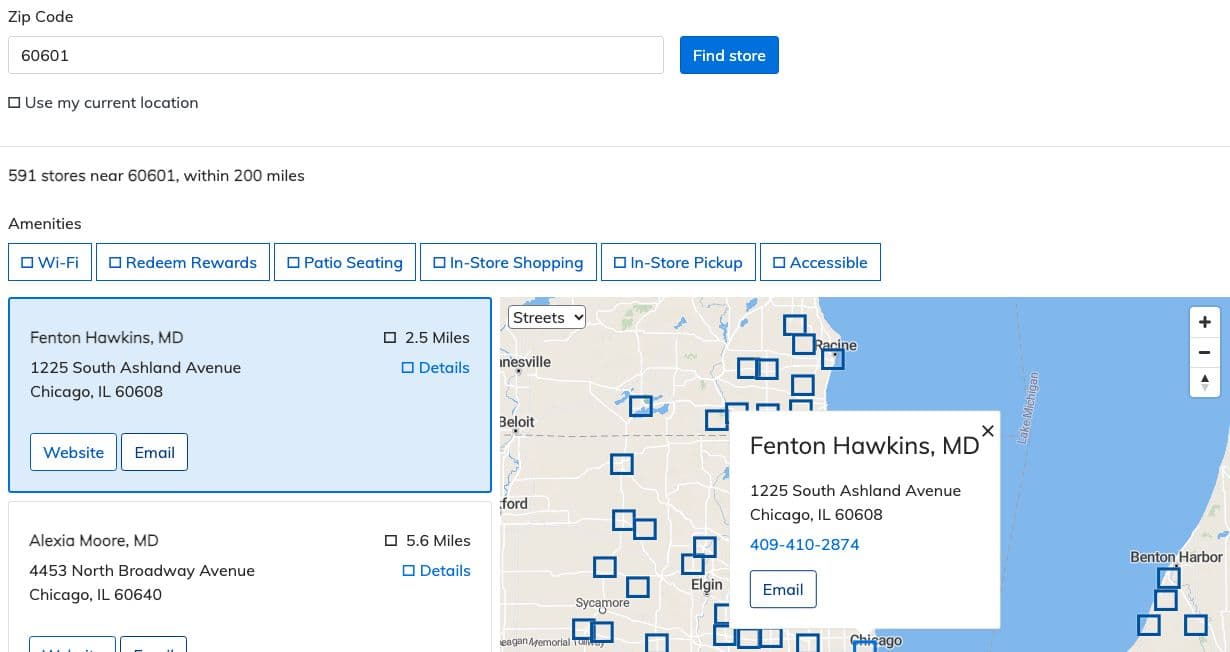
Both store locators as a shopper sees them, captured the same way: a 1280 by 800 browser window placed in Chicago, searching for Chicago. A demo holds whatever sample data its vendor chose, so where that changes what the picture shows, the caption says so. Each shot is trimmed to a common shape here; select one to see all of it.
StoreLocatorsCaptured October 15, 2026 from a live customer site, searching “Chicago, IL”.
StoreLocators · Captured October 15, 2026 from a live customer site, searching “Chicago, IL”.
MetaLocatorCaptured October 15, 2026 from the vendor’s own demo, searching “60601”.
MetaLocator · Captured October 15, 2026 from the vendor’s own demo, searching “60601”.
Pricing, side by side
Both publish. MetaLocator runs $17 to $167 a month on annual billing, or $19 to $199 month to month, across three published tiers with Enterprise above; we start at $195. It is cheaper at every published tier, and its trial is 30 days against our 14.
The comparison worth making is not entry to entry. MetaLocator meters page views and geocodes as well as locations, live chat starts at Growth, and live training and the SLA are Enterprise only.
StoreLocators
Prices published
Three tiers on our Shopify App Store listing, scaling by retail locations: Launch up to 2,000 locations, Grow from 2,000 to 10,000, and Scale above 10,000, at $195, $395 and $995 per month.
Month to month, no long-term contract and no termination fee
Refund available within 30 days of the latest charge
Map included; shopper sessions and map loads are not metered
Free trial documented. A 14-day free trial on every tier.
Sources,
MetaLocator
Prices published
Essential $17 a month billed annually ($19 monthly) for 100 locations, 5,000 page views and 100 geocodes. Growth $41 ($49 monthly) for 10,000 locations, 25,000 page views and 10,000 geocodes. Scale $167 ($199 monthly) for 100,000 locations, 50,000 page views and 100,000 geocodes. Enterprise is quote-only with unlimited traffic and geocodes. Additional users are $19 each.
No free plan; a 30-day trial, the longest in this comparison set
Month-to-month plans bill monthly after the trial
Annual plans are non-refundable and cannot be cancelled; downgrades are not pro-rated
Live chat starts at Growth; live training and the SLA are Enterprise only
White labelling is Enterprise only
Where to Buy, SEO location pages and crowdsourcing are add-ons priced by sales
Free trial documented. 30 days, no credit card required.
Sources,
StoreLocators vs MetaLocator at a glance
Sixteen rows, current as of 15 October 2026. MetaLocator is the strongest product in this comparison set, so several of these rows come down to what each of us publishes rather than to what either can do.
Source 1MetaLocator: homepagemetalocator.com. Reviewed 2026-10-15.Full citationSource 2MetaLocator: pricingmetalocator.com. Reviewed 2026-10-15.Full citationSource 3MetaLocator: terms of usemetalocator.com. Reviewed 2026-10-15.Full citationSource 4MetaLocator: privacy policymetalocator.com. Reviewed 2026-10-15.Full citationSource 5MetaLocator: enterprisemetalocator.com. Reviewed 2026-10-15.Full citationSource 6MetaLocator: Retailer Commitment policymetalocator.com. Reviewed 2026-10-15.Full citationSource 7MetaLocator: Where to Buy softwaremetalocator.com. Reviewed 2026-10-15.Full citationSource 8MetaLocator: location landing pagesmetalocator.com. Reviewed 2026-10-15.Full citationSource 9MetaLocator: featuresmetalocator.com. Reviewed 2026-10-15.Full citationSource 10MetaLocator: demosmetalocator.com. Reviewed 2026-10-15.Full citationSource 11MetaLocator on CapterraCapterra. Reviewed 2026-10-15.Full citationSource 12MetaLocator: web platform integrationsmetalocator.com. Reviewed 2026-10-15.Full citationSource 13MetaLocator: case studiesmetalocator.com. Reviewed 2026-10-15.Full citationSource 14StoreLocators: guarantee, refunds and cancellationstorelocators.com. Reviewed 2026-10-15.Open the sourceFull citationSource 15StoreLocators on the Shopify App StoreShopify App Store. Reviewed 2026-10-15.Open the sourceFull citationSource 16StoreLocators: free retailer store listsstorelocators.com. Reviewed 2026-10-15.Open the sourceFull citation
Monthly, or annual you cannot exitMetaLocator: Contract termsMonth-to-month plans bill monthly once the 30-day trial ends. Annual plans are non-refundable and cannot be cancelled, and downgrades of annual plans are not pro-rated.Sources3. MetaLocator: terms of use2. MetaLocator: pricing
Pricing
$195–$995 per monthStoreLocators: PricingThree tiers on our Shopify App Store listing, scaling by retail locations: Launch up to 2,000, Grow from 2,000 to 10,000, Scale above 10,000.Source15. StoreLocators on the Shopify App Store
$17–$167 a month billed annuallyMetaLocator: PricingEssential, Growth and Scale at $17, $41 and $167 a month on annual billing, or $19, $49 and $199 billed monthly. Enterprise is quote-only.Source2. MetaLocator: pricing
Merchant ratingSame storefront, so these compare. Read with the count.
–Not published by the vendorMetaLocator: Merchant ratingNo Shopify App Store listing.MetaLocator is not sold through Shopify at all, so no listing exists to carry a merchant rating. The nearest public figure is its Capterra profile, 4.9 from 23 reviews.That score comes from software buyers on any platform rather than from Shopify merchants, so it is not comparable with the ratings in this row, and 23 is a small sample. We could not confirm a G2 rating, so none is shown, and its Trustpilot page shows no reviews.Sources1. MetaLocator: homepage11. MetaLocator on Capterra
Yes30-day free trialMetaLocator: Evaluate without a sales callThe longest trial in this comparison set. No free tier.Source2. MetaLocator: pricing
Retailer coverage
Adding a retailer you sell throughThe gap between the retailer list you are sold and the one you actually sell through.
On request, typically within days, at no additional cost
Crawled, imported, or crowdsourcedMetaLocator: Adding a retailer you sell throughThe strongest answer in this comparison set apart from ours. Retailer data can be crawled under the Retailer Commitment policy, imported from your systems, or gathered through a crowdsourcing add-on where outside users claim and edit profiles subject to your approval. No turnaround for adding a new retailer is published.Sources6. MetaLocator: Retailer Commitment policy9. MetaLocator: features
Retailer coverageCoverage only counts where you actually sell.
–Not published by the vendorMetaLocator: Retailer coverageNo network size published.MetaLocator maintains crawled retailer data, which its Retailer Commitment policy exists to govern, but publishes no figure for how many retailers or locations that covers.Source6. MetaLocator: Retailer Commitment policy
Location capA cap you can grow past is a repricing event, not a feature.
Priced by retail locations, not cappedStoreLocators: Location capPlans scale by location count rather than cutting the map off at a number.
100, 10,000, 100,000, then unlimitedMetaLocator: Location capPage views and geocodes are metered alongside locations: Essential 5,000 page views and 100 geocodes a month, Growth 25,000 and 10,000, Scale 50,000 and 100,000, Enterprise unlimited on both. The table describes the page-view figure as the total included in the plan.Source2. MetaLocator: pricing
Data and freshness
Where the store data comes fromThe whole difference. Everything else follows.
Automatic discovery across 205 integrated retailer feedsStoreLocators: Where the store data comes fromNo spreadsheet to maintain. Retailers that stock you are found in their own feeds and appear without you entering them.
Its own crawler, plus your imports and integrationsMetaLocator: Where the store data comes fromGenuine vendor-side acquisition: MetaLocator crawls retailer product directories or takes retailer-provided APIs, under a published policy. Alongside that, CSV import and copy-and-paste on every plan, Google Drive, Airtable and Salesforce from Scale, and Google Business Profile, Google Places, Yext, HubSpot, Dynamics 365, SFTP and S3 on Enterprise only. A Data Management API is Enterprise, or quoted by sales on Growth and Scale.Sources6. MetaLocator: Retailer Commitment policy2. MetaLocator: pricing
Refresh cadenceA locator that sends a shopper to a store that dropped the line costs more trust than it wins.
Retailer feeds, refreshed daily
–Not published by the vendorMetaLocator: Refresh cadenceNo refresh interval published.Scheduled imports run daily on Scale, at 10 tasks, and unlimited with unlimited frequency on Enterprise; on Growth they are quoted by sales. For the crawled retailer data itself no cadence is published anywhere.Sources2. MetaLocator: pricing7. MetaLocator: Where to Buy software
Product-level availabilityWhether the map answers "who has this product" or only "where are the shops".
YesPer product, per variant, per store, filtered to in-stockStoreLocators: Product-level availabilityRetailer-reported rather than a live poll of a physical shelf, which is the honest description of what this category actually has.
SKU-level in-stock status, claimedMetaLocator: Product-level availabilityMetaLocator states SKU-level inventory and in-stock status per location on its Where to Buy line, with a reporting dashboard covering SKU, stock status and pricing. It is a real published capability, sold as a Price Monitoring (Where to Buy) add-on that the plan table prices through sales on Enterprise. What is not published is how often it refreshes or which retailers it covers.Sources7. MetaLocator: Where to Buy software2. MetaLocator: pricing
One line of code, on any websiteMetaLocator: Install pathNo Shopify App Store listing exists, so the Shopify route is pasting a snippet rather than installing an app or theme app block. Guides exist for Shopify, Squarespace, Wix, Weebly, Joomla, Magento, Drupal, WooCommerce and WordPress.Sources1. MetaLocator: homepage12. MetaLocator: web platform integrations
Developer requiredWhether this ships this week or waits for engineering time.
NoNot required
Not for the embed, likely for the restMetaLocator: Developer requiredThe one-line embed needs no developer. MetaLocator advertises hundreds of features and options, and its own reviewers describe the depth of customisation as overwhelming at first, so the configuration is where the time goes.Sources1. MetaLocator: homepage11. MetaLocator on Capterra
–Not published by the vendorMetaLocator: Time to launchNo setup-time figure published.The only related claim covers the embed step: "Install with a one-time copy and paste of a single line of code." No end-to-end configuration time is stated.Source1. MetaLocator: homepage
Who pays for the mapA locator billed per map load has a second invoice attached to it, from Google or Mapbox rather than the vendor.
YesIncludedStoreLocators: Who pays for the mapThe map is part of the subscription. There is no separate Google or Mapbox bill, and shopper sessions are not metered.
–Not verified by usMetaLocator: Who pays for the mapNo MetaLocator page we checked states whether the map cost is bundled or a customer key is required. The plan table meters traffic and geocodes and lists Google Maps as an Enterprise feature, but nothing published says how the map is billed, so this cell is marked unknown.Source2. MetaLocator: pricing
Features
Wholesale self-submissionIndependent stockists rarely appear in any feed. Letting them add themselves is the only way to catch them.
YesSubmit Your Location block
YesCrowdsourcing add-on, with approvalMetaLocator: Wholesale self-submissionOutside users can claim and manage profiles, with the owner approving users and staging edits. MetaLocator has published a case study using it to build a global directory of partner dental labs. It is an add-on priced through sales.Sources9. MetaLocator: features13. MetaLocator: case studies2. MetaLocator: pricing
Support
Support model
Every message reaches Our Customer Success & Onboarding Specialist
Sharply tieredMetaLocator: Support modelEssential gets documentation, a YouTube channel, a monthly performance report and email. Live Chat starts at Growth. Meetings and live training, developer support and the SLA are Enterprise only. One-to-one onboarding is ticked for Enterprise only in the plan table, while the same page says an onboarding specialist is included with Growth and Scale. What support looks like depends on the plan.Source2. MetaLocator: pricing
MetaLocator in its own words
“crawling a product directory, or obtaining data from a retailer provided API”
“SKU-level inventory and in-stock status on a per-location basis”
“Point locations.yourwebsite.com to our servers and you’re live!”
The Retailer Commitment policy is worth reading and worth crediting. It commits to honouring robots.txt, not bypassing CAPTCHAs, identifying the crawler truthfully in its user agent, and giving retailers a way to opt out. Very few vendors that crawl publish a policy at all, let alone one that gives the crawled party an exit.
The SKU-level stock claim is the strongest capability claim in this group. It is also the one with the least detail attached: no refresh interval is published, and no retailer network size, so a buyer cannot tell how current the number is or how many retailers it covers. Those are the two questions we answer with a figure, which is the honest shape of the difference.
Where StoreLocators is different
We publish how current the data is
Retailer feeds, refreshed daily, and a retailer and location count you can check against free downloadable lists. MetaLocator publishes neither a refresh interval for its crawled data nor a network size, so its SKU-level stock claim cannot be evaluated on the two questions that decide whether it is useful.,
A Shopify app, not a snippet in your theme
MetaLocator has no Shopify App Store listing, so installing it means pasting code into your theme. Ours is an app section, installed and updated through Shopify, which survives a theme change and does not need whoever owns the theme to be involved.,
Support and terms do not move with the tier
MetaLocator withholds live chat from Essential, and keeps live training, developer support, white labelling and the SLA for Enterprise. Every message to us reaches a human on every plan, and the terms are the same terms.
You can leave
Month to month, cancel any time, no termination fee, with refunds inside 30 days of the latest charge. MetaLocator’s annual plans are non-refundable, cannot be cancelled, and downgrades are not pro-rated.,
Every row where the table above separates us
Taken from that table rather than written out again, so the two cannot disagree. A row shows up here when we publish an answer and they publish none, or when both answer and ours covers more of the feature. Rows where both sides publish a figure, a price or a rating, stay out: those differ by their content.
Most of the products on this site in MetaLocator’s price bracket are widgets: they draw a map of locations you supply, and the comparison with us is about who maintains the list. MetaLocator does not fit that description, and treating it as though it did would be the easy, dishonest version of this page.
It acquires retailer data itself, by crawling product directories or taking retailer APIs. It claims SKU-level in-stock status per location. On capability it belongs alongside the enterprise where-to-buy platforms rather than alongside a $25 map.,,
So the real difference is narrower. We publish a refresh interval and a retailer count; MetaLocator publishes neither. That is not a claim that its data is worse, because we cannot see it. It is a claim that a buyer cannot check, and being able to check is most of what a comparison page is for.
What each tier withholds
MetaLocator’s $17 entry price, on annual billing ($19 month to month), is the lowest here, and it is worth knowing what it buys. Essential covers 100 locations, 5,000 page views and 100 geocodes a month, with bulk CSV import and copy-paste as the only data sources, and documentation, a YouTube channel, a monthly report and email as the support.
Growth at $41 annual ($49 monthly) adds live chat, custom CSS, lead forms and Google Analytics, but still only CSV and copy-paste as data sources. Scale at $167 ($199) adds Google Drive, Airtable and Salesforce, daily scheduled imports and Zapier. Google Business Profile, Yext, HubSpot, Dynamics 365, SFTP and S3 are Enterprise only.
White labelling, meetings and live training, developer support, the SLA and SOC 2 attestation all sit on the quote-only Enterprise tier. The pattern is worth naming: the things a buyer usually assumes come with the product are the things that move you up the ladder, so the tier ends up chosen by which single item you need rather than by how many locations you have.
The four things MetaLocator does not publish
Four of MetaLocator’s own figures go unanswered on this page rather than answered, and they are worth listing together because each one is a question a buyer will ask on a call.
How often crawled retailer data refreshes. How many retailers or locations that data covers. How long a full setup takes, as opposed to the one-line embed. And whether the map cost is bundled or needs a key of yours, which no page we checked addresses either way.,,,
None of that means the answers are bad. It means they are answers you get from a salesperson rather than from a page, which is a legitimate way to sell software and an awkward one to compare. We publish our refresh cadence, our retailer and location counts, our setup time and our prices, on a page rather than on a call.
One more thing a buyer may want: MetaLocator’s demos page shows sales demos rather than live customer locators, and its portfolio and case studies describe real projects with the clients anonymised, which is common with enterprise clients. Ask for a reference on the call.,
Moving from MetaLocator to StoreLocators
Straightforward on the data, with one commercial caveat worth checking before anything else: if you are on an annual MetaLocator plan, it cannot be cancelled and is non-refundable, so the timing of the move is set by that rather than by the work.
On the data itself, MetaLocator has bulk export and, on Enterprise, a Data Management API, so getting your locations out is not the hard part.
1Check where you are in the termAnnual plans are non-refundable and cannot be cancelled. Find the renewal date first and plan the cutover around it.One look at the invoice
2Export your locationsUse the bulk export, the API if your plan has it, or whichever integration was feeding MetaLocator. Take the custom fields and territory definitions too, so nothing is discovered missing later.Under an hour
3Separate owned locations from retailYour own sites and any independents you track become managed locations. Retail locations arrive from the feeds instead.An hour or so, once
4Turn on your retailersChoose the retailers you sell through from the integrated list. Anything missing is added on request, typically within days, at no extra cost.Minutes, plus our turnaround for anything new
5Install and redirectAdd the app section on Shopify or a script and one div elsewhere, then redirect the old locator URL. If you were using MetaLocator’s location landing pages on your own subdomain, plan where that traffic goes before switching the CNAME.Under 5 minutes on Shopify, longer if landing pages are in play
Frequently asked questions
How much does MetaLocator cost?
Three published tiers plus a quote-only Enterprise. The headline prices are for annual billing: Essential is $17 a month ($19 billed monthly) for 100 locations, 5,000 page views and 100 geocodes. Growth is $41 ($49) for 10,000 locations, 25,000 page views and 10,000 geocodes, and adds live chat. Scale is $167 ($199) for 100,000 locations and adds Google Drive, Airtable and Salesforce imports and daily scheduled imports. White labelling, live training, the SLA and most integrations are Enterprise only. The trial is 30 days with no card, the longest in this comparison set. Annual plans are non-refundable and cannot be cancelled.,
Does MetaLocator find retailers on its own?
Yes, and it is the only product in this comparison set apart from ours that does. MetaLocator runs its own crawler against retailer sites, acquiring data by crawling a product directory or taking a retailer-provided API, governed by a published Retailer Commitment policy that honours robots.txt, does not bypass CAPTCHAs, identifies the crawler truthfully and lets retailers opt out. What it does not publish is how many retailers that covers or how often the data refreshes.
Does MetaLocator show live stock?
It claims SKU-level inventory and in-stock status on a per-location basis on its Where to Buy product line, with reporting on SKU, stock status and pricing. That is a genuine published capability and the strongest in this bracket, sold as an add-on that the plan table prices through sales. No refresh interval is published for it, so how current that status is cannot be established from public pages, and it is worth asking on a call.
What does the MetaLocator entry plan actually include?
Essential at $17 a month on annual billing, or $19 monthly, covers 100 locations, 5,000 page views and 100 geocodes, with bulk CSV import and copy-paste as the only data sources, and documentation, a YouTube channel, a monthly report and email as the support. Live chat starts at Growth. Google Drive, Airtable and Salesforce imports and scheduled imports start at Scale. White labelling, meetings and live training, the SLA and the remaining integrations are Enterprise only. The tier tends to get chosen by which single one of those you need rather than by how many locations you have.
Is MetaLocator on the Shopify App Store?
No. Installation on Shopify is pasting its one-line embed into your theme rather than installing an app or theme app block. It works on any website and has guides for Squarespace, Wix, Weebly, Joomla, Magento, Drupal, WooCommerce and WordPress as well. The trade-off is the usual one for theme code: it does not travel when a theme is replaced, and it puts the change inside the theme.,
What is the best MetaLocator alternative?
MetaLocator is the most capable product in its price bracket, so the honest answer depends on why you are looking. If deep configurability is what you bought it for, territory routing by polygon and landing pages on your own subdomain have no direct equivalent here. If you want the refresh cadence and retailer coverage published rather than described, a Shopify app rather than a code paste, support that is identical on every plan, and a month-to-month agreement you can leave, that is what StoreLocators offers instead. It costs more than any published MetaLocator tier.,
Every MetaLocator claim on this page was taken from metalocator.com, its pricing, features, product, enterprise, policy and terms pages, or its public Capterra listing, and each was checked on 15 October 2026. The sources are listed below with the exact URL we read.,,
Every claim was checked twice against the vendor's own pages before publishing.,,
Four of MetaLocator’s own figures are marked as not published rather than answered: the refresh interval for crawled retailer data, the size of the retailer network, an end-to-end setup time, and whether the map cost is bundled or needs a key of yours. No page we checked addresses any of them. MetaLocator’s demos page shows sales demos, and its portfolio and case studies anonymise their clients. Claims about StoreLocators come from our own public pages and are not separately cited.
Sources
16 sources
Every claim on this page cites the source it came from, with the date we checked it. Sources are named but not linked; search for the title to find the page.
1.MetaLocator: homepagemetalocator.com. Reviewed 2026-10-15.“Install with a one-time copy and paste of a single line of code.”The only setup-effort claim on the site, and it covers the embed step rather than end-to-end configuration. There is no Shopify App Store listing. The homepage claims "over 300 features" while the pricing page claims "over 750 options and features", which is a conflict on their own site and the reason no feature count appears on this page.
2.MetaLocator: pricingmetalocator.com. Reviewed 2026-10-15.Read from the plan-table markup on 15 October 2026. Headline prices are annual-billing rates: Essential $17 ($19 monthly), Growth $41 ($49), Scale $167 ($199), The page displays no annual totals; the only trace of one is an opaque plan identifier in the markup, and 12 × $17 is $204 rather than any figure those identifiers suggest, so none is reported here. Essential: 100 locations, 5,000 page views, 100 geocodes, CSV and copy-paste only, documentation, YouTube, monthly report and email support. Growth: 10,000 locations, 25,000 page views, 10,000 geocodes, adds live chat, custom CSS and lead forms; scheduled imports and the Data Management API are sales-quoted. Scale: 100,000 locations, 50,000 page views, 100,000 geocodes, adds Google Drive, Airtable, Salesforce, Zapier, territories and scheduled imports at 10 tasks daily. Enterprise only: AWS S3, Yext, Google My Business, Google Places, SFTP, HubSpot and Dynamics 365, white labelling, meetings and live training, developer support, one-on-one onboarding, the SLA and SOC 2 attestation. The same page says an onboarding specialist is included with Growth and Scale, which conflicts with its own table. Where to Buy price monitoring, SEO location pages and crowdsourcing are add-ons priced by sales. Trial 30 days, no credit card, no free tier. Google Maps is ticked for Enterprise only, and nothing states whether a customer map key is required. The page also claims over 750 options and features.
3.MetaLocator: terms of usemetalocator.com. Reviewed 2026-10-15.Now served at /policies/terms-of-use/. Source for the annual-plan terms used on this page: "Annual subscription payments are not refundable and cannot be cancelled", and "Downgrades" of annual plans are not pro-rated, while upgrades are. Monthly plans bill after the 30-day trial. The terms also carry a 100% monthly availability guarantee excluding scheduled maintenance, with service credits of 5% of the monthly fee per 30 minutes of downtime.
4.MetaLocator: privacy policymetalocator.com. Reviewed 2026-10-15.The privacy policy is where MetaLocator’s data-handling commitments live. It states that MetaLocator is SOC 2 Type 2 compliant and audited annually by an independent third party.
5.MetaLocator: enterprisemetalocator.com. Reviewed 2026-10-15.“Integrations with GA4, GA360 and more”The enterprise page is where MetaLocator’s analytics and compliance claims live: SOC 2 Type 2, GDPR and CCPA, HIPAA, and accessibility for WCAG and Section 508.
6.MetaLocator: Retailer Commitment policymetalocator.com. Reviewed 2026-10-15.“crawling a product directory, or obtaining data from a retailer provided API”Establishes genuine vendor-side data acquisition rather than customer-supplied import alone. The policy commits to honouring robots.txt, not bypassing CAPTCHAs, identifying the crawler truthfully in its user agent, and offering retailers an opt-out. It implies MetaLocator maintains retailer-sourced data, but no network size is published anywhere.
7.MetaLocator: Where to Buy softwaremetalocator.com. Reviewed 2026-10-15.“SKU-level inventory and in-stock status on a per-location basis”Also describes a reporting dashboard covering SKU, stock status and pricing, and price-history monitoring for MAP violations. The pricing table lists Price Monitoring (Where to Buy) as an add-on priced through sales. No refresh interval or freshness commitment is published for any of it.
8.MetaLocator: location landing pagesmetalocator.com. Reviewed 2026-10-15.“Point locations.yourwebsite.com to our servers and you’re live!”Pages run on a customer-branded subdomain pointed at MetaLocator’s servers, not a metalocator.com subdomain, with a geographic directory of region pages. The pricing table lists SEO Location Pages as an add-on priced through sales.
9.MetaLocator: featuresmetalocator.com. Reviewed 2026-10-15.Names store hours, holiday hours and time zone as content fields, territory support by county, zip code and polygon boundary, and a crowdsourcing feature where users claim and manage profiles, with user approval and staged edits the owner approves.
10.MetaLocator: demosmetalocator.com. Reviewed 2026-10-15.Carries sales demos rather than links to live customer locators. The separate portfolio and case-study pages describe real projects but anonymise the clients. The only named customer seen on the pages read is Square 2 Marketing, quoted in a testimonial.
11.MetaLocator on CapterraCapterra. Reviewed 2026-10-15.4.9 across 23 reviews. Two recurring criticisms are visible on the listing: that support does not cover CSS changes after implementation, which MetaLocator disputes in its public reply, and that the amount of customisation is overwhelming at first. We could not confirm a G2 rating, so none is shown, and its Trustpilot page shows no reviews.
12.MetaLocator: web platform integrationsmetalocator.com. Reviewed 2026-10-15.Lists install guides for Shopify, Squarespace, Wix, Weebly, Joomla, Magento, Drupal, WooCommerce and WordPress. Each is an embed, not a marketplace app.
13.MetaLocator: case studiesmetalocator.com. Reviewed 2026-10-15.Includes a crowdsourcing case study on building a global directory of certified partner dental labs. Clients are described but not named.
14.StoreLocators: guarantee, refunds and cancellationstorelocators.com. Reviewed 2026-10-15.“StoreLocators.com operates on a month-to-month subscription model with no long-term contracts or termination fees.”Also states that a subscription can be cancelled at any time through Account Settings under Billing, and that a refund may be requested within 30 days of the latest charge.
16.StoreLocators: free retailer store listsstorelocators.com. Reviewed 2026-10-15.Publishes 110,516 store locations across 205 retailers as free CSV downloads with addresses, phone numbers, opening hours and coordinates. The counts are taken from the live lists.
110,516+ locations connected
Every ClickDeserves aDestination
Connect your online shoppers to in-stock products at retail stores nearby. In five minutes. With zero maintenance.