Woosmap vs StoreLocators: 2026 Pricing and Comparison
Location API platform, with store locators built from developer APIs
Woosmap is a European location platform sold as a stack of developer APIs: store search, address autocomplete, geocoding, routing, geofencing and indoor mapping, which an engineering team assembles into whatever it needs, including a store locator. Brands look for a Woosmap alternative when the locator was the only piece they wanted, or when the stores that matter belong to third-party retailers rather than to them. StoreLocators is compared against every major where-to-buy platform on our hub.,
Last reviewed
The short answer
Woosmap sells the location APIs an engineering team builds a locator from, using store data you supply. StoreLocators is a finished product locator that finds the retailers carrying your products for you.
What each product is designed to do, in its own terms. A capability named on one side is not a claim that the other lacks it, and neither column ranks the two: the table below is where they are compared row by row.
What Woosmap is built for
The locations you are mapping are your own stores, and you already have that dataset.
You are buying for a European retail organisation, and EU hosting with no personal data collected are procurement requirements.
You need address autocomplete and validation at checkout, geocoding, routing, geofencing or indoor wayfinding as well as a locator.
You have in-house or agency engineering capacity and want APIs to build against rather than a packaged app.
You are replacing Google Maps Platform and want published per-request rates and a free tier to estimate against.
You are on Salesforce Commerce Cloud or BigCommerce, or you run Yext, Partoo or Localistico for presence management.
If two or more of these describe your team, a product locator built for third-party retail is not what you are shopping for. We would rather say that here than after another thousand words.
What StoreLocators is built for
You sell through other people’s shops and do not have the store list a location API expects you to supply.
You need retailer-reported product availability without sourcing or maintaining it yourself.
You sell in the US, Canada, UK or Australia and need a locator live this week.
You are on Shopify, or you can drop a script on any other site, and have no developer time to spend.
You want availability badges on product pages and retail reporting by retailer, product and region.
A flat bill matters more than a metered one, and published contract terms matter more than a feature list.
StoreLocators and Woosmap, side by side
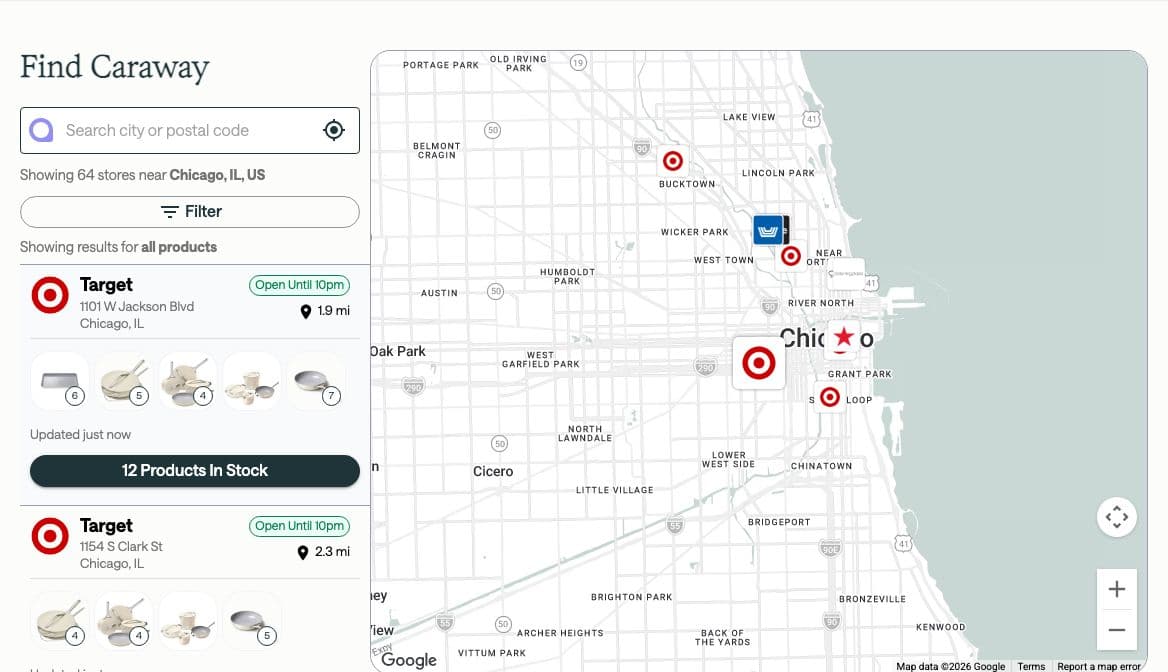
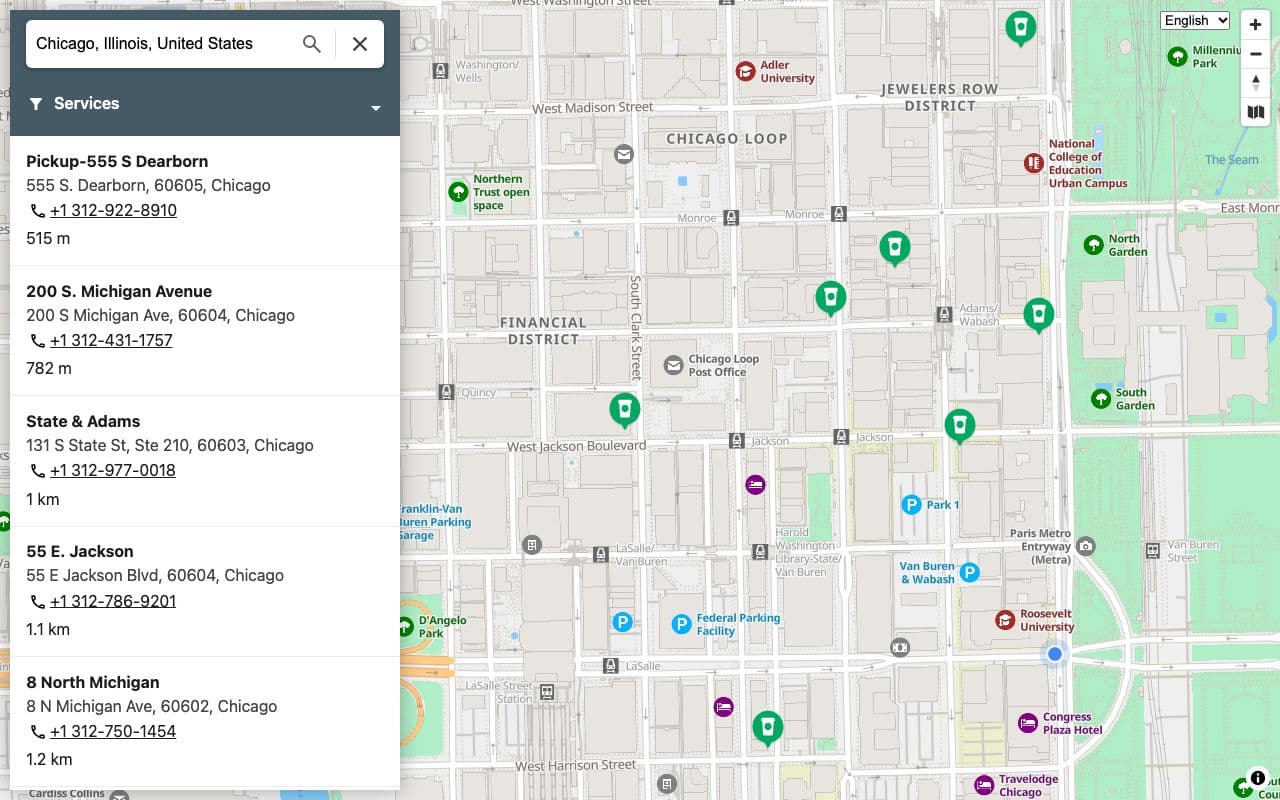
Both store locators as a shopper sees them, captured the same way: a 1280 by 800 browser window placed in Chicago, searching for Chicago. A demo holds whatever sample data its vendor chose, so where that changes what the picture shows, the caption says so. Each shot is trimmed to a common shape here; select one to see all of it.
StoreLocatorsCaptured October 15, 2026 from a live customer site, searching “Chicago, IL”.
StoreLocators · Captured October 15, 2026 from a live customer site, searching “Chicago, IL”.
WoosmapCaptured October 15, 2026 from the vendor’s own demo, searching “Chicago, IL”.
Woosmap · Captured October 15, 2026 from the vendor’s own demo, searching “Chicago, IL”.
Pricing, and what each vendor publishes
Woosmap publishes more than most vendors in this comparison, and it should get credit for that. There is a free tier of up to 10k API requests a month with no credit card, three named plans, an interactive usage simulator in euros that shows the Pro cost per 1,000 requests for each public volume tier, and a page listing the Enterprise credit cost of every call type: 0.1 credit for a Store Search asset search, 1 credit for a map load showing your assets, 2 credits for an asset write, nothing at all for an autocomplete suggestion.,
So a Pro bill can be estimated from public information, as long as your volumes sit inside the public tiers. What is not published is Enterprise pricing, or what an Enterprise credit costs in currency, so above those tiers the total is a sales conversation. Woosmap also quotes example per-1,000 rates in dollars in one of its own comparison blog posts; we treat those as illustrative rather than as a rate card.,,
StoreLocators publishes its prices too: $195, $395 and $995 a month on our Shopify App Store listing, each with a 14-day free trial, and the terms behind them take about a minute to check. Woosmap publishes the terms behind Pro as well: monthly billing on consumption, cancellation through an “Unsubscribed” button, and 30 days’ notice on any price revision. What it does not publish is the Enterprise price, the currency value of a credit, or any Enterprise contract terms. That is a statement about what is published, not a criticism of the number.,
StoreLocators
Prices published
Launch $195, Grow $395 and Scale $995 per month on the Shopify App Store listing, tiered by retail locations, each with a 14-day free trial.
Month-to-month subscription, no long-term contract
No termination fees
Cancel any time in Account Settings, with access through the end of the billing period
Refund available within 30 days of the latest charge
Flat subscription: shopper sessions and map loads are not metered
Free trial documented. A 14-day free trial on every tier, with access to every retailer integration.
Sources
Woosmap
Prices published
Woosmap publishes a free tier of "Up to 10k FREE API requests / month", Pro rates per 1,000 requests for each public volume tier in its pricing simulator (in euros), and the Enterprise credit cost of each API call. It publishes no Enterprise price and no currency value for a credit.
Three plans: Free, Pro with access to four public pricing tiers, and Enterprise
Enterprise inclusions named on the pricing page: flexible licensing, volume-based discounts, data caching options, a 99.9% SLA, a dedicated Customer Success Manager, implementation health checks and proactive budget monitoring
Billing is per API request: pay as you go on Pro, and in credits on an Enterprise licence
Pro can also be bought through AWS Marketplace
Pro contract terms are published in the Online Terms of Service: monthly consumption billing, termination by either party, and 30 days’ notice on price revisions
Enterprise contract length, minimum commitment and notice period are not published
Free trial documented. Up to 10,000 API requests a month, free, with no credit card, covering Store search, Localities, Map, Distance and Indoor. Whether the tier is permanent, and whether any time-limited Pro trial exists, is not published.
Sources,
StoreLocators vs Woosmap at a glance
Every Woosmap cell below comes from Woosmap’s own site, its developer documentation, its public status page, a dated acquisition report or a public review listing, all checked on 15 October 2026. Where they publish nothing, the cell says so rather than guessing.,,
Source 1Woosmap: homepagewoosmap.com. Reviewed 2026-10-15.Full citationSource 2Woosmap: retail use caseswoosmap.com. Reviewed 2026-10-15.Full citationSource 3Woosmap: pricingwoosmap.com. Reviewed 2026-10-15.Full citationSource 4Woosmap: online terms of servicewoosmap.com. Reviewed 2026-10-15.Full citationSource 5Woosmap: credit costs per API callwoosmap.com. Reviewed 2026-10-15.Full citationSource 6Woosmap: Google Maps API pricing breakdown (blog)woosmap.com. Reviewed 2026-10-15.Full citationSource 7Woosmap developer docs: Data Managementdevelopers.woosmap.com. Reviewed 2026-10-15.Full citationSource 8Woosmap developer docs: Stores API data managementdevelopers.woosmap.com. Reviewed 2026-10-15.Full citationSource 9Woosmap developer docs: Store Locator Widget sample usagedevelopers.woosmap.com. Reviewed 2026-10-15.Full citationSource 10Woosmap: store locator use casewoosmap.com. Reviewed 2026-10-15.Full citationSource 11Woosmap: store locator product pagewoosmap.com. Reviewed 2026-10-15.Full citationSource 12Woosmap: Stores API product pagewoosmap.com. Reviewed 2026-10-15.Full citationSource 13Woosmap: connectorswoosmap.com. Reviewed 2026-10-15.Full citationSource 14Woosmap: Salesforce Commerce Cloud store locator cartridgewoosmap.com. Reviewed 2026-10-15.Full citationSource 15Woosmap: Google Maps API alternatives (blog)woosmap.com. Reviewed 2026-10-15.Full citationSource 16Woosmap: two ways to implement a product locator (blog)woosmap.com. Reviewed 2026-10-15.Full citationSource 17Woosmap developer docs: Localities address coveragedevelopers.woosmap.com. Reviewed 2026-10-15.Full citationSource 18Woosmap: public status pagestatus.woosmap.com. Reviewed 2026-10-15.Full citationSource 19Woosmap: companywoosmap.com. Reviewed 2026-10-15.Full citationSource 20Datasharp acquires French geolocation specialist Woosmap (November 2025)manda.be. Reviewed 2026-10-15.Full citationSource 21Datasharp snaps up Woosmap (Silicon Canals, November 2025)Silicon Canals. Reviewed 2026-10-15.Full citationSource 22Woosmap reviews on CapterraCapterra. Reviewed 2026-10-15.Full citationSource 23Woosmap: how to add a store locator to Shopify (blog)woosmap.com. Reviewed 2026-10-15.Full citationSource 24StoreLocators: guarantee, refunds and cancellationstorelocators.com. Reviewed 2026-09-09.Open the sourceFull citationSource 25StoreLocators on the Shopify App StoreShopify App Store. Reviewed 2026-09-09.Open the sourceFull citationSource 26StoreLocators: free retailer store listsstorelocators.com. Reviewed 2026-09-09.Open the sourceFull citation
Feature
Pricing and proof
StoreLocators vs Woosmap at a glance
Feature
Pricing and proof
Contract termsWhat you can find out before you sign, rather than after.
Month to month, no long-term contract, no termination feeStoreLocators: Contract termsCancel in Account Settings. Refund within 30 days of the latest charge.Source24. StoreLocators: guarantee, refunds and cancellation
Pro is month to month and cancellable in the productWoosmap: Contract termsWoosmap’s public Online Terms of Service put Pro on monthly pay-on-consumption billing, charged on the last day of each month for the queries made that month, with either party able to terminate and the client doing so through a dedicated “Unsubscribed” button on the platform. The plan then ends on the last day of that month. Price revisions take at least 30 days’ written notice. Enterprise terms are negotiated and not published.Source4. Woosmap: online terms of service
PricingWhat you can work out before a sales call, and what you cannot.
$195–$995 per monthStoreLocators: PricingThree tiers on our Shopify App Store listing, scaling by retail locations: Launch covers up to 2,000, Grow covers 2,000 to 10,000, and Scale covers 10,000 and above. Every tier carries a 14-day free trial.Source25. StoreLocators on the Shopify App Store
Free tier and Pro per-request rates publishedWoosmap: PricingWoosmap publishes a free tier of up to 10k API requests a month, and its pricing-page simulator gives Pro rates in euros per 1,000 requests for each public volume tier. Enterprise is a sales conversation, billed in credits whose currency value is not published.Sources3. Woosmap: pricing5. Woosmap: credit costs per API call
Billing modelWhether the bill tracks your traffic or stays flat as the locator gets busier.
Per API request: pay as you go on Pro, credits on EnterpriseWoosmap: Billing modelPro is priced per 1,000 requests by volume tier. An Enterprise licence counts credits per call: Store Search asset search 0.1 credit, a map load showing your assets 1 credit, an asset write 2 credits, autocomplete free. What a credit costs is not published.Sources5. Woosmap: credit costs per API call3. Woosmap: pricing
Free entry point
Yes14-day free trialStoreLocators: Free entry pointOn every tier.
YesUp to 10k free API requests a month, no credit cardWoosmap: Free entry pointCovers Store search, Localities, Map, Distance and Indoor. Whether the free tier is permanent, and whether a Pro trial exists, is not published.Source3. Woosmap: pricing
Retailer coverage
Adding a new retailer or locationDistribution changes faster than any vendor roadmap does.
On request, typically within days, at no additional cost
You add it yourselfWoosmap: Adding a new retailer or locationLocalistico, Partoo and Yext are the documented sync options. Via the REST API, the console, or a presence-management connector.Sources10. Woosmap: store locator use case13. Woosmap: connectors
Retailer networkCoverage only counts where you actually sell.
CountriesTwo different meanings of coverage sit in this row. Read both cells.
USA, CAN, UK, AUSStoreLocators: CountriesRetailer integrations, with store-level availability.
Rooftop address data in 71 countriesWoosmap: CountriesPremium national datasets in France, the UK, Ireland and Poland. This is address coverage for your own locations, not retailer coverage.Source17. Woosmap developer docs: Localities address coverage
Data and freshness
Where the store data comes fromThe whole difference. Everything else is downstream.
Automatic discovery across 205 integrated retailer feeds
Locations you supplyWoosmap: Where the store data comes fromWoosmap’s public documentation describes customer-supplied assets only. Whether bespoke data services exist under an Enterprise contract is not published. Posted to the Stores API with a server-side private key.Sources7. Woosmap developer docs: Data Management10. Woosmap: store locator use case
Refresh cadenceA locator that sends a shopper to an empty shelf costs more trust than it wins.
Retailer feeds, updated dailyStoreLocators: Refresh cadenceAvailability is retailer-reported. It is not a live poll of a physical shelf.
Ecommerce platform integrationsWhich stack each product was built to drop into.
Shopify app, or a script installStoreLocators: Ecommerce platform integrationsThe script install covers headless and non-Shopify sites.Source25. StoreLocators on the Shopify App Store
Wholesale self-submissionIndependents and non-integrated chains are where emerging brands lose coverage.
YesSubmit Your Location block
–Not verified by usWoosmap: Wholesale self-submissionNo self-service submission portal for wholesale accounts is documented. The published routes into the dataset are the API, the console and presence-management connectors.Sources10. Woosmap: store locator use case13. Woosmap: connectors
Retail performance reportingWhether the platform tells you how retail is doing, or how the API is doing.
Availability and engagementStoreLocators: Retail performance reportingBroken down by retailer, product and region.
–Not verified by usWoosmap: Retail performance reportingNo retail sell-through or availability reporting product is documented on the Woosmap pages we reviewed. Enterprise plans do include proactive budget monitoring of API usage.Sources12. Woosmap: Stores API product page3. Woosmap: pricing
Availability badges on product pagesConverts the shopper already looking at the product.
YesRetail Trust Badges
Buildable with Store Search, from your own stock dataWoosmap: Availability badges on product pagesNo ready-made badge is documented, but Woosmap lists "displaying stock availability on product page according to the user’s location" as a Store Search use case. The stock values are attributes on store records you supply.Sources12. Woosmap: Stores API product page16. Woosmap: two ways to implement a product locator (blog)
Address autocomplete and validation at checkoutAn entire product category that one of these two platforms does not sell.
Every message reaches Our Customer Success & Onboarding SpecialistStoreLocators: Support modelMost replies come the same business day.
Dedicated CSM on EnterpriseWoosmap: Support modelFree includes documentation and community support, Pro adds customer support teams, and Enterprise adds a dedicated Customer Success Manager and a 99.9% SLA. No response times are published. Capterra reviewers rate Customer Service 4.8 out of 5 across 34 reviews.Sources3. Woosmap: pricing1. Woosmap: homepage22. Woosmap reviews on Capterra
What Woosmap is, in their own words
“The location platform for digital commerce. Location that converts.”
“large, multi-brand, multi-country retailers where location touches ecommerce, mobile apps, store operations, marketing, and logistics”
“Data Management is designed for server-side workflows.”
“does not collect, process, or store any personal data from your users”
Read those four lines together and the product is clear. Woosmap is sold to large retailers with in-house engineering, for whom location touches several systems at once, and it is built so that your data stays yours and your users’ data is never collected at all. That is a coherent and genuinely differentiated position in a market dominated by Google Maps Platform.,
It also explains why this comparison is not feature for feature. The store data in a Woosmap locator is data the customer posts to the Stores API, so the product assumes you know where your locations are. A brand sold through third-party retail does not, and that single assumption is what separates the two platforms far more than any row in the table below.,
Where StoreLocators is different
We find the retailers. You do not supply them
Woosmap’s documented model is that you POST your own locations to the Stores API with a server-side private key. StoreLocators discovers which retailers already carry your products across 205 retailer integrations and 110,516 locations. If you are a brand sold through third-party retail, you do not have that dataset and building it is the project.
Availability you do not have to source
A Woosmap product locator filters stock attributes that already sit on the store records you maintain, so the data problem stays yours. StoreLocators surfaces retailer-reported availability, refreshed daily from retailer feeds and re-checked while the shopper browses. Nobody on your team sources or maintains it.
No theme code, and no data pipeline
Install from the Shopify App Store, drag the Live Retail Map section into your theme, and it runs against your catalogue. Non-Shopify sites get a script and a single div. Woosmap’s Shopify route has you paste a JavaScript file, a CSS file and a section into your theme code, with your stores loaded into the Woosmap Console first. Elsewhere it is a script tag, an API key and a JavaScript config object, and keeping a changing store list current means a server-side pipeline into the Stores API.,,,
Prices and commercial terms are both published
Month to month, no long-term contract, no termination fee, cancel any time in Account Settings, and a refund window of 30 days from the latest charge. Woosmap publishes a free tier, Pro per-request rates and Enterprise credit costs, which is more than most vendors here, but no contract length, minimum commitment or overage policy.,
A flat bill rather than a metered one
Woosmap bills per API call, per 1,000 requests on Pro and in credits on Enterprise: every map load, every store search, every asset write. That is a clean model and it is published in detail, but a locator that gets busy costs more than one that does not. StoreLocators is a flat subscription and does not meter shopper sessions. Which model suits you depends on your traffic, not on which vendor you like.,
Retail reporting rather than API reporting
Availability and locator engagement broken down by retailer, product, store and region, which is what a sales team asks for before a retailer review. Woosmap’s Enterprise plan includes proactive monitoring of your API budget. Both are useful. They answer different questions.
Conversion surfaces on the pages you already have
Retail Trust Badges put availability on the product page itself, unlimited map instances can be filtered by retailer or product line for co-branded landing pages, and a wholesale portal lets stockists add their own location, with KeHE, UNFI and Faire imports behind it. With Woosmap, each of those placements is something your team wires up.
Every row where the table above separates us
Taken from that table rather than written out again, so the two cannot disagree. A row shows up here when we publish an answer and they publish none, or when both answer and ours covers more of the feature. Rows where both sides publish a figure, a price or a rating, stay out: those differ by their content.
StoreLocators: Retail Trust Badges|Woosmap: Buildable with Store Search, from your own stock data
Where the store data comes from
This is the row that decides the whole comparison, so it is worth being precise. Woosmap’s Data Management API documents the shape plainly: you send your locations to api.woosmap.com/stores with storeId, name and location mandatory, all write operations require a private key and are strictly server-side, and batch imports are capped at 15MB at up to 10 queries per second. It is a good API. It is also an API that assumes you already have the data.,
For a retailer mapping its own shops, that assumption is correct and the product is a strong fit. Carrefour knows where its stores are. For a CPG or D2C brand sold through third-party retail, it is the entire problem. You do not have a clean list of every Kroger, Whole Foods and independent grocer carrying your SKUs, and assembling one is the project you were hoping to buy your way out of.
StoreLocators works from the other end. Retailer discovery runs against your catalogue across 205 integrated retailers and 110,516 locations, and availability is retailer-reported, updated daily from those feeds and re-checked while the shopper browses. Nobody on your side POSTs anything.
One thing we will not claim: that Woosmap cannot do this. Its public documentation describes customer-supplied assets only, and we found no public evidence either way about bespoke data services under an Enterprise contract. If a retailer feed matters to you, ask them directly rather than trusting a comparison page, including this one.
Retailer coverage compared
The word coverage means two different things in this comparison, and conflating them would flatter us unfairly. Woosmap documents rooftop-precision address data in 71 countries, with premium national datasets in France, the United Kingdom through Royal Mail PAF, Ireland through Eircode and Poland. That is geocoding and address quality for locations you already own.
StoreLocators covers 205 retailers across 110,516 locations in the United States, Canada, the United Kingdom and Australia. That is a smaller map and a different one: retailers that report which of your products are on their shelves. Four markets against 71 countries looks lopsided until you notice the two numbers are not counting the same thing.
The practical test takes a minute. If your locations are shops with your name over the door, Woosmap covers far more of the world than we do. If your locations are other people’s shops, Woosmap’s country count does not help, because it still needs you to supply the list of which shops those are.,
Setup and time to launch
Woosmap’s one published time figure is for Shopify. Its guide, published in August 2026, puts adding the widget to a theme at about ten minutes once you have a public key and your stores in the Console, and says you do not need to be a developer to follow it. The route is a custom theme section: you paste a JavaScript file, a CSS file and a section definition into the theme code editor. Off Shopify, the Store Locator Widget needs a script tag for webapp.js, a container element, an API key and a JavaScript configuration object, initialised and rendered in code. Deeper layouts move to the Map JS API. Store data arrives through the console one location at a time, a server-side pipeline, or a presence-management connector.,,,
For a handful of your own stores, that is a manageable job. For a store list that changes, keeping it current is engineering work: a pipeline into the Stores API, scheduled against everything else in the sprint, and it recurs every time the dataset or the configuration changes. That is a reasonable trade for a retailer with in-house developers and a five-year location roadmap. It is a poor trade for a five-person brand team that wanted a locator live before a retail launch.
StoreLocators is a different shape rather than a faster version of the same thing. Install the app, drag the Live Retail Map section into your theme, and discovery runs against your catalogue. Under five minutes, no developer, and a documented script install for headless and non-Shopify sites.
What a Woosmap alternative actually replaces
Teams reach this question from two directions. Either the locator is the only piece of the platform they wanted and the rest of the stack is capacity they are paying an engineer to maintain, or they have realised they are buying an API when what they needed was a dataset. Both are real reasons to look, and both point at a focused product locator.
The switch stops being simple the moment Woosmap is doing a second job. Address autocomplete and validation at checkout, geocoding, routing, geofenced push and indoor wayfinding are five things no store locator performs, and pulling Woosmap out takes all of them with it. If any of those is load-bearing, this is a procurement exercise with several vendors in it rather than a swap.,
The clean case is narrow and common: a brand sold through third-party retailers, on Shopify or a headless site, that has been quoted an engineering project to build a locator on top of location APIs and does not have the store list that project assumes. There the comparison is not close, and it has nothing to do with which platform is better built.
Switching from Woosmap
Moving off Woosmap is less a migration than a subtraction, and how big it is depends entirely on how many of its APIs you are using. If the only thing you built was a store locator, this is small. If Localities is validating addresses at checkout, it is not.
Work that out before anything else. A store locator does not replace address autocomplete, geocoding, routing, geofenced push or indoor mapping, and this section is not going to pretend it does.
1Inventory which Woosmap APIs you actually callYour console usage and credit consumption will show it faster than asking around. Store Search and Map are in scope for this switch. Localities, Distance, Geolocation, Geofencing and Indoor are not, and each one needs its own answer before you cancel anything.An hour with the console open
2Export your store dataset before you do anything elseEverything in the Stores API is data you supplied, so it is yours, but it lives behind that API. Pull it out with a GET against api.woosmap.com/stores, including custom properties, opening hours and geofences, and keep it. You may not need it, and you will be glad you have it.An afternoon for a developer
3Install alongside, not insteadPut StoreLocators on a staging theme or a single product page and let retailer discovery run while Woosmap is still live. You are comparing real coverage on your own catalogue rather than a demo dataset, and for a brand sold through third-party retail the two lists will not look alike.Under 5 minutes to install
4Check coverage against your real retail listCompare what discovery found against your actual distribution. Request any missing retailers, which are typically added within days at no additional cost, and bring independents and non-integrated chains in through the wholesale portal.Days, not weeks
5Move the embeds and retire the pipelineSwap the widget on your locator page and your product pages, then decommission the server-side job that was writing to the Stores API. Keep the URLs exactly as they are so nothing you have already earned in search moves.
6Give notice properlyOn Pro, Woosmap’s published terms let either party terminate and the plan ends on the last day of that month, so there is no notice period to serve. On Enterprise, read your own agreement: those terms are negotiated and unpublished. If you are on the free tier there is nothing to cancel.Depends on your agreement
Frequently asked questions
What is Woosmap used for?
Woosmap is a European location platform that describes itself as the location platform for digital commerce. It sells developer APIs, including Store Search, Localities for address autocomplete and geocoding, Map, Distance and routing, Geolocation, Geofencing, Transit and Indoor, which engineering teams assemble into store locators, product locators, checkout address capture and geofenced messaging. It is bought mainly by retailers mapping their own store estates, and by teams that want an EU-hosted alternative to Google Maps Platform.,
How much does Woosmap cost, and is there a free version?
Woosmap publishes a free tier of up to 10,000 API requests a month with no credit card, covering Store search, Localities, Map, Distance and Indoor. Pro is pay as you go: the pricing page’s simulator gives a cost per 1,000 requests in euros for each public volume tier, so a Pro estimate can be worked out from public information. Enterprise requires contacting sales and is billed in credits; Woosmap publishes the credit cost of each API call but not what a credit costs in currency.,
Do I need a developer to set up the Woosmap Store Locator Widget?
It depends on the route. Woosmap’s Shopify guide says you do not need to be a developer to follow it: you add your stores in the Woosmap Console, then paste a JavaScript file, a CSS file and a section into your theme code, which it puts at about ten minutes. On other sites the widget needs a script tag for webapp.js, a container element, an API key and a JavaScript configuration object, and deeper customisation moves to the Map JS API. Every API write to your store dataset requires a private key and is strictly server-side, so keeping a large or changing store list in sync is developer work.,,
How do I get my store locations into Woosmap?
You supply them. Woosmap’s Data Management API takes POST, GET, PUT and DELETE requests at api.woosmap.com/stores, with storeId, name and location mandatory, batch imports capped at 15MB, and an atomic replace operation for swapping a whole dataset without downtime. You can also edit locations one at a time in the Woosmap Console, or sync them from Yext, Partoo or Localistico. Woosmap does not source store data for you.,,
Does Woosmap have a Shopify app?
No. Woosmap’s own Shopify guide adds the Store Locator Widget as a custom theme section instead, and says "No app to install. Nothing from the App Store." Its connectors page names a Salesforce Commerce Cloud cartridge, a BigCommerce Address Finder, Localistico, Partoo and Yext for presence management, and Airship, Salesforce Marketing Cloud and Batch for messaging.,
Is Woosmap GDPR compliant, and where is my data hosted?
Woosmap states that it is privacy-first and 100% EU-hosted, and that it does not collect, process, or store any personal data from your users, by architecture rather than by configuration. It positions this as removing a compliance burden compared with providers routing data through US infrastructure. That is Woosmap’s own published claim, reviewed on 15 October 2026, and it is worth confirming in writing during a procurement review.
Who acquired Woosmap?
Belgian data-intelligence group Datasharp acquired Woosmap in late November 2025. The reports we read give no deal value. Woosmap continues as an independent brand within the group, with founder Jean-Thomas Rouzin remaining as CEO, and Datasharp is backed by Strada Partners and also owns Infobel and Techsalerator. Nothing public commits either way on whether the acquisition changes Woosmap’s pricing, roadmap or EU-only data processing.,
What is the best Woosmap alternative for a brand sold through third-party retailers?
It depends on who owns the store data. Woosmap expects you to supply your locations, which suits a retailer mapping its own shops. A brand sold through other people’s shops usually wants the opposite, and a Woosmap alternative such as StoreLocators discovers which retailers carry your products across 205 retailer integrations and 110,516 locations in the US, Canada, UK and Australia, with retailer-reported availability. If you also need address capture or geocoding, no locator replaces that.
Every Woosmap claim on this page was taken from woosmap.com, developers.woosmap.com, the public Woosmap status page, a dated report of the Datasharp acquisition or a public review listing, and each one was opened and checked on 15 October 2026. The sources are listed below with the exact URL we read.,,
Where Woosmap publishes nothing, this page says so instead of estimating. That applies to the Enterprise price, the currency value of a credit, Enterprise contract terms, time to launch outside Shopify, and whether the free tier is permanent. Three different customer counts are public, 220+ on the homepage, 300+ in trade press and 600+ on the company page, so each is cited to its own source and date rather than reconciled into one number.,,,
Claims about StoreLocators are held to the same standard and come from our own public pages, linked in the same list so you can check them the same way. Where a claim of ours is checkable against a third party, such as our published prices and plan tiers on the Shopify App Store, the source is listed alongside the rest.
Sources
26 sources
Every claim on this page cites the source it came from, with the date we checked it. Sources are named but not linked; search for the title to find the page.
1.Woosmap: homepagewoosmap.com. Reviewed 2026-10-15.“The location platform for digital commerce.”Also the source for the headline figures: 220+ Enterprise customers, 28B+ location calls per year, 800M+ addresses and POIs, and a 99.9% Enterprise SLA. Frames the product around acquisition (local SEO), engagement (store search) and conversion (address capture). Named customers displayed include Holland & Barrett, Kingfisher, Carrefour, Decathlon, Accor, TotalEnergies, Kia, Leroy Merlin, El Corte Inglés and Givenchy.
2.Woosmap: retail use caseswoosmap.com. Reviewed 2026-10-15.“large, multi-brand, multi-country retailers where location touches ecommerce, mobile apps, store operations, marketing, and logistics”Names Sephora, Lacoste, Carrefour, B&Q and Holland & Barrett as retailers using Woosmap; logos shown include Decathlon, Fatboy, Fendi, Givenchy, L’Oréal and Lacoste.
3.Woosmap: pricingwoosmap.com. Reviewed 2026-10-15.“Up to 10k FREE API requests / month”Three plans: Free (no credit card required, documentation and community support, covering Store search, Localities, Map, Distance and Indoor), Pro ("Access to 4 Public Tiers of pricing", customer support teams, also sold through AWS Marketplace) and Enterprise ("Flexible Licensing Options", "Volume-based Discounts", "Data Caching options", "99.9% SLA", a dedicated Customer Success Manager, implementation health checks and proactive budget monitoring). The interactive usage simulator, in euros, gives a monthly cost estimate per API and a "Detailed Pricing" table of the cost per 1,000 requests for each public tier. For example, Store Search requests are free to 10k a month and then €0.52 per 1,000 up to 100k, and map loads are €2.58 per 1,000 from 10k to 100k. No Enterprise price appears.
4.Woosmap: online terms of servicewoosmap.com. Reviewed 2026-10-15.“When the termination is initiated by the Client: by following the procedure made available to the Client on the Platform via a dedicated “Unsubscribed” button.”The published terms behind the Pro plan. Billing is monthly on consumption, "automatically charged each month on the last day of the current month, of the prices corresponding to the number of queries performed in the given month". Either party may terminate; a terminated Pro plan "will terminate at the end of the last day of the month in which the termination occurred". Price revisions require the provider to "inform the Client at least 30 days in advance". Enterprise terms are negotiated separately and do not appear here.
5.Woosmap: credit costs per API callwoosmap.com. Reviewed 2026-10-15.Credits are "pooled in the same counter for your Enterprise licence". Publishes the credit cost of each call type: Store Search asset search 0.1 credit, asset creation, update or deletion 2 credits, mapping assets 1 credit per map load (a bare basemap is 0.5); Localities autocomplete 0 credits ("no charge on suggestions"), address details 2 to 10 credits, geocoding 1 to 7 credits; Geolocation 0.4 credits; Distance route 0.5 credits; static map 0.15 credits. What a credit costs in currency is not published.
6.Woosmap: Google Maps API pricing breakdown (blog)woosmap.com. Reviewed 2026-10-15.Woosmap describes its own billing as per-request, priced per 1,000 requests, and quotes example rates of $2.87 per 1,000 map loads, $2.04 per 1,000 geocoding requests, $2.04 per 1,000 Distance Matrix elements and $6.95 per 1,000 Localities Details, with autocomplete free at all volumes. Treated throughout this page as illustrative figures from a comparison blog post, not as a current contractual rate card.
7.Woosmap developer docs: Data Managementdevelopers.woosmap.com. Reviewed 2026-10-15.“Data Management is designed for server-side workflows where you need to populate, maintain, and synchronize your location data.”Store data is supplied by the customer through POST, GET, PUT and DELETE on https://api.woosmap.com/stores, with storeId, name and location mandatory. All write operations require a private key and are strictly server-side. Batch imports are capped at 15MB with a maximum of 10 queries per second per project.
8.Woosmap developer docs: Stores API data managementdevelopers.woosmap.com. Reviewed 2026-10-15.Documents full CRUD in batch plus an atomic replace operation for swapping an entire dataset without downtime. Assets can be visualised through the Store Locator Widget in the Woosmap Console.
9.Woosmap developer docs: Store Locator Widget sample usagedevelopers.woosmap.com. Reviewed 2026-10-15.Installing the widget requires a script tag for https://webapp.woosmap.com/webapp.js, a container element, an API key, and a JavaScript configuration object initialised with new window.WebApp("map", "YOUR_API_KEY"), then webapp.setConf(storeLocatorConfig) and webapp.render(...).
10.Woosmap: store locator use casewoosmap.com. Reviewed 2026-10-15.Three implementation paths: the Store Locator Widget ("A ready-made locator that takes very little coding to configure"), the Map JS API for building the front end yourself, or the Stores API called directly. Store data can be loaded by REST API for bulk updates, edited one location at a time in the Woosmap Console, or synced through presence-management connectors.
11.Woosmap: store locator product pagewoosmap.com. Reviewed 2026-10-15.“the base map, the colors and the point of interest icons follow your brand identity”Documents live opening-hours display, filtering, driving directions via the Distance API, and multilingual support. The product and use-case pages state 15 languages; other Woosmap-sourced material says over 20, so no language count is asserted on this page.
12.Woosmap: Stores API product pagewoosmap.com. Reviewed 2026-10-15.States that the console supports thousands of locations (or assets) and that some clients host up to 80,000 businesses, with single-store edits in the console, custom properties, advanced filtering and geofence-triggered events. Its FAQ lists "displaying stock availability on product page according to the user’s location" as a Store Search use case. Marketing page rather than documentation, so the figures are treated as vendor-stated.
13.Woosmap: connectorswoosmap.com. Reviewed 2026-10-15.Published connectors are a Salesforce Commerce Cloud Store Locator Cartridge (SFRA-compatible, configured in Business Manager), Localistico, Partoo and Yext for presence management, a BigCommerce Address Finder, and Airship, Salesforce Marketing Cloud and Batch for messaging. No Shopify connector or app appears in the list.
14.Woosmap: Salesforce Commerce Cloud store locator cartridgewoosmap.com. Reviewed 2026-10-15.“check availability of products in stock and increase curbside pickup revenues”The cartridge bundles Store Locator, Product Locator, Delivery Pickup Points and geofenced push notifications through Salesforce Marketing Cloud.
15.Woosmap: Google Maps API alternatives (blog)woosmap.com. Reviewed 2026-10-15.“does not collect, process, or store any personal data from your users”Also states "Privacy-first, 100% EU-hosted", qualifies the no-personal-data claim as holding by architecture rather than by configuration, and positions this as removing a compliance burden versus providers routing data through US infrastructure.
16.Woosmap: two ways to implement a product locator (blog)woosmap.com. Reviewed 2026-10-15.Describes a product locator as a chain of Woosmap APIs: Localities for manual location entry or Geolocation for IP-based positioning, then Store Search sorted by distance to return stores where stock is available, plus Distance Matrix and Map. Availability is filtered from attributes on store records the customer has already supplied.
17.Woosmap developer docs: Localities address coveragedevelopers.woosmap.com. Reviewed 2026-10-15.The rooftop-precision table lists 71 countries, including the United States, Canada, the United Kingdom and Australia, with premium national datasets in France (French National Address DB), the United Kingdom (Royal Mail PAF), Ireland (Eircode ECAD) and Poland. UK and Ireland premium data requires a Pro or Enterprise licence.
18.Woosmap: public status pagestatus.woosmap.com. Reviewed 2026-10-15.Lists seven separately monitored services, all operational when checked on 15 October 2026: Localities, Store Search, Geolocation, Distance, Address, Map and Indoor APIs. The breakdown is the useful part, since it shows which parts of the platform are treated as independent products.
19.Woosmap: companywoosmap.com. Reviewed 2026-10-15.“Today, we support more than 600 clients across the world, with a significant presence in Europe and North America”Names KIA, Lacoste, Givenchy, Total Energies, Yves Rocher, Nandos and Leroy Merlin. The 600+ figure conflicts with the 220+ on the homepage and the 300+ reported in trade press, so this page may be stale. Each figure is cited to its own source rather than reconciled.
20.Datasharp acquires French geolocation specialist Woosmap (November 2025)manda.be. Reviewed 2026-10-15.Dated 26 November 2025: Belgian data-intelligence group Datasharp has acquired Woosmap. No deal value is given. Woosmap continues as an independent brand within the group, CEO Jean-Thomas Rouzin remains in post, and Datasharp is backed by Strada Partners and also owns Infobel and Techsalerator. Reports Woosmap as founded in 2009 in Montpellier by Mathias Fliti and Jean-Thomas Rouzin.
21.Datasharp snaps up Woosmap (Silicon Canals, November 2025)Silicon Canals. Reviewed 2026-10-15.Reports Woosmap as headquartered in Montpellier with offices in Paris, London and Madrid, approaching €10M ARR, processing over 27 billion API queries in the prior year at a 99.99% service level, and serving 300+ clients. Figures as reported in November 2025.
22.Woosmap reviews on CapterraCapterra. Reviewed 2026-10-15.“The prices are quite high compared to the competition, we think that a cheaper "plan" is missing”Overall rating 4.7 out of 5 from 34 verified reviews, Ease of Use 4.6, Customer Service 4.8, checked on 15 October 2026. Capterra lists no starting price. Praise centres on cost relative to Google Maps ("We can implement more features that we could at the same cost of using Google Maps in the past") and support responsiveness; criticism centres on price, API breadth ("Their API is not as complete as the Google Maps one (they lack some POIs)") and "occasional inconsistencies in location accuracy, particularly in rural or less densely populated areas".
23.Woosmap: how to add a store locator to Shopify (blog)woosmap.com. Reviewed 2026-10-15.“No app to install. Nothing from the App Store, no extra subscription tied to the feature.”Published 18 August 2026. Adds the Store Locator Widget to any Online Store 2.0 theme as a custom theme section in five steps (a JavaScript asset, a CSS asset and a section created in the theme code editor, then the section added to a page with a public key), "in about ten minutes". States "You do not need to be a developer to follow it". Prerequisites: theme-code access and a Woosmap public key, with stores added in the Woosmap Console.
24.StoreLocators: guarantee, refunds and cancellationstorelocators.com. Reviewed 2026-09-09.“StoreLocators.com operates on a month-to-month subscription model with no long-term contracts or termination fees.”Also states that a subscription can be cancelled at any time through Account Settings under Billing, and that a refund may be requested within 30 days of the latest charge.
26.StoreLocators: free retailer store listsstorelocators.com. Reviewed 2026-09-09.Publishes 110,516 store locations across 205 retailers as free CSV downloads with addresses, phone numbers, opening hours and coordinates. The counts are taken from the live lists.
110,516+ locations connected
Every ClickDeserves aDestination
Connect your online shoppers to in-stock products at retail stores nearby. In five minutes. With zero maintenance.