Dynamic Store Locator vs StoreLocators: 2026 Pricing and Comparison
Shopify locator that builds its store list from wholesale orders
Dynamic Store Locator is the only product in this comparison that builds the store list on its own: retailers who buy from you through Faire or Shopify B2B are added automatically, verified against Google, and hidden again if they stop ordering. That is a genuinely good idea, and it also means the map shows your order history rather than the retail landscape. This page covers what the automation catches and what it misses.
Last reviewed
The short answer
If your entire wholesale channel runs through Faire or Shopify B2B, this is the closest thing in the category to a dealer map that maintains itself, at $50 a month. We are the better buy when retailers reach you through distributors, buying offices or history that predates those platforms, and when a shopper needs to know which store has a product.
What each product is designed to do, in its own terms. A capability named on one side is not a claim that the other lacks it, and neither column ranks the two: the table below is where they are compared row by row.
What Dynamic Store Locator is built for
Faire or Shopify B2B is how essentially all your wholesale is placed
You would rather the map filled itself than be maintained
Retailers who stop buying should come off the map on their own
You are on Shopify, in English, and that is the whole requirement
Fifty dollars a month for unlimited locations is the deciding factor
Check the six-month hide rule against how your slowest-reordering stockists actually buy before turning it loose.
What StoreLocators is built for
Distributors or buying offices sit between you and the shelf
Long-standing accounts predate your wholesale platform
Shoppers need to know which store has a product, not just which stores exist
Chain coverage needs to mean carried here rather than located here
You want per-location pages, analytics or an API later
A retailer that is still selling your stock should not disappear for ordering slowly
StoreLocators and Dynamic Store Locator, side by side
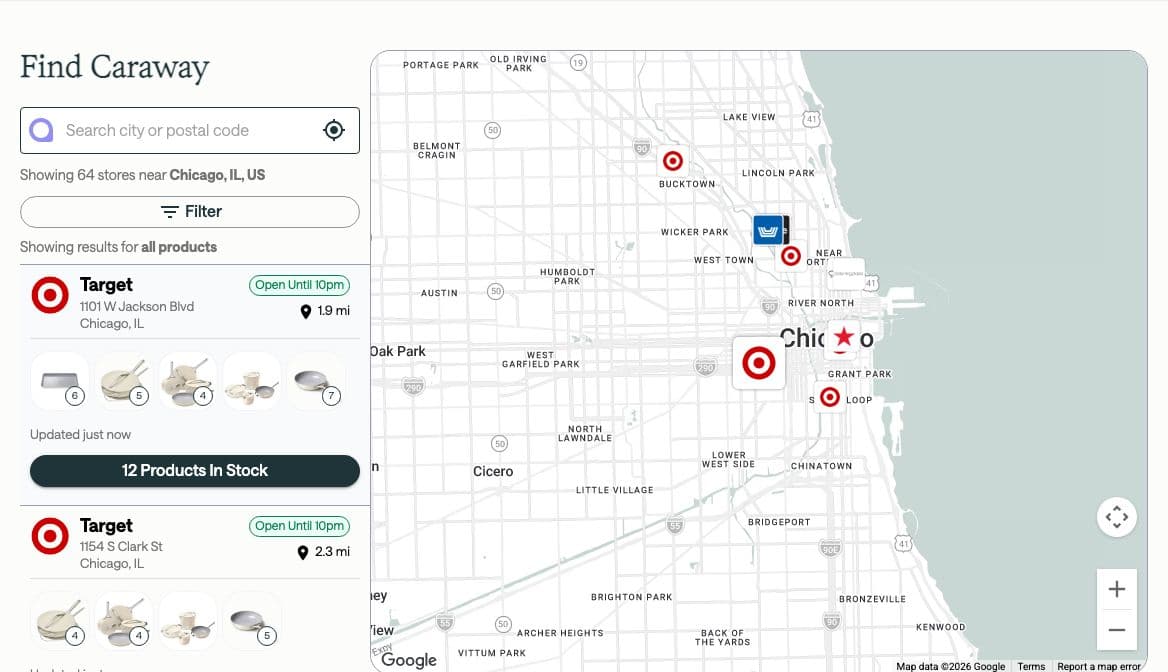
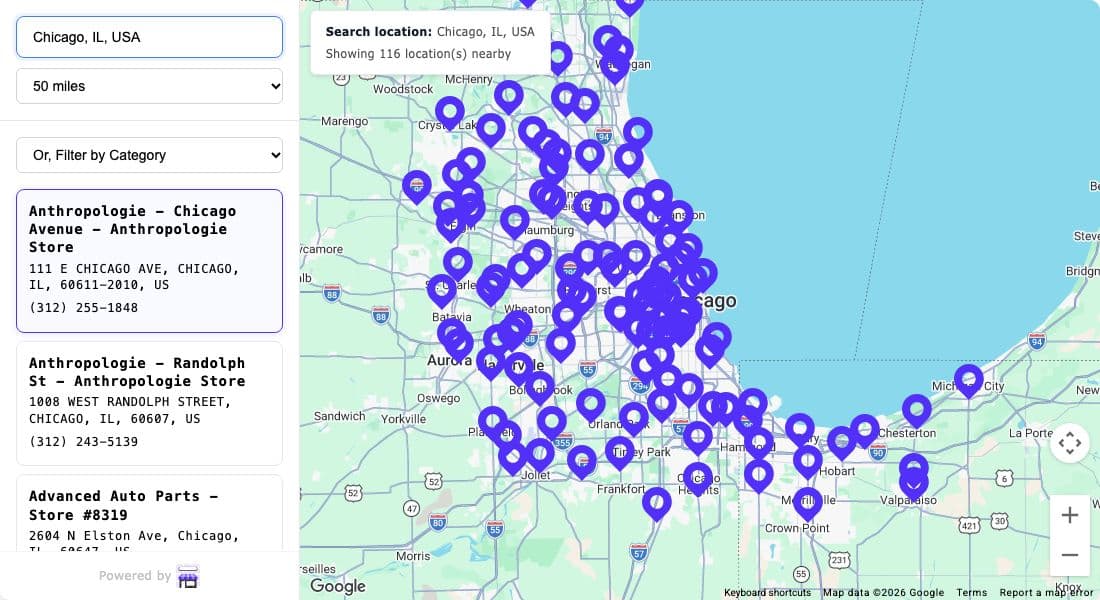
Both store locators as a shopper sees them, captured the same way: a 1280 by 800 browser window placed in Chicago, searching for Chicago. A demo holds whatever sample data its vendor chose, so where that changes what the picture shows, the caption says so. Each shot is trimmed to a common shape here; select one to see all of it.
StoreLocatorsCaptured October 15, 2026 from a live customer site, searching “Chicago, IL”.
StoreLocators · Captured October 15, 2026 from a live customer site, searching “Chicago, IL”.
Dynamic Store LocatorCaptured October 15, 2026 from the vendor’s own demo, searching “Chicago, IL”.
Dynamic Store Locator · Captured October 15, 2026 from the vendor’s own demo, searching “Chicago, IL”.
Pricing, side by side
A wide gap in price, and the honest reason is coverage rather than features.
They price an app that reads two order platforms you already use. We price retailer availability data across a retail network you have no account with, refreshed daily. If your wholesale genuinely runs through Faire, most of what we charge for is work you do not need doing.
StoreLocators
Prices published
Three tiers on our Shopify App Store listing, scaling by retail locations: Launch up to 2,000 locations, Grow from 2,000 to 10,000, and Scale above 10,000, at $195, $395 and $995 per month.
Month to month, no long-term contract and no termination fee
Refund available within 30 days of the latest charge
Map included; shopper sessions and map loads are not metered
Free trial documented. A 14-day free trial on every tier.
Sources,
Dynamic Store Locator
Prices published
Three plans, identical on the Shopify listing and the vendor site: Basic free at 10 locations, Advanced at $30 a month for up to 1,500 with the Faire and Shopify B2B integrations and CSV import and export, and Business Plus at $50 a month for unlimited locations plus the 30+ national chain dataset and priority support.
The free plan is permanent rather than a trial; paid plans carry a 7-day trial
Hard caps with no overage or usage charges
Customer supplies their own Google Maps API key; the vendor notes Google’s free allowance covers up to 10,000 map views a month
No refund, cancellation or contract terms are published; billing follows Shopify
A Powered by badge appeared on the live install we viewed, and no branding-removal option is listed on any plan
Free trial documented. A 7-day trial on both paid plans, plus a permanent free plan at 10 locations.
Sources,,
StoreLocators vs Dynamic Store Locator at a glance
Sixteen rows on one review date. The first row is the whole comparison: this is the only other product here that discovers locations rather than being told them, and where it looks is the difference.
Source 1Dynamic Store Locator on the Shopify App StoreShopify App Store. Reviewed 2026-10-15.Full citationSource 2H1 Apps: Dynamic Store Locatorh1-apps.com. Reviewed 2026-10-15.Full citationSource 3Dynamic Store Locator reviews on the Shopify App StoreShopify App Store. Reviewed 2026-10-15.Full citationSource 4H1 Web Development: terms of useh1webdev.com. Reviewed 2026-10-15.Full citationSource 5A live merchant install of Dynamic Store Locatorapollaperformance.com. Reviewed 2026-10-15.Full citationSource 6StoreLocators: guarantee, refunds and cancellationstorelocators.com. Reviewed 2026-10-15.Open the sourceFull citationSource 7StoreLocators on the Shopify App StoreShopify App Store. Reviewed 2026-10-15.Open the sourceFull citationSource 8StoreLocators: free retailer store listsstorelocators.com. Reviewed 2026-10-15.Open the sourceFull citation
Feature
Pricing and proof
StoreLocators vs Dynamic Store Locator at a glance
–Not published by the vendorDynamic Store Locator: Contract termsNo billing or cancellation terms published.The vendor’s terms of use address only that prices and availability may change without notice. No refund, cancellation or contract language appears anywhere, so billing follows Shopify.Source4. H1 Web Development: terms of use
Pricing
$195–$995 per monthStoreLocators: PricingThree tiers on our Shopify App Store listing, scaling by retail locations: Launch up to 2,000, Grow from 2,000 to 10,000, Scale above 10,000.Source7. StoreLocators on the Shopify App Store
Free–$50 per monthDynamic Store Locator: PricingIdentical on the Shopify listing and the vendor site, with no legacy-plan or grandfathering language. Faire and Shopify B2B sync start on the $30 plan; the national chain dataset and priority support are on the $50 plan.Sources1. Dynamic Store Locator on the Shopify App Store2. H1 Apps: Dynamic Store Locator
Merchant ratingSame storefront, so these compare. Read with the count.
5.0Dynamic Store Locator: Merchant rating5.0 from 8 reviews on Shopify App Store.Eight is a very small sample, and the launch date is what makes it readable: the listing went up in August 2025, so this is a normal record for a young app rather than a thin one. All eight are five-star with nothing negative on record, but three come from merchants who had used the app for two days or less. That speaks to onboarding rather than to whether the sync stays correct over a year.Sources1. Dynamic Store Locator on the Shopify App Store3. Dynamic Store Locator reviews on the Shopify App Store
Yes7-day trial, and a free plan at 10 locationsDynamic Store Locator: Evaluate without a sales callThe free plan is permanent rather than a countdown, though 10 locations is a demonstration rather than a working dealer map.Source1. Dynamic Store Locator on the Shopify App Store
Retailer coverage
Adding a retailer you sell throughThe gap between the retailer list you are sold and the one you actually sell through.
On request, typically within days, at no additional cost
Automatic, if they bought through Faire or Shopify B2BDynamic Store Locator: Adding a retailer you sell throughA qualifying wholesale order adds the retailer with no work at all, which nothing else in this comparison does. A retailer reaching you through a distributor, a buying office, a trade show order or an email is not in either platform and has to be added by hand.Source2. H1 Apps: Dynamic Store Locator
Retailer coverageCoverage only counts where you actually sell.
30+ national chains, toggled by stateDynamic Store Locator: Retailer coverageA vendor-maintained dataset of major retailers that you switch on for the states where you sell. The underlying records are read-only, so an address or phone number that is wrong stays wrong. It says where the chain has stores rather than which of them carry your product.Source2. H1 Apps: Dynamic Store Locator
Location capA cap you can grow past is a repricing event, not a feature.
Priced by retail locations, not cappedStoreLocators: Location capPlans scale by location count rather than cutting the map off at a number.
10 free, 1,500, then unlimitedDynamic Store Locator: Location capHard caps with no overage rate. Passing 1,500 locations means the top plan at $50 rather than a metered charge.Source1. Dynamic Store Locator on the Shopify App Store
Data and freshness
Where the store data comes fromThe whole difference. Everything else follows.
Automatic discovery across 205 integrated retailer feedsStoreLocators: Where the store data comes fromNo spreadsheet to maintain. Retailers that stock you are found in their own feeds and appear without you entering them.
Your Faire and Shopify B2B order history, plus a chain datasetDynamic Store Locator: Where the store data comes fromRetailers who order through those two channels are added automatically with their company details, alongside a vendor list of 30+ national chains you toggle on by state. Anything reaching you another way is a manual entry or a CSV row.Source2. H1 Apps: Dynamic Store Locator
Refresh cadenceA locator that sends a shopper to a store that dropped the line costs more trust than it wins.
Retailer feeds, refreshed daily
On every qualifying order, and after six months of noneDynamic Store Locator: Refresh cadenceA new wholesale customer appears when they buy. A retailer who has not ordered in six months is hidden automatically, whether or not they still have stock on the shelf.Source2. H1 Apps: Dynamic Store Locator
Product-level availabilityWhether the map answers "who has this product" or only "where are the shops".
YesPer product, per variant, per store, filtered to in-stockStoreLocators: Product-level availabilityRetailer-reported rather than a live poll of a physical shelf, which is the honest description of what this category actually has.
NoNot offeredDynamic Store Locator: Product-level availabilityNo product or inventory feature appears in any vendor material. The app-store listing carries a product-type filter, which sorts locations by category rather than telling a shopper what is in stock.Sources1. Dynamic Store Locator on the Shopify App Store2. H1 Apps: Dynamic Store Locator
A Shopify app blockDynamic Store Locator: Install pathDescribed as no-code, with a free install assistance meeting offered rather than a paid implementation fee. Shopify only.Source2. H1 Apps: Dynamic Store Locator
Developer requiredWhether this ships this week or waits for engineering time.
NoNot required
NoNot requiredDynamic Store Locator: Developer requiredThe vendor offers to walk through the install on a call at no charge.Source2. H1 Apps: Dynamic Store Locator
–Not published by the vendorDynamic Store Locator: Time to launchNo setup time published.Neither surface states a figure. The install is a no-code app block, and how long the first sync takes to populate a map is not documented.Source2. H1 Apps: Dynamic Store Locator
Who pays for the mapA locator billed per map load has a second invoice attached to it, from Google or Mapbox rather than the vendor.
YesIncludedStoreLocators: Who pays for the mapThe map is part of the subscription. There is no separate Google or Mapbox bill, and shopper sessions are not metered.
NoYour own Google Maps keyDynamic Store Locator: Who pays for the mapStated as a requirement for the map to display correctly. The vendor pairs it with the point that Google’s free allowance covers up to 10,000 map views a month, which for a small merchant means the practical cost is often nothing.Source2. H1 Apps: Dynamic Store Locator
Features
Wholesale self-submissionIndependent stockists rarely appear in any feed. Letting them add themselves is the only way to catch them.
YesSubmit Your Location block
NoNo self-submission formDynamic Store Locator: Wholesale self-submissionThere is no route for a stockist to add themselves, which follows from the design: retailers are meant to arrive through an order rather than an application.Source2. H1 Apps: Dynamic Store Locator
Support
Support model
Every message reaches Our Customer Success & Onboarding Specialist
Tickets, a help centre and free install meetingsDynamic Store Locator: Support modelA ticket form, a support widget on the website, a help centre, a contact page, and free installation meetings. Only priority support is plan-gated, to the top tier. No response-time commitment is published.Source2. H1 Apps: Dynamic Store Locator
Dynamic Store Locator in its own words
“Automatically sync customers who buy from you through Shopify B2B including all their company information.”
“If a retailer hasn't purchased from you in 6 months or more, the app will automatically hide them from your map.”
The first quote is the good idea, and it is a real one. Most brands maintain a stockist spreadsheet whose only source of truth is the order system nobody thought to connect to it. This connects it.
The second is the same idea in reverse, and it cuts both ways. A retailer who dropped the line disappears without anyone noticing, which is good. A retailer who bought six months of stock and has not needed to reorder disappears too, while your product sits on their shelf.
Where StoreLocators is different
We look at retail, they look at your orders
Their discovery is your Faire and Shopify B2B history, which is exactly right for retailers who buy that way and blind to everyone else: distributors, buying offices, trade-show orders, long-standing accounts that predate the platforms. We discover retailers that stock you across integrated retailer feeds, refreshed daily, regardless of how the product reached the shelf.
Six months of quiet is not the same as gone
Their rule hides a retailer who has not ordered in six months. A shop that bought a year of stock, or orders seasonally, or is simply slow, disappears from the map while your product is sitting on their shelf. Ours reflects what retailer feeds show is being carried rather than when a purchase order was last raised.
Chains you can trust the detail of
Their 30+ chain dataset is toggled by state and read-only: a wrong address or phone number cannot be corrected by you, and switching a chain on says the chain has stores in your states rather than that those stores carry your line. Ours is retailer-level coverage with per-product, per-variant, per-store availability behind it.,
Things a growing brand asks for later
No per-location pages for search, no documented public API, Shopify only, English only, and a Powered by badge on the live install we viewed, with no removal option listed on any plan. At $50 a month those are reasonable trades. They are the list of what you will want next.,
Every row where the table above separates us
Taken from that table rather than written out again, so the two cannot disagree. A row shows up here when we publish an answer and they publish none, or when both answer and ours covers more of the feature. Rows where both sides publish a figure, a price or a rating, stay out: those differ by their content.
StoreLocators: Submit Your Location block|Dynamic Store Locator: No self-submission form
What the automation can and cannot see
This is the one competitor in the set that shares our starting premise: a store list a human maintains is a store list that is wrong. Where the two products differ is where they look for the truth.
Dynamic Store Locator looks at your outbound orders. If a shop bought from you on Faire last month, it is on the map. That is a strong signal and it is free of the errors that come from typing. It is also a complete answer only if every retailer carrying your product bought it from you, directly, on one of two platforms.
For most brands past a certain size, that is not the case. Distributors buy in bulk and place product in shops you never invoice. Chains buy through a central office, so one order becomes 300 stores that the sync sees as one customer. Accounts that predate your move onto Faire have no record in it. And a retailer who bought heavily and has not reordered for seven months is hidden by the six-month rule while the product is still on their shelf.
We look at the other end: retailer feeds, refreshed daily, showing what is being carried and where, regardless of how it got there. Neither view is complete on its own. Theirs is exactly right for a Faire-native brand and progressively blinder as the channel diversifies.
The national chain list, and what switching it on says
The top plan adds a vendor dataset of more than thirty major national retailers, which you enable per chain and restrict to the states where your product is sold.
Two things follow from how it works. The records are read-only: you can add a custom popup message on a chain, but an address, phone number or URL that is out of date cannot be corrected by you, and there is no route to fix it for the shoppers who hit it.
And what the toggle asserts is geographic rather than commercial. Enabling a chain in a state puts every one of that chain’s stores in that state on your map. It does not know which of them stocks your product, and a shopper who drives to one because your map showed it is relying on that inference holding. Availability at the store level is a different kind of data with a different kind of cost behind it.
A one-year-old app, read fairly
The listing shows 5.0 from eight reviews, and the app launched in August 2025. Read without the date, eight reviews looks thin. Read with it, it is a normal record for a product a little over a year old, and every review is positive.,
The one qualifier worth carrying: three of the eight come from merchants who had been using the app for two days or less. Those are real reviews and they say something real about onboarding. They cannot say anything about whether the sync stays correct over a year, because nobody has had a year yet.
The reviews that do run longer point at the same thing the vendor sells: retailers appearing and disappearing automatically as a time saver, and hands-on help with the integrations. The vendor is a division of a Denver Shopify agency, with a second app listed as coming soon.,
Moving from Dynamic Store Locator to StoreLocators
Easy on the mechanics and worth thinking about on the substance, because this is the one product here that may be doing something you want to keep.
If Faire and Shopify B2B are a meaningful part of your channel, that sync is genuinely useful. The question is whether it is the whole picture or part of one.
1Export what the sync builtCSV export is available on the paid plans, so the retailer list the automation assembled comes out as a file. Take it before cancelling: it is the record of which wholesale customers passed the Google Business check.Minutes
2Work out what the automation was missingCompare the exported list against your actual stockist list. The gap is the retailers reaching you through distributors, buying offices or older accounts, and it is the reason to be looking at this at all.An hour, and worth it
3Turn on your retailersChoose the retailers you sell through from the integrated list. Anything missing is added on request, typically within days, at no extra cost. Wholesale customers not covered by a feed become managed locations.Minutes, plus our turnaround for anything new
4Install and redirectAdd the app section on Shopify, then redirect the old locator page URL. Remove the H1 app block from the theme rather than leaving it in place unused.Under 5 minutes on Shopify
5Cancel, and retire the Maps keyUninstall through Shopify, since no vendor billing or refund terms are published. Then delete or restrict the Google Maps API key that was serving the old locator.Minutes
Frequently asked questions
How much does Dynamic Store Locator cost?
Three plans, priced identically on the Shopify listing and the vendor site: Basic is free for up to 10 locations, Advanced is $30 a month for up to 1,500 and adds the Faire and Shopify B2B integrations plus CSV import and export, and Business Plus is $50 a month for unlimited locations plus the 30+ national chain dataset and priority support. Caps are hard with no overage charges. Not in the price: your own Google Maps API key, though the vendor notes Google’s free allowance covers up to 10,000 map views a month.,
How does the Faire and Shopify B2B sync work?
A retailer that places a wholesale order through either platform is added to your map automatically, with their company information. Their shipping address is checked against Google to confirm it belongs to a public, open-for-business retail location, and by default wholesale customers without a Google Business listing are excluded so warehouses and home addresses do not appear; the vendor says that check can be switched off in settings. A retailer who has not ordered in six months or more is hidden again automatically.
Will it find retailers who do not buy through Faire?
No. The discovery is your order history on those two platforms, so a retailer buying through a distributor, a chain buying through a central office, or a long-standing account that predates your move onto Faire will not appear on its own. Those have to be added manually or by CSV. For a brand whose wholesale genuinely runs through Faire and Shopify B2B, that is a small gap. For one with a distributor channel, it is most of the map.
What is the national retailer list on the top plan?
A vendor-maintained dataset of more than thirty major chains that you switch on per chain and limit to the states where your product sells. Two things are worth knowing: the records are read-only, so an out-of-date address or phone number cannot be corrected by you, and enabling a chain puts all of that chain’s stores in your states on the map. It tells a shopper where the chain has stores rather than which of them carry your product.
Is Dynamic Store Locator any good?
It holds 5.0 from eight reviews, all five-star, on a listing that launched in August 2025, which makes that a normal record for a young app rather than a thin one. Three of the eight come from merchants who had used it for two days or less, so nothing in the record speaks to how the sync behaves over a year. The recurring themes are the automatic adding and hiding of retailers as a time saver, and hands-on help from the team through the integrations. The vendor is a division of a Denver Shopify agency.,,
What is the best Dynamic Store Locator alternative?
Nothing else in this category syncs a dealer map from Faire and Shopify B2B orders, so if that is the feature you want there is no close substitute. If the problem is that the automation only sees retailers who buy from you directly on those platforms, or that shoppers want to know which store has a product rather than which stores exist, that is what StoreLocators does instead: retailer feeds refreshed daily regardless of how the product reached the shelf, per-product and per-store availability, and the map included. It costs many times more.,
Every claim about Dynamic Store Locator on this page was taken from its Shopify App Store listing and review page, the H1 Apps product page, or the H1 Web Development terms of use, and each was checked against the live page on 15 October 2026. A live merchant install was also viewed to confirm the search interface and the branding. The sources are listed below with the exact URL we read.,,
Every claim was checked twice against the vendor’s own pages before publishing.,
The rating on this page always appears with the launch date, because eight reviews means something different for an app a year old than for one that has been shipping for a decade. Three of those eight come from installs of two days or less, which is stated wherever the record is discussed. Claims about StoreLocators come from our own public pages and are not separately cited.
Sources
8 sources
Every claim on this page cites the source it came from, with the date we checked it. Sources are named but not linked; search for the title to find the page.
1.Dynamic Store Locator on the Shopify App StoreShopify App Store. Reviewed 2026-10-15.As of 15 October 2026, the listing carried a Built for Shopify badge and read 5.0 from 8 reviews. Three plans: Basic free at up to 10 locations with custom search filters and Google Maps integration, Advanced at $30 a month for up to 1,500 locations adding Shopify B2B and Faire integrations and bulk CSV import and export, and Business Plus at $50 a month for unlimited locations adding major retailer locations and priority support. Both paid plans carry a 7-day free trial; the free plan is permanent. No overage or usage charges appear. Works with Shopify Admin, Faire and Google Maps; Shopify only, English only. The listing launched on 13 August 2025. Its facet-tag list includes a product-type filter, which sorts locations by category rather than reporting stock, and an Analytics tag that no vendor description explains. Developer of record is H1 Web Development, Denver, Colorado.
2.H1 Apps: Dynamic Store Locatorh1-apps.com. Reviewed 2026-10-15.“Automatically sync customers who buy from you through Shopify B2B including all their company information.”States that retailers can be added manually, imported in bulk by CSV, or synced from Faire and Shopify B2B on eligible plans; that a retailer who has not purchased in six months or more is hidden automatically; that each retailer’s shipping address is checked against Google to confirm a public, open-for-business retail location; and that wholesale customers without a Google Business listing are excluded from the sync, a check the FAQ says can be disabled in the app settings. Google Business data also fills gaps on synced records, including social handles, URL and opening hours. The national retailer feature covers 30+ major chains toggled by state (the Business Plus plan description on the same page says 40+), with address, phone number and URL not editable by the merchant. A Google Maps API key is required for the map to display, and the vendor notes Google’s free tier covers up to 10,000 map views a month. Install is a Shopify app block described as no-code, with a free install assistance meeting offered. Custom location tags include wheelchair accessible, open 24 hours and Wi-Fi available. Support runs through a ticket form, a Help Scout support widget on the site, and a help centre at h1-apps.helpscoutdocs.com. The company describes itself as a division of a Denver Shopify agency, with a second app listed as coming soon. Prices match the Shopify listing exactly.
3.Dynamic Store Locator reviews on the Shopify App StoreShopify App Store. Reviewed 2026-10-15.5.0 from eight reviews on 15 October 2026, all five-star, with no negative reviews on record. Three of the eight come from merchants who had been using the app for two days or less. Recurring themes are retailers being added and hidden automatically based on sales as a time saver, and hands-on help from the team with the integrations.
4.H1 Web Development: terms of useh1webdev.com. Reviewed 2026-10-15.Addresses only that the price and availability of services may change at any time without notice. No refund, cancellation, contract-length or service-availability language appears, and no compliance framework is named on either vendor domain.
5.A live merchant install of Dynamic Store Locatorapollaperformance.com. Reviewed 2026-10-15.Confirms the shopper-facing interface: a postcode input, a radius selector offering 5, 10, 25, 50 and 100 miles, and an all-locations filter. The locator carries a Powered by badge on this install. No per-store links or per-location pages are exposed.
6.StoreLocators: guarantee, refunds and cancellationstorelocators.com. Reviewed 2026-10-15.“StoreLocators.com operates on a month-to-month subscription model with no long-term contracts or termination fees.”Also states that a subscription can be cancelled at any time through Account Settings under Billing, and that a refund may be requested within 30 days of the latest charge.
8.StoreLocators: free retailer store listsstorelocators.com. Reviewed 2026-10-15.Publishes 110,516 store locations across 205 retailers as free CSV downloads with addresses, phone numbers, opening hours and coordinates. The counts are taken from the live lists.
110,516+ locations connected
Every ClickDeserves aDestination
Connect your online shoppers to in-stock products at retail stores nearby. In five minutes. With zero maintenance.