Closeby vs StoreLocators: 2026 Pricing and Comparison
Design-led store locator for Shopify and any website
Closeby has the most generous pricing in this comparison: a genuine free plan with every feature at five locations, then $9.99 for a hundred and $19.99 for ten thousand, with no feature gating between tiers. It is a design-led product with a 4.9 rating, and by its own account the owner and developer answers the support email personally. This page covers what that price includes, and three things in its own documents a buyer would rather know first.
Last reviewed
The short answer
Closeby is very hard to beat on price and it is a genuinely well-made product. We are the better buy when the store list belongs to retailers rather than to you, when shoppers need real availability rather than a tag, or when the security and support posture behind a one-person product is not something you can sign off.
What each product is designed to do, in its own terms. A capability named on one side is not a claim that the other lacks it, and neither column ranks the two: the table below is where they are compared row by row.
What Closeby is built for
You own your locations and the list is already accurate
The locator has to look like part of your brand, not a widget bolted on
You want to evaluate free, with all features, for as long as it takes
Ten thousand locations for $19.99 a month is the deciding factor
A self-described small operation with no published SLA is an acceptable risk for you
Read the variable-rate clause in the terms before assuming the published price is contractually fixed.
What StoreLocators is built for
Retailers you do not control hold the store list
Shoppers need per-product, per-variant, per-store availability rather than a tag
Encryption at rest is a question you have to answer yes to
Support needs to be a team, and the rate needs to be fixed in the contract
Retailers that start stocking you should appear without anyone adding them
StoreLocators and Closeby, side by side
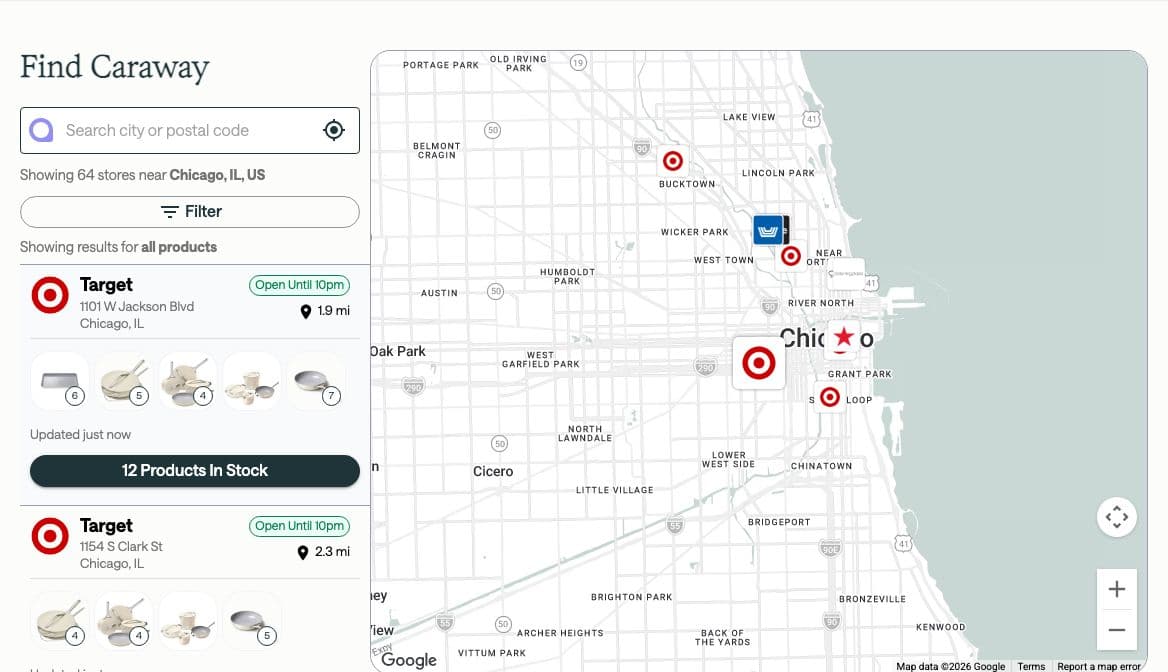
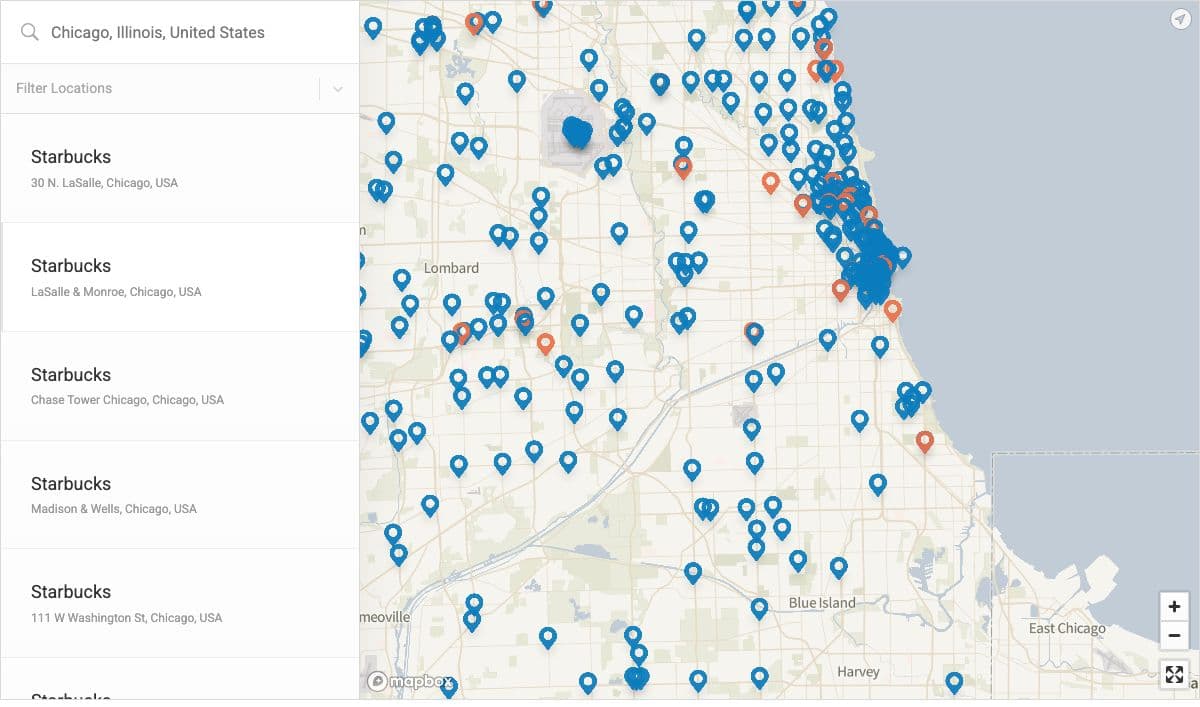
Both store locators as a shopper sees them, captured the same way: a 1280 by 800 browser window placed in Chicago, searching for Chicago. A demo holds whatever sample data its vendor chose, so where that changes what the picture shows, the caption says so. Each shot is trimmed to a common shape here; select one to see all of it.
StoreLocatorsCaptured October 15, 2026 from a live customer site, searching “Chicago, IL”.
StoreLocators · Captured October 15, 2026 from a live customer site, searching “Chicago, IL”.
ClosebyCaptured October 15, 2026 from the vendor’s own demo, searching “Chicago, IL”.
Closeby · Captured October 15, 2026 from the vendor’s own demo, searching “Chicago, IL”.
Pricing, side by side
Not a close comparison on price and there is no point pretending otherwise. Closeby covers 10,000 locations for $19.99 a month. Our equivalent tier is $395.
What separates them is what the money buys. Closeby prices a map of locations you supply. Ours prices retailer availability data for locations you do not own, refreshed daily. For a brand whose store list is its own, that is a large amount of money for something not being used.
StoreLocators
Prices published
Three tiers on our Shopify App Store listing, scaling by retail locations: Launch up to 2,000 locations, Grow from 2,000 to 10,000, and Scale above 10,000, at $195, $395 and $995 per month.
Month to month, no long-term contract and no termination fee
Refund available within 30 days of the latest charge
Map included; shopper sessions and map loads are not metered
Free trial documented. A 14-day free trial on every tier.
Sources,
Closeby
Prices published
Three tiers, differing only by location count: Free for 5 locations, $9.99 a month for 100, and $19.99 for 10,000, with annual options on Shopify at $99.99 and $199.99 a year. Every tier is listed with all features and customizations, with no feature gating between them.
The free plan is a plan rather than a time-limited trial
Customer supplies their own Mapbox access token
Month to month; cancellation is immediate and self-serve, with no proration on downgrade or for unused time
Refund policy stated only as "our fair refund policy", with no specifics published
The terms reserve a right to vary the monthly rate by usage covering locations, map views and API calls; no rate card is published
Free trial documented. A free plan at 5 locations with every feature, rather than a time-limited trial.
Sources,,
StoreLocators vs Closeby at a glance
Fifteen rows on one review date. Where Closeby publishes nothing, the cell says so rather than guessing, and several rows here are unpublished because Closeby documents less than most vendors in this set.
Source 1Closeby: homepagecloseby.co. Reviewed 2026-10-15.Full citationSource 2Closeby: pricing (homepage section)closeby.co. Reviewed 2026-10-15.Full citationSource 3Closeby: terms of servicecloseby.co. Reviewed 2026-10-15.Full citationSource 4Closeby: privacy policycloseby.co. Reviewed 2026-10-15.Full citationSource 5Closeby on the Shopify App StoreShopify App Store. Reviewed 2026-10-15.Full citationSource 6Closeby blog: Store Locator Apps Comparedcloseby.co. Reviewed 2026-10-15.Full citationSource 7StoreLocators: guarantee, refunds and cancellationstorelocators.com. Reviewed 2026-10-15.Open the sourceFull citationSource 8StoreLocators on the Shopify App StoreShopify App Store. Reviewed 2026-10-15.Open the sourceFull citationSource 9StoreLocators: free retailer store listsstorelocators.com. Reviewed 2026-10-15.Open the sourceFull citation
Month to month, with a variable-rate clauseCloseby: Contract termsCancellation is self-serve and takes effect immediately, with no proration for a downgrade or for unused time in the final billing cycle. The refund policy is stated only as "our fair refund policy" with no specifics. The terms also reserve a right to vary the monthly rate by usage, covering additional locations, map views and API use, which the flat published prices do not reflect and for which no rate card is published.Source3. Closeby: terms of service
Pricing
$195–$995 per monthStoreLocators: PricingThree tiers on our Shopify App Store listing, scaling by retail locations: Launch up to 2,000, Grow from 2,000 to 10,000, Scale above 10,000.Source8. StoreLocators on the Shopify App Store
4.9Closeby: Merchant rating4.9 from 19 reviews on Shopify App Store.Nineteen reviews is a small sample, so read the score as a strong signal rather than a settled one. The split is 16 five-star and 3 four-star, with nothing at three stars or below, on a listing that has been up since October 2018.Source5. Closeby on the Shopify App Store
YesA free plan, not a trialCloseby: Evaluate without a sales callA free plan of five locations listed with all features and customizations, with no time limit stated. Better than a time-limited trial for evaluating a locator properly.Sources2. Closeby: pricing (homepage section)5. Closeby on the Shopify App Store
Retailer coverage
Adding a retailer you sell throughThe gap between the retailer list you are sold and the one you actually sell through.
On request, typically within days, at no additional cost
You add it yourselfCloseby: Adding a retailer you sell throughNo discovery mechanism appears anywhere in the product or its listing. Every location is one you supply.Source5. Closeby on the Shopify App Store
Retailer coverageCoverage only counts where you actually sell.
–Not published by the vendorCloseby: Retailer coverageNo retailer network.Closeby supplies no store data and publishes no coverage figure, because the locations are yours.Source2. Closeby: pricing (homepage section)
Location capA cap you can grow past is a repricing event, not a feature.
Priced by retail locations, not cappedStoreLocators: Location capPlans scale by location count rather than cutting the map off at a number.
Where the store data comes fromThe whole difference. Everything else follows.
Automatic discovery across 205 integrated retailer feedsStoreLocators: Where the store data comes fromNo spreadsheet to maintain. Retailers that stock you are found in their own feeds and appear without you entering them.
Locations you supply, synced from a sheetCloseby: Where the store data comes fromCloseby says you can manage locations in its interface or "sync with Google Sheets", and its Shopify listing ticks "Import and export" without naming a format. Sync direction, trigger and frequency are not documented anywhere, so no cadence is claimed here in either direction.Sources2. Closeby: pricing (homepage section)5. Closeby on the Shopify App Store
Refresh cadenceA locator that sends a shopper to a store that dropped the line costs more trust than it wins.
Retailer feeds, refreshed daily
–Not published by the vendorCloseby: Refresh cadenceNo sync cadence published.The Google Sheets sync is named as a feature but its frequency and trigger are not stated, so how quickly a sheet edit reaches the map is not established.Source2. Closeby: pricing (homepage section)
Product-level availabilityWhether the map answers "who has this product" or only "where are the shops".
YesPer product, per variant, per store, filtered to in-stockStoreLocators: Product-level availabilityRetailer-reported rather than a live poll of a physical shelf, which is the honest description of what this category actually has.
Product tags and filters, no stockCloseby: Product-level availabilityProduct search, product type filtering, tagging and custom filters are all listed, so a shopper can narrow to locations carrying a line. It is static tagging you maintain rather than a stock feed, and no freshness claim is made for it.Source5. Closeby on the Shopify App Store
Copy and paste, in-page or as an overlayCloseby: Install pathCloseby shows Shopify, Squarespace and WordPress logos and says it can integrate with any website. The specific Shopify mechanism, app block against manual snippet, is not documented, so this page does not state which it is.Sources1. Closeby: homepage5. Closeby on the Shopify App Store
Developer requiredWhether this ships this week or waits for engineering time.
NoNot required
NoNot requiredCloseby: Developer requiredCloseby’s Shopify listing says "no design or engineering experience required".Source5. Closeby on the Shopify App Store
A few steps, per ClosebyCloseby: Time to launchTheir claim, and no more specific figure is published.Source1. Closeby: homepage
Who pays for the mapA locator billed per map load has a second invoice attached to it, from Google or Mapbox rather than the vendor.
YesIncludedStoreLocators: Who pays for the mapThe map is part of the subscription. There is no separate Google or Mapbox bill, and shopper sessions are not metered.
NoYour own Mapbox tokenCloseby: Who pays for the mapCloseby states a Mapbox access token is required to activate the map, so it runs on Mapbox rather than Google Maps. The Mapbox account, and any usage charges above its free allowance, are yours.Source2. Closeby: pricing (homepage section)
Features
Wholesale self-submissionIndependent stockists rarely appear in any feed. Letting them add themselves is the only way to catch them.
YesSubmit Your Location block
–Not verified by usCloseby: Wholesale self-submissionNo stockist or dealer self-submission intake appears in Closeby’s published material. Its help centre is not publicly accessible, so we cannot rule out that one is documented there.Source5. Closeby on the Shopify App Store
Support
Support model
Every message reaches Our Customer Success & Onboarding Specialist
Email, answered by the ownerCloseby: Support modelEmail to the team address plus a help centre. Closeby’s own blog says the owner/developer answers all the emails personally. No response-time commitment is published on its site; a support auto-reply quoted in one Shopify review gives a typical response time of 5 business days, while other reviews describe fixes within a business day. Support is not a tier differentiator.Sources6. Closeby blog: Store Locator Apps Compared5. Closeby on the Shopify App Store3. Closeby: terms of service
Closeby in its own words
“Just copy and paste. In a few steps, you can easily add a beautiful locator to your own website in-page or as a custom overlay.”
“Manage locations within our simple interface or sync with Google Sheets.”
That second quote, plus a line on its Shopify listing about syncing with Google Sheets for teams and an "Import and export" feature tick, is the whole published description of how data gets in. Which direction the sync runs, what triggers it and how often are not stated anywhere, so this page does not describe Closeby’s data workflow as manual or as automated. It says what Closeby says.,
Worth respecting Closeby’s own positioning here. Its blog says the main locator apps are "all priced similarly" and that Closeby is "hyper focused on design and brand integration". The price is the most striking fact about it, but the maker is not selling on price, and the locator genuinely does look better than most in this bracket.
Where StoreLocators is different
The store list is found rather than supplied
Closeby maps what you give it, through a sheet or an import. We discover retailers that stock you across integrated feeds, refreshed daily, so a store that started carrying your line appears without anyone adding a row. That is the difference between a map you maintain and one that maintains itself.
Availability rather than a tag
Closeby’s product filtering runs on tags you set and keep current. Ours is per product and per store from retailer feeds, refreshed daily, which answers whether this store has it rather than whether this location carries the line.
A price that is fixed in the contract, not just on the page
Closeby’s terms reserve a right to vary the monthly rate by usage covering locations, map views and API calls, with no rate card published. Ours is a flat subscription: shopper sessions and map loads are not metered, and that is the commercial arrangement rather than current practice.,
Encryption at rest, and a team behind the inbox
Closeby’s privacy policy states data is encrypted in transit and in backups but not while live in the database, which it says it secures by other means, and its own blog says the owner and developer answers all the support email personally. For some buyers neither matters. For anyone with a security review or an uptime dependency, both are answers they have to give.,
Every row where the table above separates us
Taken from that table rather than written out again, so the two cannot disagree. A row shows up here when we publish an answer and they publish none, or when both answer and ours covers more of the feature. Rows where both sides publish a figure, a price or a rating, stay out: those differ by their content.
StoreLocators: Submit Your Location block|Closeby: Not verified
Three things behind a very good price
Closeby’s pricing is the most generous in this comparison set and the strengths section says so first, because it is the honest headline. Three things sit underneath it that are not on the pricing page, all of them from Closeby’s own documents.
The first is that the flat price is not contractually flat. The terms reserve a right to vary the monthly rate by usage, naming additional locations, map views and API use, and no overage rate card is published anywhere. In practice the published tiers appear to be what people pay. As a commitment, the terms leave room they do not quantify.
The second is encryption. Closeby’s privacy policy states data is encrypted in transit over SSL or TLS and encrypted in backups, but not encrypted while it is live in the database; it adds that it goes to great lengths to secure data at rest by other means. Store locations are not usually sensitive data, and for most brands this is a non-issue. If you have a security questionnaire, it is a question you will be asked and this is the answer.
The third is that support rests on one person. Closeby’s own blog says the owner and developer answers all the emails personally, and a support auto-reply quoted in a Shopify review calls it "a small operation". That is likely why reviewers thank the person who helped them by name, and it also means support depends on that person. Both facts are true at once.
The thing more vendors should copy
Every Closeby tier, free included, is listed with all features and customizations. The only difference between free, $9.99 and $19.99 is how many locations you may have.,
That is unusual to the point of being worth naming. Elsewhere in this comparison set, the API is a top-tier feature, the data sync is a top-tier feature, branding removal is a top-tier feature, and in one case analytics is withheld from the entry plan entirely. Buyers end up on a tier chosen by which single feature they need rather than by their size.
Our own plans work the same way as Closeby’s in this respect, scaling by retail locations rather than by which features you are allowed, and it is the right model. It is worth crediting the vendor that does it at a tenth of the price.
What is genuinely unknown here
Closeby documents less publicly than most vendors in this set, and this page marks four cells unpublished or unknown as a result rather than filling them with inference.
How the Google Sheets sync actually behaves: direction, trigger and frequency are all unstated, so "sync with Google Sheets" is the entire published description. Whether the Shopify install is an app block or a manual snippet. Whether any stockist self-submission exists, which we cannot rule out because the help centre is not publicly accessible. And what an API costs or does, since the terms carry API terms and name API use in the billing clause, but no API documentation, tier or scope is published.,
For a $19.99 product this is a reasonable amount to leave undocumented, and a support email will answer any of it. It is listed because a comparison page that guessed at those four would look more complete and be worth less.
Moving from Closeby to StoreLocators
Easy on the data. Closeby has an import and export path and a Google Sheets sync, so in most cases the sheet you were syncing is already the export.
The point of the move is that retailer locations stop being rows anyone owns. Your own locations stay managed; the rest arrive from feeds.
1Take the sheet, or exportIf you were syncing a Google Sheet, that is your data. Otherwise use the export; the format is not documented, so check what comes out before you rely on it.Minutes
2Separate owned locations from retailYour own sites and any independents you track by hand become managed locations. Chain retail rows do not need to come across: those retailers arrive from feeds, current.An hour or so, once
3Turn on your retailersChoose the retailers you sell through from the integrated list. Anything missing is added on request, typically within days, at no extra cost.Minutes, plus our turnaround for anything new
4Install and redirectAdd the app section on Shopify, or a script and one div elsewhere, then redirect the old locator URL so nothing indexed is lost.Under 5 minutes on Shopify
5Cancel, and retire the Mapbox tokenCancellation is immediate and self-serve, with no proration for unused time, so cancel at the end of a paid period rather than the start. Then remove or restrict the Mapbox token that was serving the old locator.Minutes
Frequently asked questions
How much does Closeby cost?
Three tiers that differ only by location count: a free plan for 5 locations, $9.99 a month for 100, and $19.99 a month for 10,000. Every tier is listed with all features and customizations, so there is no feature gating between them, which is unusual in this category. Two things are not on the pricing page: you supply your own Mapbox access token, and the terms reserve a right to vary the monthly rate by usage covering additional locations, map views and API use, with no rate card published.,
Does Closeby have a free plan?
Yes, and it is a real free plan rather than a trial: five locations with every feature and customization, with no time limit stated. For evaluating whether a locator looks right in your brand and behaves the way you want, that is more useful than a fourteen-day countdown, because design feedback rarely arrives inside two weeks.
Does Closeby show live stock?
No. It has product search, product type filtering, tagging and custom filters, so a shopper can narrow to locations carrying a line, but those are static tags you maintain rather than a stock feed. No freshness claim is made for them. If a shopper needs to know whether a specific store has a unit today, that is the line between this and a where-to-buy platform.
Is Closeby secure?
Its privacy policy enumerates GDPR rights in full and states data is encrypted in transit over SSL or TLS and encrypted in backups. It also states data is not encrypted while live in the database, which it says it secures by other means. There is no CCPA or SOC 2 language, no published SLA, and the terms disclaim uninterrupted, timely, secure and error-free service. For store locations, which are usually public information anyway, most buyers will not care. If you have a security review, those are the answers you will be giving.,
Is Closeby good?
It holds 4.9 across 19 reviews on the Shopify App Store with nothing below four stars, and it launched in October 2018. The one negative signal on record is a reviewer who complained about a slow ticket response during an urgent error, then edited the review to say support had fixed it within one business day. Closeby positions on design and brand integration rather than price, and in our view the product supports that: it is the best-looking locator in this bracket. By Closeby’s own account the owner and developer answers support email personally, which goes some way to explaining why reviewers praise it, and also means support depends on one person.,
What is the best Closeby alternative?
If you want the same job done and Closeby is not working out, other widgets in this class do it, though few match its free plan. If the problem is that the store list belongs to retailers rather than to you, or that shoppers want to know which store has a product rather than which locations carry the line, that is what StoreLocators does instead: retailer feeds refreshed daily rather than a sheet, per-product and per-store availability, and the map inside the subscription. It costs many times more, which on an owned store list is not worth paying.
Every Closeby claim on this page was taken from closeby.co, its pricing section, terms and privacy pages, its own blog, or its Shopify App Store listing and reviews. Each was last checked on 15 October 2026. The sources are listed below with the exact URL we read.,,
Every claim was checked twice against the vendor’s own pages before publishing.
Four things are marked unpublished or unknown rather than inferred, because Closeby documents less publicly than most vendors here: how the Google Sheets sync behaves in direction, trigger and frequency; whether the Shopify install is an app block or a manual snippet; whether any stockist self-submission exists, since its help centre is not publicly accessible; and what the API does or costs, since the terms mention it but no API documentation is published. Claims about StoreLocators come from our own public pages and are not separately cited.
Sources
9 sources
Every claim on this page cites the source it came from, with the date we checked it. Sources are named but not linked; search for the title to find the page.
1.Closeby: homepagecloseby.co. Reviewed 2026-10-15.“Just copy and paste. In a few steps, you can easily add a beautiful locator to your own website in-page or as a custom overlay.”Also states "Closeby can easily integrate with any website", with Shopify, Squarespace and WordPress shown as logos, and "Manage locations within our simple interface or sync with Google Sheets."
2.Closeby: pricing (homepage section)closeby.co. Reviewed 2026-10-15.“Manage locations within our simple interface or sync with Google Sheets.”Pricing sits in the homepage section the site navigation links to. It lists "Free for up to 5 locations", "$9.99 for up to 100 locations" and "$19.99 for up to 10,000 locations", then "That's it." and "Mapbox access token required to activate map." Sync direction, trigger and frequency are not stated.
3.Closeby: terms of servicecloseby.co. Reviewed 2026-10-15.“Your rate per month may increase or decrease based on usage. This is based on additional locations, as well as total maps views or use of the API.”No overage rate card is published anywhere, so the flat published prices are not contractually flat. Cancellation is self-serve from the Account screen and takes effect immediately, with "no prorating for downgrades in between billing cycles" and no prorating of unused time in the last billing cycle. "Refunds are processed according to our fair refund policy", with no specifics. The terms disclaim that the service "will be uninterrupted, timely, secure, or error-free", and no SLA or uptime figure appears. An "API Terms" section governs API use, but no API documentation, tier or scope is published.
4.Closeby: privacy policycloseby.co. Reviewed 2026-10-15.“Data isn’t encrypted while it’s live in our database (since it needs to be ready to send to you when you need it), but we go to great lengths to secure your data at rest”Enumerates GDPR rights in full: access, correction, erasure, complaint, restriction, objection, portability and no automated decision-making. States data is encrypted via SSL/TLS in transit and that database backups are encrypted. No CCPA or SOC 2 language appears.
5.Closeby on the Shopify App StoreShopify App Store. Reviewed 2026-10-15.“Easy setup: no design or engineering experience required”4.9 across 19 reviews, being 16 five-star and 3 four-star with nothing at three stars or below, and launched 11 October 2018. Plans: Free up to 5 locations, $9.99 a month (or $99.99 a year) up to 100, and $19.99 a month (or $199.99 a year) up to 10,000, each listed with "All features and customizations". Feature ticks include location search, product search, store name search, tagging, autocomplete, geolocation, product type filter, custom filters, search reports, import and export, business hours and a single "Locator page" rather than per-location indexable pages. Works with Any Website, Google Analytics, Google Sheets and MapBox. One reviewer complained about a 5-business-day ticket response during an urgent error, quoting an auto-reply that calls Closeby "a small operation", then edited the review to say support fixed it within 1 business day.
6.Closeby blog: Store Locator Apps Comparedcloseby.co. Reviewed 2026-10-15.“the owner/developer answers all the emails personally”Says of the main locator apps "we're all priced similarly" and that Closeby is "hyper focused on design and brand integration". The owner/developer line is the source for the support row on this page; it also appears on the blog index at closeby.co/blog.
7.StoreLocators: guarantee, refunds and cancellationstorelocators.com. Reviewed 2026-10-15.“StoreLocators.com operates on a month-to-month subscription model with no long-term contracts or termination fees.”Also states that a subscription can be cancelled at any time through Account Settings under Billing, and that a refund may be requested within 30 days of the latest charge.
9.StoreLocators: free retailer store listsstorelocators.com. Reviewed 2026-10-15.Publishes 110,516 store locations across 205 retailers as free CSV downloads with addresses, phone numbers, opening hours and coordinates. The counts are taken from the live lists.
110,516+ locations connected
Every ClickDeserves aDestination
Connect your online shoppers to in-stock products at retail stores nearby. In five minutes. With zero maintenance.