Bullseye vs StoreLocators: 2026 Pricing and Comparison
Dealer locator and lead-routing platform for channel networks
Bullseye Locations has been building dealer locators since 1998, and it is the most enterprise product in this comparison: partner portals with approval workflows, lead routing by territory and responsiveness, and a daily Salesforce sync. It is built for dealer and contractor networks rather than for retail shelves. This page covers what it costs and what its terms commit to.
Last reviewed
The short answer
Bullseye is the right tool for a dealer or contractor network: partner portals and lead routing are things most of this category does not attempt. We are the better buy when the locations belong to retailers rather than to partners you have a relationship with, when shoppers need per-product availability, and when the store list should keep itself current rather than being uploaded.
What each product is designed to do, in its own terms. A capability named on one side is not a claim that the other lacks it, and neither column ranks the two: the table below is where they are compared row by row.
What Bullseye is built for
Your channel is dealers, contractors or installers with a partner relationship
Partners should manage their own listing behind an approval workflow
Leads need routing by territory, tier or responsiveness rather than just displaying
Several brands run through one dealer network, or territories decide who covers what
The locator has to feed Salesforce, HubSpot or Dynamics
Price the search tier for your busiest month, and add the mapping line if you buy it through Bullseye. Both are on the search-volume page.
What StoreLocators is built for
The locations are retail shelves rather than partners with a portal login
Shoppers need per-product, per-variant, per-store availability
The store list should stay current without a scheduled upload anyone owns
You want price, cancellation terms and the map settled before a sales call
Retailers that start stocking you should appear on their own
StoreLocators and Bullseye, side by side
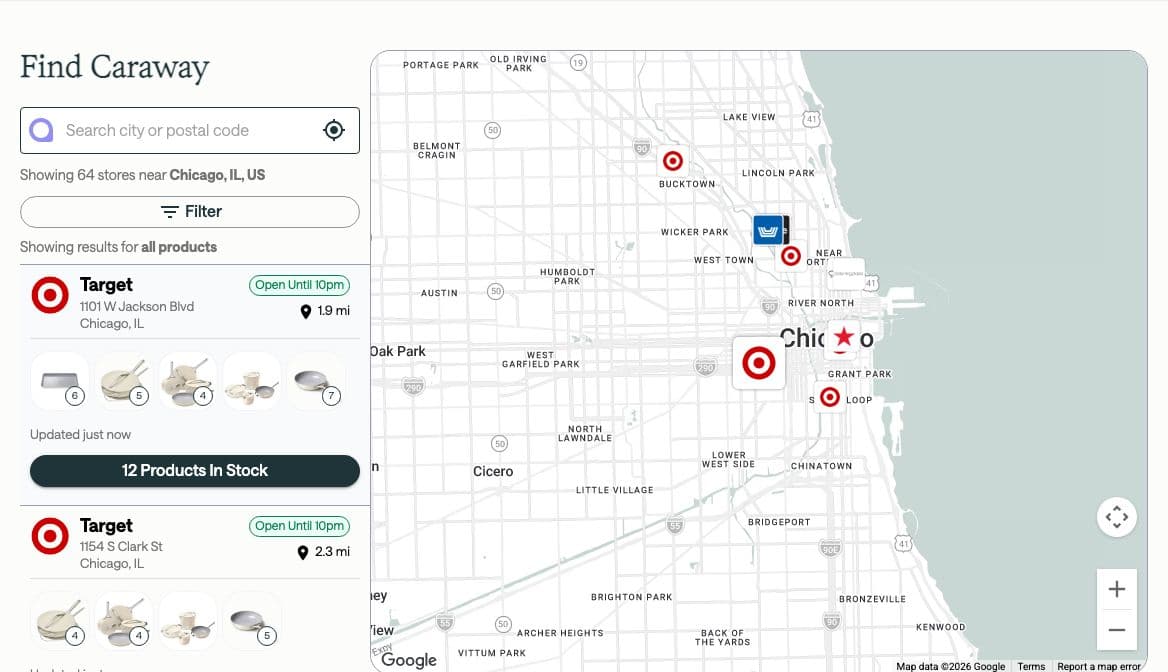
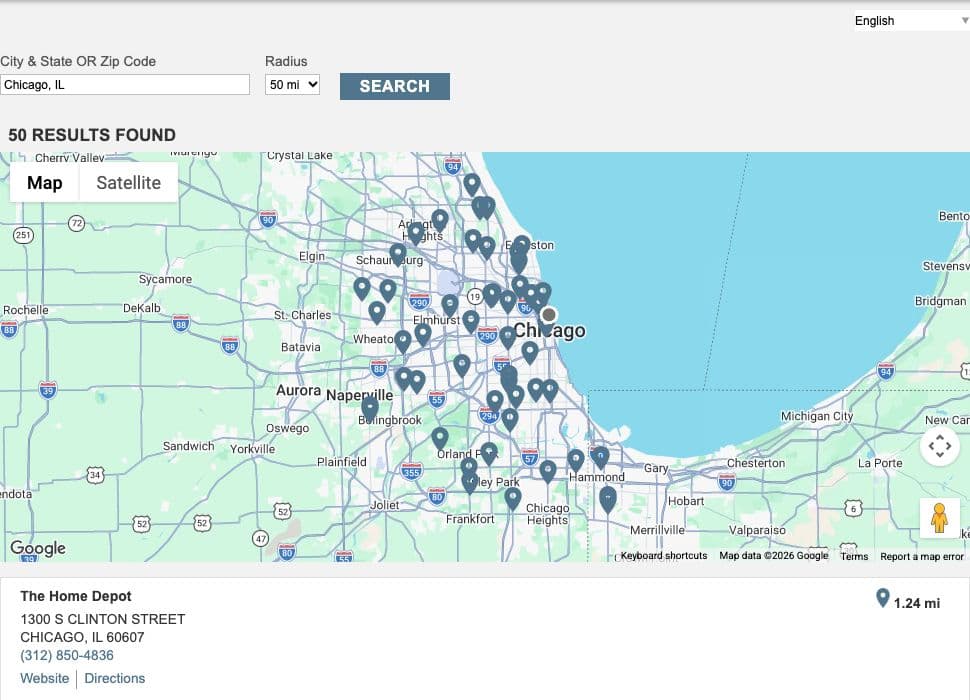
Both store locators as a shopper sees them, captured the same way: a 1280 by 800 browser window placed in Chicago, searching for Chicago. A demo holds whatever sample data its vendor chose, so where that changes what the picture shows, the caption says so. Each shot is trimmed to a common shape here; select one to see all of it.
StoreLocatorsCaptured October 15, 2026 from a live customer site, searching “Chicago, IL”.
StoreLocators · Captured October 15, 2026 from a live customer site, searching “Chicago, IL”.
BullseyeCaptured October 15, 2026 from a customer the vendor names publicly, searching “Chicago, IL”.
Bullseye · Captured October 15, 2026 from a customer the vendor names publicly, searching “Chicago, IL”.
Pricing, side by side
Closer than most comparisons in this set, at least at the entry tiers, though the two ladders are metered on different things.
Bullseye sells unlimited locations with a monthly search allowance. We sell retailer availability data priced by retail locations, with shopper sessions unmetered. On a busy locator that difference compounds: above 10,000 searches a month Bullseye bills by search tier, and mapping bought through it scales the same way.,
StoreLocators
Prices published
Three tiers on our Shopify App Store listing, scaling by retail locations: Launch up to 2,000 locations, Grow from 2,000 to 10,000, and Scale above 10,000, at $195, $395 and $995 per month.
Month to month, no long-term contract and no termination fee
Refund available within 30 days of the latest charge
Map included; shopper sessions and map loads are not metered
Free trial documented. A 14-day free trial on every tier.
Sources,
Bullseye
Prices published
Search at $89 a month and Find at $225 on the vendor pricing page, with Connect and Enterprise on quote. The Shopify App Store listing shows $225 a month. Search volume above 10,000 a month is sold in published tiers from $100 a month for 25,000, with searches beyond your tier at $8 per 1,000.
Unlimited locations on every tier; 10,000 searches a month included
Google or Mapbox mapping is a separate subscription, bought through Bullseye at published add-on rates or brought yourself
Billed monthly or annually, with a discount for annual; both auto-renew
The pricing FAQ says you can cancel any time with no cancellation fees; the terms contain no cancellation process and no refund language
Upgrades are pro-rated; the terms put downgrades at the next subscription anniversary, the FAQ at the next billing cycle
Free trial documented. 14 days, on both the pricing page and the Shopify listing. The pricing FAQ says an unconverted trial is deactivated with data kept for 30 days.
Sources,,,
StoreLocators vs Bullseye at a glance
Sixteen rows on one review date. One of them goes to Bullseye outright: its partner portal is a great deal more than a submission form.
Source 1Bullseye Locations: pricingbullseyelocations.com. Reviewed 2026-10-15.Full citationSource 2Bullseye Locations: search volume and pricing detailsbullseyelocations.com. Reviewed 2026-10-15.Full citationSource 3Bullseye Locations: terms of usebullseyelocations.com. Reviewed 2026-10-15.Full citationSource 4Bullseye Store Locator on the Shopify App StoreShopify App Store. Reviewed 2026-10-15.Full citationSource 5Bullseye Store Locator reviews on the Shopify App StoreShopify App Store. Reviewed 2026-10-15.Full citationSource 6Bullseye Store Locator pricing on GetAppGetApp. Reviewed 2026-10-15.Full citationSource 7Bullseye Locations: bulk data management toolsbullseyelocations.com. Reviewed 2026-10-15.Full citationSource 8Bullseye Locations: premium supportbullseyelocations.com. Reviewed 2026-10-15.Full citationSource 9Bullseye Locations: Pro Portalsbullseyelocations.com. Reviewed 2026-10-15.Full citationSource 10Bullseye Locations: enterprisebullseyelocations.com. Reviewed 2026-10-15.Full citationSource 11Bullseye Locations: integrationsbullseyelocations.com. Reviewed 2026-10-15.Full citationSource 12Bullseye Locations: features for better resultsbullseyelocations.com. Reviewed 2026-10-15.Full citationSource 13Bullseye Locations: privacy policybullseyelocations.com. Reviewed 2026-10-15.Full citationSource 14Bullseye Locations: aboutbullseyelocations.com. Reviewed 2026-10-15.Full citationSource 15Bullseye Locations: Loblaw case studybullseyelocations.com. Reviewed 2026-10-15.Full citationSource 16Bullseye Locations: API documentationapi.bullseyelocations.com. Reviewed 2026-10-15.Full citationSource 17StoreLocators: guarantee, refunds and cancellationstorelocators.com. Reviewed 2026-10-15.Open the sourceFull citationSource 18StoreLocators on the Shopify App StoreShopify App Store. Reviewed 2026-10-15.Open the sourceFull citationSource 19StoreLocators: free retailer store listsstorelocators.com. Reviewed 2026-10-15.Open the sourceFull citation
Cancel any time per the FAQ; the terms say lessBullseye: Contract termsThe pricing FAQ says you can cancel at any time from account settings or through support, with no cancellation fees or long-term contracts, and that a downgrade applies from the next billing cycle. The terms of use are thinner: monthly subscriptions renew on the monthly anniversary and annual ones on the yearly anniversary, downgrades take effect at the next anniversary, and there is no cancellation process and no refund language. Monthly or annual billing, with a discount for annual.Sources1. Bullseye Locations: pricing3. Bullseye Locations: terms of use
Pricing
$195–$995 per monthStoreLocators: PricingThree tiers on our Shopify App Store listing, scaling by retail locations: Launch up to 2,000, Grow from 2,000 to 10,000, Scale above 10,000.Source18. StoreLocators on the Shopify App Store
5.0Bullseye: Merchant rating5.0 from 3 reviews on Shopify App Store.5.0 from 11 reviews on Capterra, GetApp and Software Advice.Three reviews is too small a base to read as a verdict either way. All three are five-star and all three date from 2015 and 2016, on a listing that launched in December 2014; nothing has been posted since. G2 appears in search results at 4.5 from 16 reviews, but we could not confirm that on the listing itself, so it is not shown.Sources5. Bullseye Store Locator reviews on the Shopify App Store6. Bullseye Store Locator pricing on GetApp
Yes14-day free trialBullseye: Evaluate without a sales callThe pricing page and the Shopify listing both state 14 days. What happens after differs by document: the pricing FAQ says the account is deactivated with data kept for 30 days and calls the Free plan legacy, while the terms say an unupgraded trial reverts to a Free Subscription.Sources1. Bullseye Locations: pricing4. Bullseye Store Locator on the Shopify App Store3. Bullseye Locations: terms of use
Retailer coverage
Adding a retailer you sell throughThe gap between the retailer list you are sold and the one you actually sell through.
On request, typically within days, at no additional cost
You add it, or a dealer submits through the Pro PortalBullseye: Adding a retailer you sell throughThe portal is the strongest version of this in the comparison set: dealers manage their own listing, photos and projects, behind an approval workflow. It still starts with a partner who knows they are your partner.Source9. Bullseye Locations: Pro Portals
Retailer coverageCoverage only counts where you actually sell.
–Not published by the vendorBullseye: Retailer coverageNo retailer network.Bullseye supplies no store data. Its "over 5,500 clients" figure counts brands using the platform rather than locations available to you.Source14. Bullseye Locations: about
Location capA cap you can grow past is a repricing event, not a feature.
Priced by retail locations, not cappedStoreLocators: Location capPlans scale by location count rather than cutting the map off at a number.
Where the store data comes fromThe whole difference. Everything else follows.
Automatic discovery across 205 integrated retailer feedsStoreLocators: Where the store data comes fromNo spreadsheet to maintain. Retailers that stock you are found in their own feeds and appear without you entering them.
Locations you supply, by CSV or XML, on a schedule if you wantBullseye: Where the store data comes fromBulk upload by CSV or XML, bulk updates to store hours and holiday schedules, and recurring scheduled XML uploads, which is better automation than most of this category offers. Salesforce account data can also sync as a daily process. It still moves data you already hold; nothing is discovered.Sources7. Bullseye Locations: bulk data management tools11. Bullseye Locations: integrations
Refresh cadenceA locator that sends a shopper to a store that dropped the line costs more trust than it wins.
Retailer feeds, refreshed daily
As often as your scheduled upload runsBullseye: Refresh cadenceThe cadence is yours to set and yours to keep running. A store that starts stocking you does not appear until it is in the file somebody uploads.Source7. Bullseye Locations: bulk data management tools
Product-level availabilityWhether the map answers "who has this product" or only "where are the shops".
YesPer product, per variant, per store, filtered to in-stockStoreLocators: Product-level availabilityRetailer-reported rather than a live poll of a physical shelf, which is the honest description of what this category actually has.
Product Availability Search, tagged by youBullseye: Product-level availabilityProduct Availability Search is a named feature and the same page mentions "buy online" or "pick up in store" options, so a shopper can filter to locations carrying a line. No inventory mechanism, feed or refresh cadence is published for it, so this is an association you maintain rather than stock data.Source12. Bullseye Locations: features for better results
WordPress plugin, Shopify app, or an iframe elsewhereBullseye: Install pathThe WordPress plugin inherits your theme styles and generates shortcodes. Drupal, Squarespace, Wix, Magento and Joomla use automatically generated iframe code.Source11. Bullseye Locations: integrations
Developer requiredWhether this ships this week or waits for engineering time.
NoNot required
NoNot required to launchBullseye: Developer requiredThe plugin and the iframe need no engineering. The API, the CRM sync and anything Enterprise does need it, and Bullseye sells expert onboarding as a Connect-tier inclusion.Sources11. Bullseye Locations: integrations1. Bullseye Locations: pricing
–Not published by the vendorBullseye: Time to launchNo setup time published.The vendor site publishes no figure. Its Shopify listing says the locator can be added in minutes, which describes the embed rather than the dealer data, the routing rules or the CRM connection.Source4. Bullseye Store Locator on the Shopify App Store
Who pays for the mapA locator billed per map load has a second invoice attached to it, from Google or Mapbox rather than the vendor.
YesIncludedStoreLocators: Who pays for the mapThe map is part of the subscription. There is no separate Google or Mapbox bill, and shopper sessions are not metered.
NoA separate mapping subscription, theirs or yoursBullseye: Who pays for the mapThe pricing page states that Google or Mapbox mapping requires a separate subscription, purchased through Bullseye or brought yourself. Bought through Bullseye, the base-tier add-on is listed at $120 or $170 a month for Google Maps and $20 for Mapbox, rising with search volume; with your own key or token there is no add-on charge.Sources1. Bullseye Locations: pricing2. Bullseye Locations: search volume and pricing details
Features
Wholesale self-submissionIndependent stockists rarely appear in any feed. Letting them add themselves is the only way to catch them.
YesSubmit Your Location block
YesPro Portals, with an approval workflowBullseye: Wholesale self-submissionWell beyond a submission form. Dealers log in to update photos, publish videos, promote projects and manage their own leads, with an approval workflow in front of what goes live.Source9. Bullseye Locations: Pro Portals
Support
Support model
Every message reaches Our Customer Success & Onboarding Specialist
Standard support, with a premium plan for enterpriseBullseye: Support modelPremium Support and SLA, described as an offering for enterprise organizations, covers 24 hours a day, 365 days a year, with a one-hour response time for Level 1 issues, an off-hours 1-800 line and 10 hours of development support. It is an add-on rather than included everywhere.Source8. Bullseye Locations: premium support
Bullseye in its own words
“Automatically route leads to dealers based on radius, territory, responsiveness, tier, or number of leads.”
“All subscriptions include up to 10,000 searches per month. See search volume for additional tiers.”
The first quote is the product in one line, and it is a genuinely different product from a store locator. Routing a lead by a dealer’s responsiveness only makes sense when the locations are partners with an inbox and an obligation. Retail shelves do not work that way.
The second is what actually meters the bill. Locations are unlimited on every tier; searches are what run out. The linked search-volume page publishes the tiers: up to 25,000 searches a month for $100 more, 50,000 for $250, 100,000 for $450, up to $3,000 for a million, and $8 per 1,000 searches beyond whichever tier you chose. Mapping bought through Bullseye is charged on top at its own rates.,
Where StoreLocators is different
Retailers you have no relationship with
Bullseye’s model assumes a partner who logs in. That works for dealers and contractors, and it does nothing for a grocery chain that stocks your line and will never open a portal account. We discover retailers that carry you across integrated feeds, refreshed daily, with no relationship required at either end.
Availability rather than a product tag
Bullseye names Product Availability Search and buy online, pick up in store, and publishes no inventory mechanism or refresh cadence behind either. Ours is per product and per store from retailer feeds, refreshed daily, which answers whether that store has it rather than whether someone tagged it once.
Fewer moving parts on the bill
Bullseye publishes $89 and $225 for its first two tiers, with Connect and Enterprise on quote, then bills search volume above 10,000 a month by tier or at $8 per 1,000, with mapping on top unless you bring your own key. Its terms have no cancellation clause and no refund language, though its pricing FAQ says you can cancel any time. Ours are three published prices, month to month with a 30-day refund window, and the map included with sessions unmetered.,,,
Nobody owns the upload
A scheduled XML import is a real improvement on manual uploads, and it still needs a source system, a file format and somebody who notices when it stops running. Retailer feeds refresh daily without a job on anyone’s list, which is the difference between data that stays current and data that stays current while someone is watching.
Every row where the table above separates us
Taken from that table rather than written out again, so the two cannot disagree. A row shows up here when we publish an answer and they publish none, or when both answer and ours covers more of the feature. Rows where both sides publish a figure, a price or a rating, stay out: those differ by their content.
StoreLocators: Included|Bullseye: A separate mapping subscription, theirs or yours
What Bullseye actually costs
Bullseye’s pricing page names four tiers with their inclusions, and prices the first two: Search at $89 a month and Find at $225, with Connect and Enterprise on quote. Search covers unlimited locations, two embeddable locators, two category filters, location management, hours and custom styles. Find adds multi-brand support, unlimited categories and interfaces, territory search, API access, events, promotions, reviews and Google Analytics. Connect adds lead management, local and city pages, white label, a user manager, CRM integration and expert onboarding. Enterprise adds ongoing SEO work, account groups and custom development.
The same $225 appears on Bullseye’s Shopify App Store listing as its single "Shopify Premium" plan, and GetApp and Software Advice list the same $89 and $225. So the entry price is consistent everywhere it is published.,
The part to model is search volume. Every subscription includes 10,000 searches a month. Above that, the search-volume page sells tiers at $100 a month more for 25,000, $250 for 50,000, $450 for 100,000 and up to $3,000 for a million, and bills searches beyond your chosen tier at $8 per 1,000. Mapping bought through Bullseye scales with the same tiers, from $20 a month for Mapbox or $120 to $170 for Google Maps at the base tier, and costs nothing extra if you bring your own key. A busy locator therefore has three lines on the bill rather than one, all of them published.,
What the terms do and do not say
Bullseye’s terms of use are worth reading before signing, less for what is in them than for what is not, and worth reading beside the pricing FAQ, which says more.,
They set out how subscriptions renew, monthly on the monthly anniversary and annual on the yearly one, and they grant the right to upgrade or downgrade. They contain no cancellation process and no refund language at all, and a downgrade takes effect at the next subscription anniversary, which on an annual term could mean paying the higher tier for the rest of the year. The pricing FAQ is more generous: cancel any time from account settings or through support, no cancellation fees or long-term contracts, and downgrades from the next billing cycle. Where the two differ, get the FAQ’s version confirmed in your order form.,
The terms also name a Free Subscription that an unupgraded trial reverts to, and reserve the right to eliminate free subscriptions on 30 days notice. The pricing FAQ describes the Free plan as a legacy plan replaced by the current four tiers, and says an unconverted trial is deactivated with data kept for 30 days. So do not plan on a free tier existing after the trial.,
One further item a security review will surface: the privacy policy still states compliance with the EU-U.S. and Swiss-U.S. Privacy Shield frameworks and carries no last-updated date. Privacy Shield was invalidated in 2020. The policy may simply be out of date, but it can stall a procurement review.
Dealer networks and retail shelves are different problems
The clearest way to tell whether Bullseye is the right shape for you is to ask what a location is. If it is a business with a name, an owner, a territory and an interest in receiving your leads, Bullseye is built for exactly that, and very little else in this comparison is.,
If a location is a shelf inside a chain that stocks thousands of brands, none of that machinery applies. The store will not log into a portal, will not manage its listing, and has no interest in being routed a lead. What matters is whether it currently carries the product, and that answer changes without anybody telling you.
Plenty of brands have both. A tool business with 400 independent dealers and shelf space in two national chains genuinely needs two different things, and there is no dishonest way to claim one product does both well. Bullseye’s portals and routing are better than anything we offer for the dealer half. Retailer feeds refreshed daily are better than anything Bullseye offers for the shelf half.
Moving from Bullseye to StoreLocators
More involved than most moves in this set, because Bullseye usually holds more than locations: portal accounts, lead history and CRM plumbing that a locator swap does not replace.
Be honest about which half you are moving. If your dealer network lives in Bullseye portals with routing rules attached, that half may be worth keeping. The retail half is what moves cleanly.
1Export locations, and take the leads with themBullseye holds bulk data in CSV and XML and has an API on the Find tier and above. Pull the locations, and pull the lead history too: it is the part that does not exist anywhere else once the subscription lapses.An hour or two
2Decide what happens to the dealer portalsIf partners log in and manage their own listings, work out where that goes before switching anything off. Nothing in this comparison replaces portal accounts, and telling a dealer network their logins have gone is a conversation worth planning.A real decision, not a step
3Separate owned and dealer locations from retailYour own sites, and independents you manage directly, become managed locations. Chain retail rows do not need to come across: those retailers arrive from feeds, current.An hour or so, once
4Turn on your retailersChoose the retailers you sell through from the integrated list. Anything missing is added on request, typically within days, at no extra cost.Minutes, plus our turnaround for anything new
5Install, redirect, and time the cancellation carefullyAdd the app section on Shopify, or a script and one div elsewhere, then redirect the old locator URLs. On cancellation, the pricing FAQ says you can cancel from account settings, but the terms publish no cancellation process and put downgrades at the next anniversary, so confirm the terms in writing well before a renewal date rather than after it.Minutes to install; plan weeks of notice on the contract
Frequently asked questions
How much does Bullseye Locations cost?
Search is $89 a month and Find is $225 on Bullseye’s pricing page; Connect and Enterprise are on quote. Its Shopify App Store listing shows $225 a month. Every tier includes unlimited locations and 10,000 searches a month. Above that, search tiers start at $100 a month more for 25,000 searches, and searches beyond your tier are billed at $8 per 1,000. Google or Mapbox mapping is a separate subscription: free on top if you bring your own key, or from $20 a month for Mapbox and $120 for Google Maps if you buy it through Bullseye.,,
Does Bullseye have a free plan?
Not one you can choose today. There is a 14-day free trial. The pricing FAQ says the old Free plan is a legacy plan replaced by Search, Find, Connect and Enterprise, and that an account whose trial ends without a subscription is deactivated, with its data kept for 30 days. The terms of use still describe a Free Subscription that trials revert to, which Bullseye may eliminate on 30 days notice, so do not build on it.,
Does Bullseye integrate with a CRM?
Yes, and it is one of the reasons to buy it. Leads captured by the locator route to dealers by radius, territory, responsiveness, tier or lead count, and flow into Salesforce on a daily synchronisation process, or into HubSpot, ActiveCampaign, Zoho CRM, Dynamics 365, Mailchimp, RevBase, Zapier or Genesys. Lead management and CRM integration are Connect-tier inclusions rather than entry-level ones. Most locators end at a phone number on a card; this one ends in a CRM record with an owner attached.,,
Can dealers manage their own Bullseye listing?
Yes, through Pro Portals, and this is the strongest version of dealer self-service in this comparison. Partners log in to update photos, publish videos, promote projects and manage the leads they receive, with an approval workflow controlling what goes live. It shifts listing maintenance onto the people who know the details, which works well when your locations are partners and not at all when they are retail shelves.
Is Bullseye good?
It has been running since 1998, is owned by Electric Vine and based in Branchburg, New Jersey, and says it serves over 5,500 clients. Independent ratings are thin rather than bad: 5.0 from 11 verified reviews on Capterra, GetApp and Software Advice, which share one review pool, and 5.0 from three Shopify reviews all dating from 2015 and 2016 on a listing that launched in December 2014. We could not confirm G2 or Trustpilot ratings, so none is shown. The reference customer on its own site is a grocery group running more than 2,400 locations across 25 banners and serving 40,000 location content requests a day, which is a real scale claim.,,,
What is the best Bullseye alternative?
It depends which half of Bullseye you use. For dealer portals, lead routing and CRM integration, most of this category does not compete and you would be looking at another channel platform rather than a locator. If what you actually need is for shoppers to find which retailers stock a product, that is what StoreLocators does instead: retailer feeds refreshed daily rather than uploads you schedule, per-product and per-store availability, the map inside the subscription, and published prices with a 30-day refund window.,
Every Bullseye claim on this page was taken from bullseyelocations.com, its pricing and search-volume pages, its terms of use, its privacy policy, its feature and enterprise pages, its API documentation, or its Shopify App Store listing, and each was last checked on 15 October 2026. Ratings from Capterra, GetApp and Software Advice are attributed to them. The sources are listed below with the exact URL we read.,,
Every claim was checked twice against the vendor’s own pages before publishing.
Some things could not be established and are left alone rather than filled in: the API’s rate limits, which its documentation does not state, and whether the Shopify install uses a theme app block or a code edit, which the listing does not describe. Claims about StoreLocators come from our own public pages and are not separately cited.,
Sources
19 sources
Every claim on this page cites the source it came from, with the date we checked it. Sources are named but not linked; search for the title to find the page.
1.Bullseye Locations: pricingbullseyelocations.com. Reviewed 2026-10-15.“All subscriptions include up to 10,000 searches per month. See search volume for additional tiers.”Four tiers: Search at $89/month and Find at $225/month, each with "Try It Free", and Connect and Enterprise marked "Contact Us". Search covers unlimited locations, 2 embeddable locators, 2 category filters, location management, location hours and custom styles. Find adds multi-brand, unlimited categories and interfaces, territory search, API access, events, promotions, reviews and Google Analytics. Connect adds lead management, local pages, city pages, white label, a user manager, CRM integration and expert onboarding. Enterprise adds ongoing SEO optimisation, account groups and custom development. Also states that Google or Mapbox mapping requires a separate subscription, purchased through Bullseye or brought by the customer. The FAQ states a 14-day free trial after which an unsubscribed account "will be deactivated but your data will be retained for 30 days"; billing monthly or annually with an annual discount; "You can cancel your subscription at any time from your account settings or by contacting our support team. There are no cancellation fees or long-term contracts."; upgrades prorated and downgrades taking effect "at the start of your next billing cycle"; and that the Web Premium, Web Plus and Free plans are legacy plans replaced by the current structure.
2.Bullseye Locations: search volume and pricing detailsbullseyelocations.com. Reviewed 2026-10-15.“Searches that exceed your selected search tier will be billed at a standard rate per 1,000 searches and based on your map selections.”Search tiers: base up to 10,000 included, then up to 25,000 at $100/month, 50,000 at $250, 100,000 at $450, 150,000 at $600, 300,000 at $1,050, 500,000 at $1,750, 1,000,000 at $3,000, and above that on contact. Standard overage rate $8 per 1,000 searches for Bullseye Search. Optional mapping add-ons scale with the same tiers: at the base tier $120 or $170 a month in the two Google Maps columns and $20 for Mapbox, with overage at $9 or $19 (Google Maps) and $1 (Mapbox) per 1,000. "Plans using their own API key or token will not incur additional charges for optional add-ons."
3.Bullseye Locations: terms of usebullseyelocations.com. Reviewed 2026-10-15.“If you have not upgraded by the end of the Trial Subscription Period, your subscription will automatically revert to a Free Subscription.”Names a Free Subscription tier that renews monthly from the registration date and that Bullseye may eliminate on 30 days notice. Sets the trial period at registration rather than at a fixed length. States that monthly subscriptions renew on the monthly anniversary and annual subscriptions on the yearly anniversary. Grants upgrade and downgrade rights, with upgrades pro-rated and downgrades "effective on the next anniversary of your subscription period", and contains no cancellation process and no refund language. Also states that Bullseye does not charge for Google Maps implementation, integration or service, which disclaims their own fee rather than the mapping subscription.
4.Bullseye Store Locator on the Shopify App StoreShopify App Store. Reviewed 2026-10-15.Publishes a Shopify Premium plan at $225 a month with a 14-day free trial, and states that searches are billed per 1,000 searches based on options. Claims support for nearly 60 languages and says the locator "can be added to your Shopify store in minutes without the help of a developer". The listing launched on 10 December 2014, gives the developer address as Branchburg, NJ, and does not describe whether the install is a theme app block or a code edit.
5.Bullseye Store Locator reviews on the Shopify App StoreShopify App Store. Reviewed 2026-10-15.5.0 from three reviews, all five-star, dated 28 January 2015, 4 November 2015 and 12 April 2016. One reads "We tried other locators and Bullseye is the best, easy and fast importing, simple setup, a great relief after frustrations with other apps." Nothing more recent has been posted.
6.Bullseye Store Locator pricing on GetAppGetApp. Reviewed 2026-10-15.Lists Search at $89 per month and Find at $225 per month, with a starting price of $89 flat rate per month, and shows 5.0 out of 5 from 11 verified user reviews. Software Advice and Capterra (https://www.capterra.com/p/144509/Bullseye-Store-Locator/), sibling Gartner Digital Markets properties, show the same 5.0 from 11 reviews. G2 is not publicly accessible to automated requests; search results show 4.5 from 16 reviews there, which is not carried into the table because it could not be confirmed on the page.
7.Bullseye Locations: bulk data management toolsbullseyelocations.com. Reviewed 2026-10-15.“Bulk upload locations via CSV or XML files”Also offers bulk upload of categories, leads, users and attributes via CSV, bulk updates to store hours, holiday schedules, and scheduled regular XML file uploads. No automatic discovery mechanism is described, and geocoding is not addressed on this page.
8.Bullseye Locations: premium supportbullseyelocations.com. Reviewed 2026-10-15.“a 1 hour response time for Level 1 issues”Describes Premium Support and SLA as an offering for enterprise organizations, with assistance "24X7 365 days per year", a 1-800 number for off-hours support, a 1 hour response for Level 1 issues and 10 hours of development support.
9.Bullseye Locations: Pro Portalsbullseyelocations.com. Reviewed 2026-10-15.Dealers log in to update photos, publish videos, promote projects and manage their own leads. An approval workflow is listed as a feature, so a brand controls what publishes.
10.Bullseye Locations: enterprisebullseyelocations.com. Reviewed 2026-10-15.“Automatically route leads to dealers based on radius, territory, responsiveness, tier, or number of leads.”
11.Bullseye Locations: integrationsbullseyelocations.com. Reviewed 2026-10-15.A WordPress plugin that inherits theme styles and generates locator shortcodes, automatically generated iframe code for Drupal, Squarespace, Wix, Magento and Joomla, and a native Shopify app. Lead and CRM destinations include Salesforce on a daily synchronisation process, HubSpot, ActiveCampaign, Zoho CRM, Dynamics 365, Mailchimp, RevBase, Zapier and Genesys.
12.Bullseye Locations: features for better resultsbullseyelocations.com. Reviewed 2026-10-15.Names Product Availability Search, and mentions tools for "offering 'buy online' or 'pick up in store' options". No inventory mechanism, data source or refresh cadence is stated for either.
13.Bullseye Locations: privacy policybullseyelocations.com. Reviewed 2026-10-15.States compliance with the EU-U.S. Privacy Shield Framework and the Swiss-U.S. Privacy Shield Framework, which was invalidated in 2020. Carries no last-updated date and contains no CCPA statement.
14.Bullseye Locations: aboutbullseyelocations.com. Reviewed 2026-10-15.States "Bullseye was developed in 1998", became a hosted service in 2005, and "has provided locator services for over 5,500 clients in its various configurations". Bullseye Locations is a division of Electric Vine, Inc., located in Branchburg, NJ.
15.Bullseye Locations: Loblaw case studybullseyelocations.com. Reviewed 2026-10-15.Reports more than 2,400 locations across 25 banners spanning 5 distinct divisions, and support for 40,000 requests per day for location content. Describes the platform as "proven 100% reliable", which is the customer’s own wording rather than a measured figure.
16.Bullseye Locations: API documentationapi.bullseyelocations.com. Reviewed 2026-10-15.Documents location search, location add, update and delete, lead and XML batch-import endpoints. Authentication calls AuthenticateClient with a client ID and Administrative API Key and returns a ClientToken valid for 20 seconds. No rate limits are stated in the documentation index.
17.StoreLocators: guarantee, refunds and cancellationstorelocators.com. Reviewed 2026-10-15.“StoreLocators.com operates on a month-to-month subscription model with no long-term contracts or termination fees.”Also states that a subscription can be cancelled at any time through Account Settings under Billing, and that a refund may be requested within 30 days of the latest charge.
19.StoreLocators: free retailer store listsstorelocators.com. Reviewed 2026-10-15.Publishes 110,516 store locations across 205 retailers as free CSV downloads with addresses, phone numbers, opening hours and coordinates. The counts are taken from the live lists.
110,516+ locations connected
Every ClickDeserves aDestination
Connect your online shoppers to in-stock products at retail stores nearby. In five minutes. With zero maintenance.