Yext vs StoreLocators: 2026 Pricing and Comparison
Listings management and digital presence platform
Yext and StoreLocators solve different problems. Yext keeps your own locations correct everywhere they appear, pushing your addresses and hours to Google, Apple, Bing, Yelp and hundreds of other publishers. We answer which nearby store has a given product, from retailer feeds: if your locations are wrong across the internet, buy Yext.
Last reviewed
The short answer
Not really a choice between two products. Yext manages how your own locations appear across the internet at enterprise scale. We tell shoppers which nearby store stocks your product. Brands that need both usually buy both, and a brand choosing between them has probably not yet decided which problem it has.
What each product is designed to do, in its own terms. A capability named on one side is not a claim that the other lacks it, and neither column ranks the two: the table below is where they are compared row by row.
What Yext is built for
Your own location data is wrong or inconsistent across major directories
You need on-domain location pages at the scale of hundreds or thousands
Publisher distribution is the actual job rather than a side effect
You are an enterprise buyer comfortable with a sales-quoted contract
A brand with owned locations often needs Yext and a locator, rather than one instead of the other.
What StoreLocators is built for
The locations that matter belong to retailers you do not control
Shoppers need to know which nearby store has a specific product
You have more than 10 locations and want a published price
A Shopify install and a locator live the same day matter
Retailers that start stocking you should appear without anyone adding them
StoreLocators and Yext, side by side
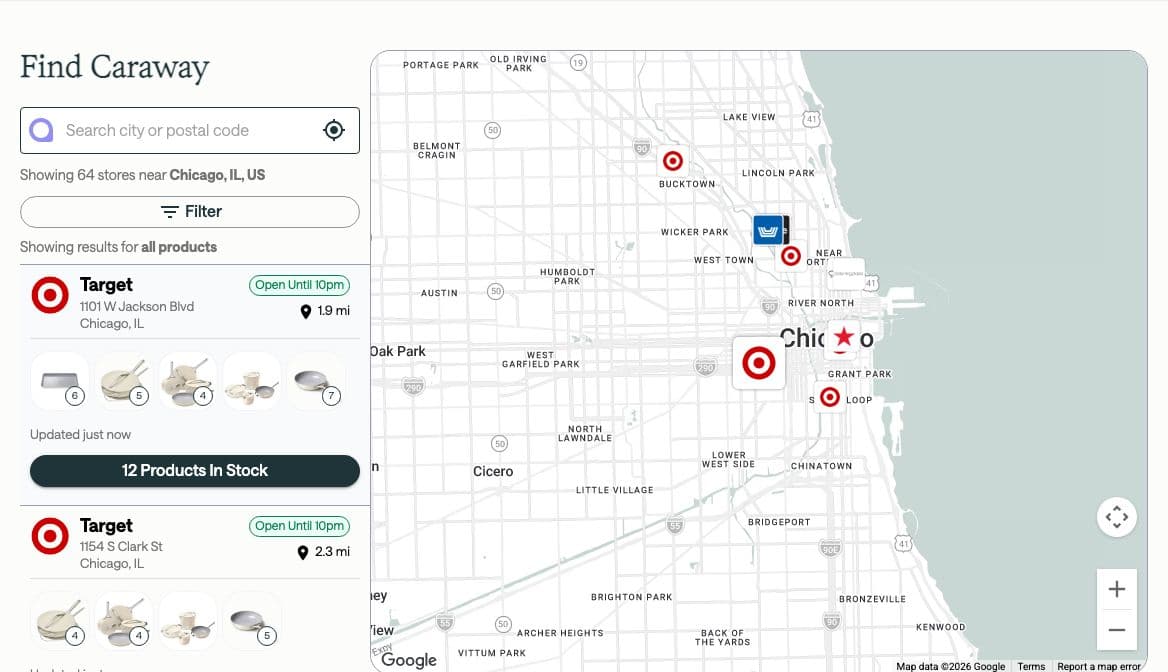
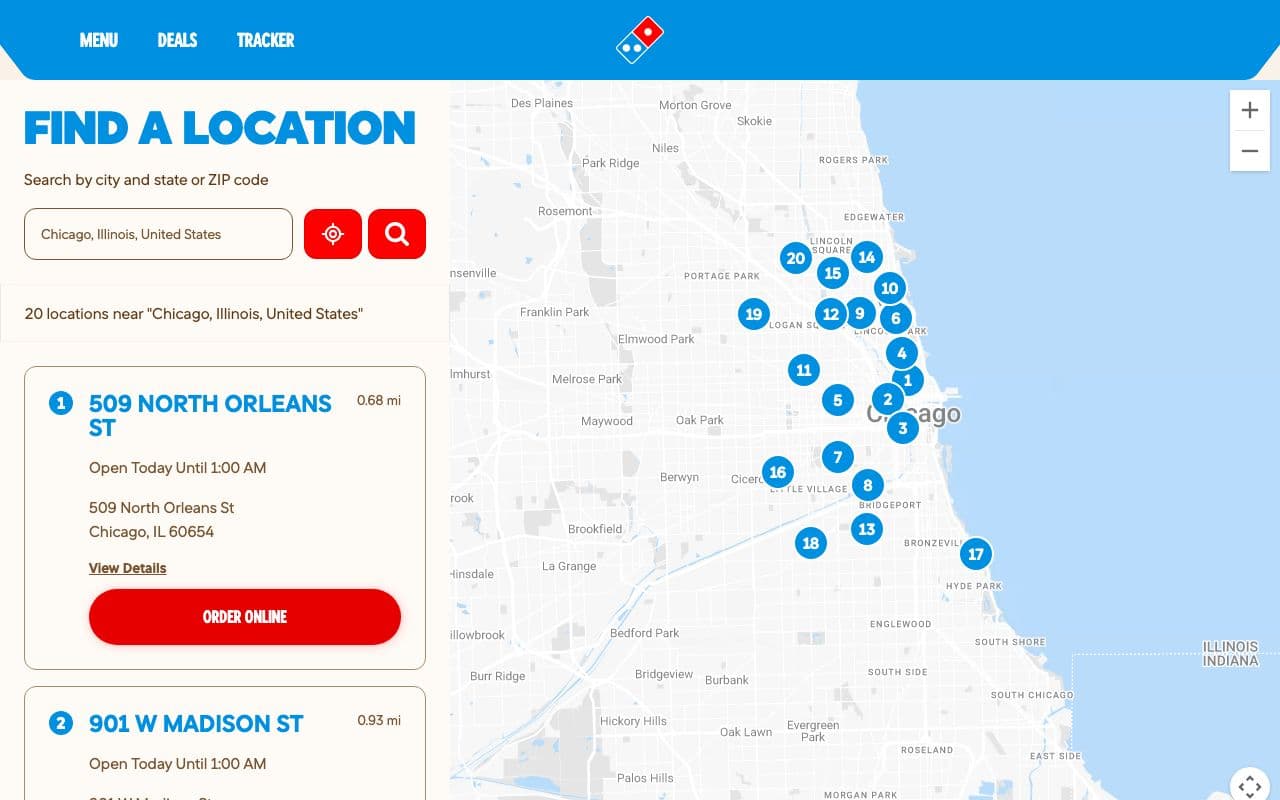
Both store locators as a shopper sees them, captured the same way: a 1280 by 800 browser window placed in Chicago, searching for Chicago. A demo holds whatever sample data its vendor chose, so where that changes what the picture shows, the caption says so. Each shot is trimmed to a common shape here; select one to see all of it.
StoreLocatorsCaptured October 15, 2026 from a live customer site, searching “Chicago, IL”.
StoreLocators · Captured October 15, 2026 from a live customer site, searching “Chicago, IL”.
YextCaptured October 15, 2026 from a customer the vendor names publicly, searching “Chicago, IL”.
Yext · Captured October 15, 2026 from a customer the vendor names publicly, searching “Chicago, IL”.
Pricing, side by side
Both publish, and the published sets barely overlap. Yext’s four plans run $199 to $999 a year and cover up to 10 locations. Ours start at $195 a month and are published up to 10,000 locations and beyond.
That difference is a scope difference rather than a value one. Yext’s self-serve tiers buy publisher distribution for a handful of your own locations; ours buy retailer availability data for a brand selling through stores it does not own.
StoreLocators
Prices published
Three tiers on our Shopify App Store listing, scaling by retail locations: Launch up to 2,000 locations, Grow from 2,000 to 10,000, and Scale above 10,000, at $195, $395 and $995 per month.
Month to month, no long-term contract and no termination fee
Refund available within 30 days of the latest charge
Map included; shopper sessions and map loads are not metered
Free trial documented. A 14-day free trial on every tier.
Sources,
Yext
Prices published
Four self-serve plans, billed annually and headlined weekly: Emerging $199 a year, Essential $449, Complete $499 and Premium $999. All are capped at 10 locations. Above that nothing is published and the page links to a demo request.
No free trial or free tier is published for the listings product
Each self-serve plan lasts 12 months
Self-serve is capped at 10 locations; enterprise pricing is quote-only
No public master agreement, data processing addendum or service level agreement found for plans above 10 locations
Cancelling does not overwrite updates already made through Yext
The tiers differ by publisher distribution rather than by feature
Free trial not documented either way. No trial is published for the listings product. An AI visibility report is offered on request as a separate entry point.
Sources,
StoreLocators vs Yext at a glance
Sixteen rows, current as of 15 October 2026. Several of these rows are about capabilities Yext does not aim at, which is a statement about scope rather than quality, and the sections below say which product fits which problem.
Source 1Yext: plans and pricingyext.com. Reviewed 2026-10-15.Full citationSource 2Yext: Listingsyext.com. Reviewed 2026-10-15.Full citationSource 3Yext: Knowledge Graphyext.com. Reviewed 2026-10-15.Full citationSource 4Yext: Pagesyext.com. Reviewed 2026-10-15.Full citationSource 5Yext: platform overviewyext.com. Reviewed 2026-10-15.Full citationSource 6Yext Trust Centertrustcenter.yext.com. Reviewed 2026-10-15.Full citationSource 7Yext on TrustpilotTrustpilot. Reviewed 2026-10-15.Full citationSource 8Yext on CapterraCapterra. Reviewed 2026-10-15.Full citationSource 9Shopify App Store: search for YextShopify App Store. Reviewed 2026-10-15.Full citationSource 10Yext: Shopify Products connectoryext.com. Reviewed 2026-10-15.Full citationSource 11Yext: Form 8-K, second quarter fiscal 2027 resultsU.S. Securities and Exchange Commission. Reviewed 2026-10-15.Full citationSource 12Yext: customer storiesyext.com. Reviewed 2026-10-15.Full citationSource 13Yext: AI visibility reportyext.com. Reviewed 2026-10-15.Full citationSource 14StoreLocators: guarantee, refunds and cancellationstorelocators.com. Reviewed 2026-10-15.Open the sourceFull citationSource 15StoreLocators on the Shopify App StoreShopify App Store. Reviewed 2026-10-15.Open the sourceFull citationSource 16StoreLocators: free retailer store listsstorelocators.com. Reviewed 2026-10-15.Open the sourceFull citation
–Not published by the vendorYext: Contract termsEnterprise terms not published.We found no public master agreement, data processing addendum or service level agreement for plans above 10 locations. The self-serve plans page states that every plan lasts 12 months, and that cancelling does not overwrite updates already made through Yext.Source1. Yext: plans and pricing
Pricing
$195–$995 per monthStoreLocators: PricingThree tiers on our Shopify App Store listing, scaling by retail locations: Launch up to 2,000, Grow from 2,000 to 10,000, Scale above 10,000.Source15. StoreLocators on the Shopify App Store
Published to 10 locations, quoted aboveYext: PricingFour self-serve plans billed annually: Emerging $199, Essential $449, Complete $499 and Premium $999 a year, headlined as $4, $9, $10 and $19 a week. Essential, Complete and Premium show struck-through original weekly prices of $20, $22 and $35. The page is titled for one-location businesses and each plan lasts 12 months. Above 10 locations nothing is published.Source1. Yext: plans and pricing
Merchant ratingSame storefront, so these compare. Read with the count.
–Not published by the vendorYext: Merchant ratingNo Shopify App Store listing.There is nothing to rate on the storefront the rest of this group sells through: apps.shopify.com/yext returns a 404 and no Yext app appears in App Store search. What Yext does carry elsewhere is 2.0 out of 5 from 348 Trustpilot reviews and 4.2 out of 5 from 114 on Capterra.Those are third-party software-directory scores for an enterprise platform rather than merchant ratings from the same storefront, so they are not comparable with the other rows in this group. The gap between the two is picked apart further down the page.Sources9. Shopify App Store: search for Yext7. Yext on Trustpilot8. Yext on Capterra
–Not published by the vendorYext: Evaluate without a sales callNo trial published.No free trial or free tier is published for the listings product. Yext does offer an AI visibility report on request as a separate entry point.Sources1. Yext: plans and pricing13. Yext: AI visibility report
Retailer coverage
Adding a retailer you sell throughThe gap between the retailer list you are sold and the one you actually sell through.
On request, typically within days, at no additional cost
Built around locations you ownYext: Adding a retailer you sell throughYext describes its Knowledge Graph as verified facts "for every location you own", and its connectors bring in and distribute your own data. None of its pages we read describes finding a retailer that started stocking you.Sources5. Yext: platform overview3. Yext: Knowledge Graph
Retailer coverageCoverage only counts where you actually sell.
–Not published by the vendorYext: Retailer coveragePublishers, not retailers.Yext publishes a network of 200+ publishers, directories and LLMs reached by direct integration rather than through an aggregator, and states 12M+ locations managed on its listings page against a 9M+ figure on its homepage. Those count places it distributes to and locations under management, not retailers that stock a brand.Source2. Yext: Listings
Location capA cap you can grow past is a repricing event, not a feature.
Priced by retail locations, not cappedStoreLocators: Location capPlans scale by location count rather than cutting the map off at a number.
10 on self-serve, unpublished aboveYext: Location capEvery published plan stops at 10 locations. Above that the page links to a demo request, and no location cap or price is published for enterprise agreements.Source1. Yext: plans and pricing
Data and freshness
Where the store data comes fromThe whole difference. Everything else follows.
Automatic discovery across 205 integrated retailer feedsStoreLocators: Where the store data comes fromNo spreadsheet to maintain. Retailers that stock you are found in their own feeds and appear without you entering them.
Your own location data, distributed outwardYext: Where the store data comes fromPre-built connectors, APIs, spreadsheet uploads and automated website crawls, per its Knowledge Graph page. The direction of travel is the opposite of ours: Yext takes the locations you already own and pushes them out to publishers, rather than bringing in locations you do not know about.Sources2. Yext: Listings3. Yext: Knowledge Graph
Refresh cadenceA locator that sends a shopper to a store that dropped the line costs more trust than it wins.
Retailer feeds, refreshed daily
As current as the data you maintainYext: Refresh cadenceYext keeps publishers in sync with your record. How current that record is remains your responsibility, and no refresh interval applies because there is no third-party data being pulled in.Source2. Yext: Listings
Product-level availabilityWhether the map answers "who has this product" or only "where are the shops".
YesPer product, per variant, per store, filtered to in-stockStoreLocators: Product-level availabilityRetailer-reported rather than a live poll of a physical shelf, which is the honest description of what this category actually has.
–Not verified by usYext: Product-level availabilityYext distributes inventory outward rather than discovering it. Its Listings page sells publishing “inventory in real time” and pushing “product availability to directories and shopping sites”, which takes stock data you already hold and syndicates it. Nothing published describes reading availability back from retailers you do not control, which is the direction this row is about.Sources2. Yext: Listings3. Yext: Knowledge Graph5. Yext: platform overview
Hosted platform with an APIYext: Install pathNo Shopify App Store listing and no dedicated commerce-platform plugin. Yext is a hosted SaaS platform integrated through its API and its Pages product rather than a widget dropped onto a storefront.Sources5. Yext: platform overview9. Shopify App Store: search for Yext
Developer requiredWhether this ships this week or waits for engineering time.
NoNot required
Not for Pages, likely for integrationYext: Developer requiredYext claims location pages are launched in minutes with no developers needed, and no-code templates back that up. Wiring your own systems into the Management or Content Delivery APIs is a different exercise.Sources4. Yext: Pages5. Yext: platform overview
Minutes for pages, days at scaleYext: Time to launchTheir claim: pages launched in minutes with no developers, and thousands of location, provider or service pages launched in days.Source4. Yext: Pages
Who pays for the mapA locator billed per map load has a second invoice attached to it, from Google or Mapbox rather than the vendor.
YesIncludedStoreLocators: Who pays for the mapThe map is part of the subscription. There is no separate Google or Mapbox bill, and shopper sessions are not metered.
–Not verified by usYext: Who pays for the mapNo Yext page we checked states whether a customer-supplied map key is required or whether mapping is bundled. Nothing published says how the map is billed, so this cell is marked unknown.Source1. Yext: plans and pricing
Features
Wholesale self-submissionIndependent stockists rarely appear in any feed. Letting them add themselves is the only way to catch them.
YesSubmit Your Location block
–Not verified by usYext: Wholesale self-submissionNo stockist or dealer self-submission intake appears on the Yext pages we read, which fits a platform built around your own locations. Nothing states that it is absent either, so this is our limit rather than a statement about the product.Source5. Yext: platform overview
Support
Support model
Every message reaches Our Customer Success & Onboarding Specialist
Help centre, docs, academy and sales-ledYext: Support modelA help centre, API documentation, Yext Academy training and a sales contact route. Vendor-supplied information on Capterra also lists email, phone and 24/7 live representatives. No response-time commitment is published on the site.Sources8. Yext on Capterra5. Yext: platform overview
Yext in its own words
“launched in minutes, no developers needed”
“CTAs, embedded reviews, and booking tools built in”
“Buying for more than 10 locations?”
That third quote is the shape of the commercial relationship. Yext publishes four self-serve plans, and every one of them stops at 10 locations. Above that there is no published price, no published location cap and no published contract; there is a demo request. For most brands reading this page, Yext is a sales-quoted enterprise purchase.
It is worth being clear that the self-serve plans are a listings product rather than a locator product. What they buy is distribution: the Emerging tier lists you on ten named smaller directories and thirty more, and the higher tiers add Google, Apple, Bing, Yelp, Facebook, Foursquare and MapQuest among others.
Where StoreLocators is different
We answer a question Yext does not ask
Which nearby store has this product, from retailer feeds refreshed daily. Yext publishes availability you already hold out to directories; it does not gather it back from retailers you do not control. For a brand selling through other people’s shelves, that direction is the whole requirement rather than a feature comparison.,
The locations come from outside your own records
Yext distributes data about locations you already hold. We discover retailers that stock you across integrated feeds, so a store that started carrying your line appears without anybody adding it. Those are opposite directions of travel, and only one of them helps a brand that does not know its own retail footprint.,
A price above ten locations
Every Yext self-serve plan stops at 10 locations, and above that there is a demo request rather than a number. Our prices are published to 10,000 locations and beyond, on a public app listing, with no call required to see them.,
Live the same day, on Shopify
A Shopify app section in under five minutes. Yext has no Shopify App Store listing and no commerce-platform plugin; it is a hosted platform you integrate with.,,
Every row where the table above separates us
Taken from that table rather than written out again, so the two cannot disagree. A row shows up here when we publish an answer and they publish none, or when both answer and ours covers more of the feature. Rows where both sides publish a figure, a price or a rating, stay out: those differ by their content.
StoreLocators: Submit Your Location block|Yext: Not verified
Listings and locators are not the same product
A store locator answers a shopper’s question on your website: where can I get this. A listings platform answers a different one, out on the rest of the internet: is this business’s address, phone number and opening hours correct wherever someone finds it.
Yext is the second thing. Its network of 200+ publishers exists so that one correction to your record propagates to Google, Apple, Bing, Yelp, Facebook, Foursquare and the long tail, by direct integration rather than through an aggregator. For a chain of 400 branches with drifting hours data, that is a real and expensive problem and Yext is the standard answer to it.,
It is not the first thing, and does not claim to be. Its pages describe no product availability feature, and its data model is built around locations you own rather than retailers that started stocking you. If your locations are stores other companies own, Yext has nothing to distribute on your behalf, because the data is not yours.,
The brands that need both tend to buy both, and that is a perfectly sensible outcome. The ones who should think hardest are brands with few or no owned locations, where a listings subscription can end up managing a head office address.
What the published prices actually buy
Yext publishes four plans, billed annually and headlined as a weekly figure: Emerging at $199 a year, Essential at $449, Complete at $499 and Premium at $999. Essential, Complete and Premium display struck-through original weekly prices of $20, $22 and $35.
All four stop at 10 locations. The page carries a line reading "Buying for more than 10 locations?" above a demo request, and above that ceiling nothing is published: no price, no location cap, no contract, no service level agreement. For most brands that reach this page, Yext is a sales-quoted enterprise purchase and the published tiers are not the relevant product.
Worth noting what the cheapest tier includes, because the ladder is about distribution breadth rather than features. Emerging lists you on ten named smaller directories, Merchant Circle, eLocal, Topix, YellowPageCity, LocalStack, EZLocal, ShowMeLocal, WhereTo?, YellowMoxie and CitySquares, plus thirty more. The major publishers, Google, Apple, Bing, Yelp and Facebook among them, arrive on the higher tiers.
Two review scores that disagree
Yext holds 2.0 out of 5 on Trustpilot across 348 reviews, and 4.2 out of 5 on Capterra across 114. That is a wide enough gap to need explaining rather than quoting.,
The Trustpilot distribution is bimodal rather than uniformly poor: 48% five-star against 35% one-star, with 17% across the three ratings in between. The recurring themes in the negative half are unresponsive support and difficulty getting listing data corrected. A pattern like that usually means a product that works well when it works and is painful when something needs fixing.
We are putting both numbers here with the distribution because publishing the 2.0 on its own would be the easy version of this page and a misleading one. Neither score settles anything; the Trustpilot population for enterprise software skews towards people with an unresolved problem, and directory reviews are often invited by the vendor.,
Moving from Yext to StoreLocators
Usually the wrong framing, and worth saying so before the steps. These products do different jobs, so most brands that have both keep both. The move below is for the case where Yext was bought to power a store locator and that turned out not to be the job it is best at.
If listings distribution is genuinely being used, replacing Yext with us leaves that gap open, and nothing here fills it.
1Decide which half you are replacingSeparate what Yext is doing for you: listings distribution, on-domain location pages, and the locator itself. Only the third is something we replace.One conversation
2Export your location recordsYext has a full Management API and CSV export. Take everything, including the fields you built up over time.Under an hour
3Separate owned locations from retailYour own branches become managed locations. Retailer locations arrive from feeds, so they do not need to come across at all.An hour or so, once
4Turn on your retailersChoose the retailers you sell through from the integrated list. Anything missing is added on request, typically within days, at no extra cost.Minutes, plus our turnaround for anything new
5Install and redirectAdd the app section on Shopify or a script and one div elsewhere, then redirect the old locator URL.Under 5 minutes on Shopify
Frequently asked questions
How much does Yext cost?
Yext publishes four self-serve plans, billed annually and headlined as a weekly price: Emerging at $199 a year, Essential at $449, Complete at $499 and Premium at $999. Essential, Complete and Premium display struck-through original weekly prices of $20, $22 and $35, and each plan lasts 12 months. The page is aimed at single-location businesses and sends anyone buying for more than 10 locations to a demo. Above that nothing is published and the page directs you to a demo request, so for most brands Yext is a sales-quoted enterprise purchase. The tiers differ by which publishers you are distributed to rather than by feature.
Is Yext a store locator?
Not primarily. Yext is a listings management platform: its core job is keeping your own location data correct across Google, Apple, Bing, Yelp and a network of 200+ publishers, and building on-domain location pages at scale. It can publish inventory and product availability out to directories and shopping sites, but that syndicates stock data you already hold; none of its product pages we read describes discovering which retailers stock you, or reading their availability back. If the question is where your own branches are, Yext handles that very well. If it is which nearby shop has your product, that is a different product.,,
Why is Yext rated 2.0 on Trustpilot?
The score is real, across 348 reviews, but the distribution matters: it is bimodal, roughly 48% five-star against 35% one-star, with 17% in between. The recurring complaints are unresponsive support and difficulty getting listing data corrected. On Capterra the same product holds 4.2 across 114 reviews. Neither figure settles anything on its own. Trustpilot populations for enterprise software skew towards people with an unresolved problem, and directory reviews are often invited by the vendor, which is why both are on this page rather than the lower one.,
Does Yext have a Shopify app?
No. There is no Yext listing on the Shopify App Store: apps.shopify.com/yext returns a 404 and no Yext app appears in App Store search. There is no dedicated commerce-platform plugin either. Yext is a hosted platform integrated through its APIs and its Pages product rather than a widget installed on a storefront. The one thing that sounds like an exception is not one: Yext publishes a Shopify Products connector, but by its own documentation that is a custom app you create inside your own Shopify admin and authenticate with an Admin API token, and it pulls your product catalogue into Yext rather than putting a locator on your store.,,
What is the best Yext alternative?
It depends entirely on which half of Yext you are replacing. For listings distribution across Google, Apple, Bing and Yelp, the alternatives are other listings platforms and we are not one of them. For the locator itself, particularly if your products sit in retailers you do not own, StoreLocators does that instead: retailer feeds refreshed daily, per-product and per-store availability, published pricing well past 10 locations, and a Shopify install in under five minutes.
Every Yext claim on this page was taken from yext.com, its plans, platform, listings, content and pages sections, its public Trust Center, its SEC filings, or its listings on Capterra and Trustpilot, and each was checked on 15 October 2026. The sources are listed below with the exact URL we read.,,
Every claim was checked twice against the vendor's own pages before publishing.,
Some things are deliberately absent rather than estimated. No enterprise price, location cap or contract term is published above 10 locations, and none is guessed at here. Whether a customer-supplied map key is needed is not addressed on any page we read, so that cell says so. Yext states 12M+ locations managed on one page and 9M+ on another, so neither figure is used. Claims about StoreLocators come from our own public pages and are not separately cited.
Sources
16 sources
Every claim on this page cites the source it came from, with the date we checked it. Sources are named but not linked; search for the title to find the page.
1.Yext: plans and pricingyext.com. Reviewed 2026-10-15.“Buying for more than 10 locations?”The pricing page, which sits at /plans (now redirecting to /pl/powerlistings/plans.html) rather than /pricing; /pricing returns 404. Titled for one-location businesses, and states that all plans last 12 months. Four plans, billed annually with a weekly headline: Emerging $199 a year, Essential $449, Complete $499 (marked Best Value) and Premium $999, with struck-through original weekly prices of $20, $22 and $35 on the upper three. Buyers of more than 10 locations are directed to a demo. The Emerging tier names ten smaller directories, Merchant Circle, eLocal, Topix, YellowPageCity, LocalStack, EZLocal, ShowMeLocal, WhereTo?, YellowMoxie and CitySquares, plus 30 more; Essential adds Google, Yahoo, Facebook, Bing, Apple, Yelp, MapQuest, Citysearch, Local.com and Foursquare plus 4 more. Also states that cancelling does not overwrite the updates made through Yext. This older page cites 100+ direct integrations, against 200+ on the current platform pages.
2.Yext: Listingsyext.com. Reviewed 2026-10-15.“Retail: Publish inventory in real time. Push product availability to directories and shopping sites to drive conversions by showing customers what’s in stock.”Source for the 200+ publisher, directory and language-model network reached by direct integration rather than through an aggregator, and for 12M+ locations managed, which conflicts with a 9M+ figure on the homepage; neither figure is used on this page. No mechanism for discovering unlisted stores appears here. The retail section sells publishing inventory and product availability outward to directories and shopping sites, and the FAQ adds that "retailers can publish inventory data across relevant platforms" — syndication of stock the brand already holds, not discovery of a third-party retailer’s shelf.
3.Yext: Knowledge Graphyext.com. Reviewed 2026-10-15.Replaces /platform/content, which returned a server error on 15 October 2026. Describes modelling locations, providers, products, services and events as entities, and bringing data in through 50+ pre-built connectors, APIs, spreadsheet uploads or automated web crawls. The words inventory, in-stock and availability do not appear.
4.Yext: Pagesyext.com. Reviewed 2026-10-15.“launched in minutes, no developers needed”Also states "Launch thousands of location, provider, or service pages in days" and "CTAs, embedded reviews, and booking tools built in". On-domain per-location pages with built-in schema markup and no-code templates. Named case studies, Domino’s, Cox Communications and Fazoli’s among them, sit on the customer stories page.
5.Yext: platform overviewyext.com. Reviewed 2026-10-15.A hosted SaaS platform. Its developer documentation lists Management, Content Delivery, Events and Agreements APIs. The platform page describes the Knowledge Graph as verified facts "for every location you own". No Shopify App Store listing or dedicated commerce-platform plugin appears anywhere on it.
6.Yext Trust Centertrustcenter.yext.com. Reviewed 2026-10-15.Public and linked from the site footer, carrying a SOC 2 entry, penetration testing reports, a network diagram and status monitoring. It states a Recovery Time Objective of 24 hours; no uptime percentage is published on it.
7.Yext on TrustpilotTrustpilot. Reviewed 2026-10-15.2.0 across 348 reviews on 15 October 2026, distributed 48% five-star, 8% four-star, 5% three-star, 4% two-star and 35% one-star. Recurring themes in the one-star reviews are unresponsive support, difficulty getting listing data corrected, and billing after cancellation.
8.Yext on CapterraCapterra. Reviewed 2026-10-15.4.2 across 114 reviews, with a customer service sub-rating of 4.0. Vendor-supplied support information on this listing names email support, phone access, 24/7 live representatives and a knowledge base, none of which carries a published response-time commitment on Yext’s own site.
9.Shopify App Store: search for YextShopify App Store. Reviewed 2026-10-15.Checked on 11 September 2026: no Yext app appears in App Store search. apps.shopify.com/yext also returned 404 on 15 October 2026.
10.Yext: Shopify Products connectoryext.com. Reviewed 2026-10-15.“Have created a custom app in your Shopify store”Yext’s only Shopify touchpoint, and not an App Store listing. Installing it requires the merchant to create a custom app inside their own Shopify admin and supply an Admin API access token, and what it does is pull the merchant’s product catalogue into Yext Content. It is a data-ingestion source rather than a storefront locator widget, and it is not distributed through apps.shopify.com.
11.Yext: Form 8-K, second quarter fiscal 2027 resultsU.S. Securities and Exchange Commission. Reviewed 2026-10-15.Filed 1 September 2026. States Annual Recurring Revenue of $440.8 million as of 31 July 2026 and identifies the stock as listed on the New York Stock Exchange. A take-private proposal from the CEO in August 2025 was withdrawn in February 2026.
12.Yext: customer storiesyext.com. Reviewed 2026-10-15.Lists named customer stories including Domino’s, Cox Communications, Fazoli’s, FedEx, IHG Hotels & Resorts and Samsung.
13.Yext: AI visibility reportyext.com. Reviewed 2026-10-15.A form offering a report on how a brand appears across AI and traditional search. The page does not state a price, so this page does not call it free.
14.StoreLocators: guarantee, refunds and cancellationstorelocators.com. Reviewed 2026-10-15.“StoreLocators.com operates on a month-to-month subscription model with no long-term contracts or termination fees.”Also states that a subscription can be cancelled at any time through Account Settings under Billing, and that a refund may be requested within 30 days of the latest charge.
16.StoreLocators: free retailer store listsstorelocators.com. Reviewed 2026-10-15.Publishes 110,516 store locations across 205 retailers as free CSV downloads with addresses, phone numbers, opening hours and coordinates. The counts are taken from the live lists.
110,516+ locations connected
Every ClickDeserves aDestination
Connect your online shoppers to in-stock products at retail stores nearby. In five minutes. With zero maintenance.