Simple Shopify map widget with a bundled map on every plan
Way is the simplest locator in this comparison and the easiest to get running: the map is bundled on every plan including the free one, so there is no API key and no cloud account, the install is one click, and it carries a Built for Shopify badge. Its import template has thirteen columns and none of them is a product.
Last reviewed
The short answer
If the requirement is a map with pins on a Shopify page and nothing else, Way does it with less setup than anything here. We are the better buy the moment the question becomes which stores carry a product, or the store list stops being one somebody maintains by hand.
What each product is designed to do, in its own terms. A capability named on one side is not a claim that the other lacks it, and neither column ranks the two: the table below is where they are compared row by row.
What Way is built for
You own your locations and the list is short and stable
Getting a map live with no cloud account is the priority
Opening hours have to be right, per day, per store
Annual billing at $67.10 for fifty locations, the lowest rate in this comparison, is the deciding factor
Eleven interface languages on the cheapest plan is what you need
You are on Shopify and only on Shopify
The terms rule out refunds after purchase, so treat the seven-day trial as the entire evaluation window.
What StoreLocators is built for
Retailers you do not control hold the store list
Shoppers need to know which store has a product
The store list runs past a couple of thousand locations
The locator has to be findable in search, not only usable on the site
You want published refund terms and documentation to read
StoreLocators and Way, side by side
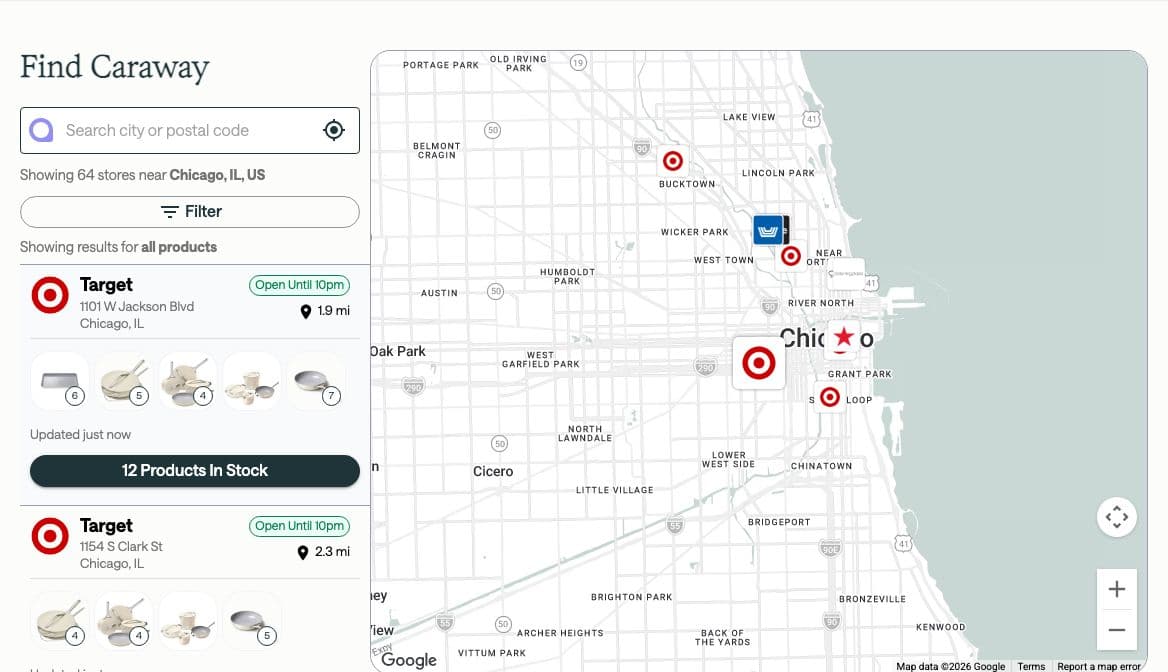
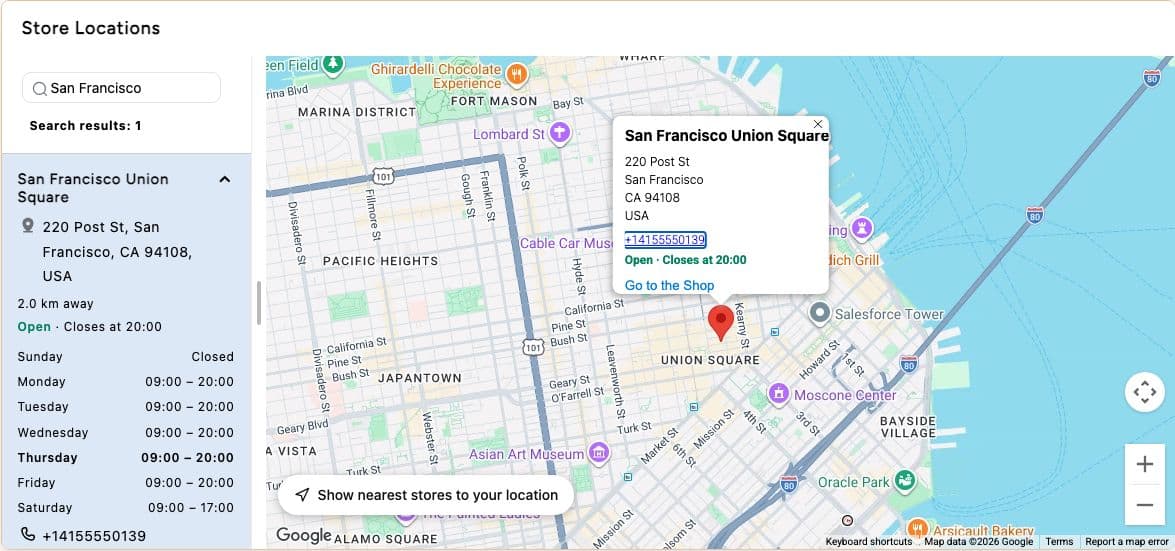
Both store locators as a shopper sees them, captured the same way: a 1280 by 800 browser window placed in Chicago, searching for Chicago. A demo holds whatever sample data its vendor chose, so where that changes what the picture shows, the caption says so. Each shot is trimmed to a common shape here; select one to see all of it.
StoreLocatorsCaptured October 15, 2026 from a live customer site, searching “Chicago, IL”.
StoreLocators · Captured October 15, 2026 from a live customer site, searching “Chicago, IL”.
WayCaptured October 15, 2026 from the vendor’s own demo, searching “San Francisco”.The box here filters the store list by text rather than searching by location, and the demo's two sample stores are in San Francisco and Austin, so "San Francisco" was typed instead of Chicago.
Way · Captured October 15, 2026 from the vendor’s own demo, searching “San Francisco”. The box here filters the store list by text rather than searching by location, and the demo's two sample stores are in San Francisco and Austin, so "San Francisco" was typed instead of Chicago.
Pricing, side by side
Not a close comparison on price. Way covers two thousand locations for $287.90 a year. Our entry tier is $195 a month.
What separates them is what the money buys. Way prices a map widget for locations you upload. Ours prices retailer availability data for locations you do not own, refreshed daily. On a short owned store list, that is a very large amount of money for something not being used.
StoreLocators
Prices published
Three tiers on our Shopify App Store listing, scaling by retail locations: Launch up to 2,000 locations, Grow from 2,000 to 10,000, and Scale above 10,000, at $195, $395 and $995 per month.
Month to month, no long-term contract and no termination fee
Refund available within 30 days of the latest charge
Map included; shopper sessions and map loads are not metered
Free trial documented. A 14-day free trial on every tier.
Sources,
Way
Prices published
Four plans: Free at 1 location with in-app branding, Basic at $6.99 a month or $67.10 a year for up to 50, Advanced at $14.99 or $143.90 for up to 500, and Pro at $29.99 or $287.90 for up to 2,000. Annual billing saves 20% on every paid tier, each of which carries a 7-day free trial.
No API key required on any plan; the map is bundled including on the free tier
Charges billed in USD every 30 days; no per-location or usage charge is published
Subscriptions renew automatically until cancelled by the user
No refunds are provided after a transaction has been completed
The terms state the plugin may be interrupted by errors outside the operator’s control
A listing highlight promises unlimited locations, which the 2,000-location top plan contradicts
Free trial documented. A 7-day free trial on each paid plan, plus a permanent free plan at 1 location with in-app branding.
Sources,
StoreLocators vs Way at a glance
Sixteen rows. The map row goes to Way outright, and the availability row is decided by an import template with no product column in it.
Source 1Way: Google Maps Store Locator on the Shopify App StoreShopify App Store. Reviewed 2026-10-15.Full citationSource 2Way: Google Maps Store Locator reviews on the Shopify App StoreShopify App Store. Reviewed 2026-10-15.Full citationSource 3Effectify help centre: bulk import for Wayeffectify.help. Reviewed 2026-10-15.Full citationSource 4Effectify: terms of serviceeffectify.help. Reviewed 2026-10-15.Full citationSource 5Effectify: privacy policyeffectify.help. Reviewed 2026-10-15.Full citationSource 6Effectify help centreeffectify.help. Reviewed 2026-10-15.Full citationSource 7Effectify: status pageeffectify.io. Reviewed 2026-10-15.Full citationSource 8Effectify: company siteeffectify.io. Reviewed 2026-10-15.Full citationSource 9StoreLocators: guarantee, refunds and cancellationstorelocators.com. Reviewed 2026-10-15.Open the sourceFull citationSource 10StoreLocators on the Shopify App StoreShopify App Store. Reviewed 2026-10-15.Open the sourceFull citationSource 11StoreLocators: free retailer store listsstorelocators.com. Reviewed 2026-10-15.Open the sourceFull citation
Auto-renewing until cancelled, no refundsWay: Contract termsSubscriptions renew automatically until cancelled by the user, and cancelling does not cancel fees already owed. The terms state that no refunds will be provided after a transaction has been completed, which is the strictest position in this comparison. They also state that the plugin’s activity may be interrupted by errors outside the operator’s control.Source4. Effectify: terms of service
Pricing
$195–$995 per monthStoreLocators: PricingThree tiers on our Shopify App Store listing, scaling by retail locations: Launch up to 2,000, Grow from 2,000 to 10,000, Scale above 10,000.Source10. StoreLocators on the Shopify App Store
Free–$29.99 per monthWay: PricingAnnual billing at $67.10, $143.90 and $287.90 saves 20% on each paid tier. Charges are billed in USD every 30 days, and no per-location or usage charge is published for this app.Source1. Way: Google Maps Store Locator on the Shopify App Store
Merchant ratingSame storefront, so these compare. Read with the count.
4.7Way: Merchant rating4.7 from 135 reviews on Shopify App Store.A long, solid record rather than a spotless one: 119 five-star, 11 four, none at three, 3 two-star and 2 one-star, on a listing live since April 2020. Two of the two-star reviews are the ones to read before the trial ends, since they describe the theme display and the free plan. Shopify is the only rating we can check; any G2 or Capterra standing is unknown, so nothing from those appears here.Source2. Way: Google Maps Store Locator reviews on the Shopify App Store
–Not published by the vendorWay: Retailer coverageNo retailer network.Way supplies no store data. The vendor’s customer and revenue figures are company-wide across roughly three dozen apps rather than anything about this one.Source8. Effectify: company site
Location capA cap you can grow past is a repricing event, not a feature.
Priced by retail locations, not cappedStoreLocators: Location capPlans scale by location count rather than cutting the map off at a number.
1 free, then 50, 500 and 2,000Way: Location capFour hard caps with no overage rate published. Note that a highlight on the same listing promises unlimited store locations, which the top plan’s two-thousand cap contradicts.Source1. Way: Google Maps Store Locator on the Shopify App Store
Data and freshness
Where the store data comes fromThe whole difference. Everything else follows.
Automatic discovery across 205 integrated retailer feedsStoreLocators: Where the store data comes fromNo spreadsheet to maintain. Retailers that stock you are found in their own feeds and appear without you entering them.
Refresh cadenceA locator that sends a shopper to a store that dropped the line costs more trust than it wins.
Retailer feeds, refreshed daily
Whenever you re-import or editWay: Refresh cadenceNothing refreshes on its own. The map is as current as the last file somebody uploaded.Source3. Effectify help centre: bulk import for Way
Product-level availabilityWhether the map answers "who has this product" or only "where are the shops".
YesPer product, per variant, per store, filtered to in-stockStoreLocators: Product-level availabilityRetailer-reported rather than a live poll of a physical shelf, which is the honest description of what this category actually has.
NoNo product field in the data modelWay: Product-level availabilityThe import template has no product, tag, SKU or inventory column, so there is nowhere to record what a store carries even manually. This is a boundary of the data model rather than a missing feature.Source3. Effectify help centre: bulk import for Way
A theme app block, or a floating widgetWay: Install pathTwo modes: an app block you place on a page, and a floating map injected by script tag. The app requests write access to Online Store script tags, theme and files, which is worth knowing if your theme is managed by someone else.Source1. Way: Google Maps Store Locator on the Shopify App Store
Developer requiredWhether this ships this week or waits for engineering time.
NoNot required
NoNot requiredWay: Developer requiredOne-click installation with universal theme support, and no API key to create at any tier. The app carries a Built for Shopify badge.Source1. Way: Google Maps Store Locator on the Shopify App Store
–Not published by the vendorWay: Time to launchNo setup time published.No figure is stated, and the claim is one-click installation. With the map bundled there is no account-creation step in front of it, which is the part that usually takes the time.Source1. Way: Google Maps Store Locator on the Shopify App Store
Who pays for the mapA locator billed per map load has a second invoice attached to it, from Google or Mapbox rather than the vendor.
YesIncludedStoreLocators: Who pays for the mapThe map is part of the subscription. There is no separate Google or Mapbox bill, and shopper sessions are not metered.
YesIncluded on every planWay: Who pays for the mapNo API key is required, stated on all four plans including the free one. There is no Google Cloud project to set up and no separate map bill. One of very few products here that can say that at every tier.Source1. Way: Google Maps Store Locator on the Shopify App Store
Features
Wholesale self-submissionIndependent stockists rarely appear in any feed. Letting them add themselves is the only way to catch them.
Every message reaches Our Customer Success & Onboarding Specialist
Email and live chat, same on every planWay: Support modelOnline support appears identically on all four plans, so nothing is gated. The help centre’s entire coverage of this app is two articles, one on bulk import and one on showing the floating icon on specific pages. No response-time commitment is published.Sources6. Effectify help centre1. Way: Google Maps Store Locator on the Shopify App Store
Way in its own words
“Universal theme support and easy one click installation - no API key is required”
“No refunds will be provided after the transaction has been completed”
The first is the product’s whole argument and it is a good one. The map is bundled on all four plans, the free one included, so there is no Google Cloud project, no billing account and no second invoice. Several vendors in this comparison make that the customer’s first job.
The second is the strictest refund position in this set, and it sits beside a seven-day trial. Take the trial seriously: it is the only window in which a mistake costs nothing.,
Where StoreLocators is different
The store list is found rather than uploaded
Way maps a file you upload, with no sync and no discovery. We find retailers that stock you across integrated feeds, refreshed daily, so a store that started carrying your line appears without anyone re-exporting anything.
There is nowhere to put a product
Way’s import template has thirteen columns and none of them describes what a store sells. Ours is per product and per store from retailer feeds, refreshed daily. That is not a feature gap between similar products; it is the line between a map of shops and a where-to-buy answer.
Refund terms that exist
Their terms state that no refunds are provided after a completed transaction, so the seven-day trial is the whole evaluation window. Ours allow a refund within thirty days of the latest charge, with cancellation self-serve.,
Documentation, and something to search for
The help centre’s entire coverage of Way is two short articles, and no per-location search surface is established. Ours publishes store lists running to tens of thousands of locations and location pages that can be indexed. At $6.99 a month the first trade is fair; it is what you outgrow.,
Every row where the table above separates us
Taken from that table rather than written out again, so the two cannot disagree. A row shows up here when we publish an answer and they publish none, or when both answer and ours covers more of the feature. Rows where both sides publish a figure, a price or a rating, stay out: those differ by their content.
StoreLocators: Submit Your Location block|Way: Not offered
Thirteen columns, and what they decide
The clearest way to understand any locator is to read its import template, because that is the shape of everything it can ever say. Way’s has thirteen columns: title, full address, latitude, longitude, phone, image URL, and one for each day of the week.
That is a complete answer to where the shops are. It is a good answer, too: the hours handling is genuinely well specified, taking both 24-hour and 12-hour formats, a Closed value for days a store does not open, and a midnight-to-midnight range for the ones that never close.
What is not there is any column describing what a store sells. No product, no tag, no SKU, no inventory. So the question a shopper holding a specific item actually asks, which of these places has it, has no field to be answered in. That is a boundary rather than a bug, and it is where the comparison with a where-to-buy platform ends rather than begins.
Three things to settle inside the trial
The refund position makes the seven-day trial unusually load-bearing. The terms state that no refunds will be provided after a transaction has been completed, so anything discovered in week two is a month you have already paid for.,
First, test the display path on your actual theme. One merchant review from May 2026 reports the locator not loading on their theme and the store icon not being removable. One report is not a pattern, and it is precisely what a trial is for.
Second, if you are planning to run on the free plan, confirm what it displays. A July 2026 review says the free plan advertises one store locator, and that showing that store required an upgrade. The vendor’s reply says the free plan’s floating locator works for a single store out of the box. One account against the other, so verify it rather than assuming either way.
Third, check the cap against your list. The listing’s own highlight promises unlimited store locations while its top plan caps at two thousand. The plan tables are the numbers that bill you.
Who is behind it, and what is documented
Way is one of roughly three dozen Shopify apps from an Israeli company, and the customer and revenue figures on the vendor’s site are company-wide across all of them rather than anything about this product.
Two things point in opposite directions on operational maturity. The help centre’s entire coverage of this app is two articles, one on bulk import and one on limiting the floating icon to specific pages, with the related-articles sidebar pointing at unrelated apps in the portfolio, so there is little setup, styling or troubleshooting documentation to read. Against that, the vendor runs a public status page which monitors this app by name, which is more than almost anything in this price bracket offers.,
On privacy the record is better than the documentation: the privacy policy names both the GDPR and the California Consumer Privacy Act explicitly. No SOC 2, ISO 27001 or data processing agreement was found.
Moving from Way to StoreLocators
One of the simplest moves in this set, because there is very little to move: thirteen columns of location data and little configuration to speak of.
The point of the move is that retailer locations stop being rows anyone owns. Your own locations stay managed; the rest arrive from feeds.
1Export, or find the file you importedPaid plans list bulk export, and the original import file already carries addresses, coordinates, phone numbers, images and per-day opening hours. The export format is not documented, so check it holds the opening hours before relying on it, and keep the import file either way.Minutes
2Separate owned locations from retailYour own sites and any independents you track by hand become managed locations. Chain retail rows do not need to come across: those retailers arrive from feeds, current.An hour or so, once
3Turn on your retailersChoose the retailers you sell through from the integrated list. Anything missing is added on request, typically within days, at no extra cost.Minutes, plus our turnaround for anything new
4Install and redirectAdd the app section on Shopify, then redirect the old locator page. If Way was running as the floating widget rather than an app block, check that the injected script has actually gone after uninstalling.Under 5 minutes on Shopify
5Cancel at the right point in the cycleSubscriptions auto-renew until cancelled and no refunds are given after a completed transaction, so cancel at the end of a paid period rather than the start of one.Minutes
Frequently asked questions
How much does Way Store Locator cost?
Four plans: free for 1 location with in-app branding, then $6.99 a month or $67.10 a year for up to 50 locations, $14.99 or $143.90 for up to 500, and $29.99 or $287.90 for up to 2,000. Annual billing saves 20% on every paid tier and each carries a 7-day free trial. There is no per-location or usage charge, and no API key is required on any plan, so the map costs nothing extra.
Does Way need a Google Maps API key?
No, on any plan including the free one. The listing states no API key is required alongside universal theme support and one-click installation. That means no Google Cloud project, no billing account and no separate map invoice, which is the step that most often stalls a locator project at the vendors in this comparison that require a customer key.
Can Way show which stores stock a product?
No, and it is worth understanding why rather than treating it as a missing setting. The import template has thirteen columns: title, full address, latitude, longitude, phone, image URL and one per day of the week. There is no product, tag, SKU or inventory column, so there is nowhere to record what a store carries even by hand. Way answers where the shops are, completely, and stops there.
Can I get a refund from Way?
No. The terms state that no refunds will be provided after the transaction has been completed, which is the strictest refund position of any vendor in this comparison. Subscriptions renew automatically until cancelled, so the practical advice is to use the full seven-day trial and to cancel at the end of a paid period rather than the start of one.
Is Way Store Locator good?
It holds 4.7 across 135 reviews on the Shopify App Store, with 119 at five stars, and carries the Built for Shopify badge; the listing launched in April 2020. Praise centres on how quickly it sets up and how fast support replies. The most specific critical reviews are two-star: one from May 2026 reporting the locator not loading on a particular theme, and one from July 2026 saying that showing the single free-plan store required an upgrade, which the vendor disputes in its reply. Both are worth verifying during the trial rather than after.
What is the best Way Store Locator alternative?
Several widgets in this class do the same job, and a few of them also bundle the map. If the problem is that the store list belongs to retailers rather than to you, or that shoppers want to know which store has a product rather than which stores exist, that is what StoreLocators does instead: retailer feeds refreshed daily rather than a file you upload, per-product and per-store availability, and the map inside the subscription. It costs many times more, which on a short owned store list is not worth paying.
Every Way claim on this page was taken from its Shopify App Store listing and review pages, the Effectify help centre, terms of service and privacy policy, the Effectify company site or its public status page, and each was last checked on 15 October 2026. The sources are listed below with the exact URL we read.,,
Every claim was checked twice against the vendor's own pages before publishing.,,,
Geocoding behaviour is not documented anywhere in the vendor’s material, so no claim about it appears, in either direction. Whether the locator page produces crawlable per-location URLs could not be established, so the page says the vendor lists a locator page and stops there. No reviewer is named. Claims about StoreLocators come from our own public pages and are not separately cited.,
Sources
11 sources
Every claim on this page cites the source it came from, with the date we checked it. Sources are named but not linked; search for the title to find the page.
1.Way: Google Maps Store Locator on the Shopify App StoreShopify App Store. Reviewed 2026-10-15.“Universal theme support and easy one click installation - no API key is required”Four plans: Free adds 1 store location with a floating map and in-app branding, Basic is $6.99 a month or $67.10 a year for up to 50, Advanced $14.99 or $143.90 for up to 500, and Pro $29.99 or $287.90 for up to 2,000, each annual option saving 20% and each paid plan carrying a 7-day free trial. "No API key required" appears on all four plans. Charges are billed in USD every 30 days and no per-location or usage charge is published for this app. Display options list a locator page, directions, images and mobile responsiveness; analytics features list activity tracking, funnel analysis, an analytics dashboard and multi-store reports, with no export or GA4 named. Paid plan bullets name a floating map and a map widget app block, bulk import and export, and custom CSS, and the app requests write access to Online Store script tags, theme and files. Eleven interface languages are listed and online support appears identically on every plan. Carries the Built for Shopify badge; launched 24 April 2020; the developer is shown as Effective Apps, at an address in Ashdod, Israel. The works-with list names Google Maps, Apple Maps and Mapbox. A highlight bullet promises unlimited store locations, which the 2,000-location top plan contradicts. The AI-powered claim on the listing attaches to bulk import of a CSV file rather than to store discovery.
2.Way: Google Maps Store Locator reviews on the Shopify App StoreShopify App Store. Reviewed 2026-10-15.4.7 across 135 reviews: 119 at five stars, 11 at four, none at three, 3 at two and 2 at one, the same figures appearing in the listing header, in the reviews section and in the page’s embedded structured data. Praise from September 2026 centres on setup simplicity and support responsiveness. The two most specific critical reviews are two-star: one from May 2026 reporting the locator failing to load on a particular theme with the store icon not removable, and one from July 2026 saying the free plan advertises one store locator but that displaying that store required an upgrade. The vendor’s reply to the free-plan review says the free plan’s floating locator works for a single store location out of the box. Of the two one-star reviews, one (December 2025, in French) says the app is not a map for positioning stores at all and the other carries no text.
3.Effectify help centre: bulk import for Wayeffectify.help. Reviewed 2026-10-15.Titled How to import Store Locations (Bulk Upload). Accepted formats are CSV and Excel (.xlsx). The import template columns are exactly title, full address, latitude, longitude, phone, image URL and one column for each day from Sunday to Saturday; there is no product, tag, SKU or inventory column. Opening hours accept both 24-hour and 12-hour formats, a Closed value for non-operating days, and a midnight-to-midnight range for 24-hour locations. Geocoding is not described anywhere in the document, and export is not covered. The host without the www prefix no longer resolves, so the URL uses www.
4.Effectify: terms of serviceeffectify.help. Reviewed 2026-10-15.“No refunds will be provided after the transaction has been completed”Updated 25 August 2026. Also states that any subscription plan renews automatically until cancelled by the user, that cancelling does not exempt the user from unpaid fees, and that the activity of the plugin may be interrupted from time to time due to errors not controlled by the operator. No SLA or uptime figure appears. Names the legal entity as Effectify Ltd with a registered company number.
5.Effectify: privacy policyeffectify.help. Reviewed 2026-10-15.Linked from the Shopify listing. Names the data controller as EFFECTIFY LTD, an Israeli company, and names both the General Data Protection Regulation and the California Consumer Privacy Act explicitly. No SOC 2, ISO 27001 or data processing agreement is referenced.
6.Effectify help centreeffectify.help. Reviewed 2026-10-15.The help centre publishes a support email address and a live chat entry point. Its Shopify Apps category lists two articles under Way: bulk import, and displaying the floating store locator icon on specific pages. The import article’s related-articles sidebar points at unrelated apps in the same portfolio. No styling or troubleshooting article for the locator exists.
7.Effectify: status pageeffectify.io. Reviewed 2026-10-15.A public status page monitoring roughly three dozen Effectify apps, listing Way: Google Maps Store Locator as a monitored component by name. It carries no uptime percentage and is not an SLA. The same page confirms the app is offered for Shopify only.
8.Effectify: company siteeffectify.io. Reviewed 2026-10-15.Publishes customer and revenue figures that are company-wide across the whole app portfolio rather than specific to this locator. No founding year appears. The single testimonial on the page is company-wide and dated 2021.
9.StoreLocators: guarantee, refunds and cancellationstorelocators.com. Reviewed 2026-10-15.“StoreLocators.com operates on a month-to-month subscription model with no long-term contracts or termination fees.”Also states that a subscription can be cancelled at any time through Account Settings under Billing, and that a refund may be requested within 30 days of the latest charge.
11.StoreLocators: free retailer store listsstorelocators.com. Reviewed 2026-10-15.Publishes 110,516 store locations across 205 retailers as free CSV downloads with addresses, phone numbers, opening hours and coordinates. The counts are taken from the live lists.
110,516+ locations connected
Every ClickDeserves aDestination
Connect your online shoppers to in-stock products at retail stores nearby. In five minutes. With zero maintenance.